If you ever find yourself wandering along the beaches near Varkala, it will lead you to one of Kerala’s most fascinating historical treasures, the Anjuthengu Fort once known as Anjengo Fort. Sandwiched between the Arabian Sea on one side and backwaters on the other, this fortress is not just stone and mortar but a living chronicle of battles, betrayals and beginnings.
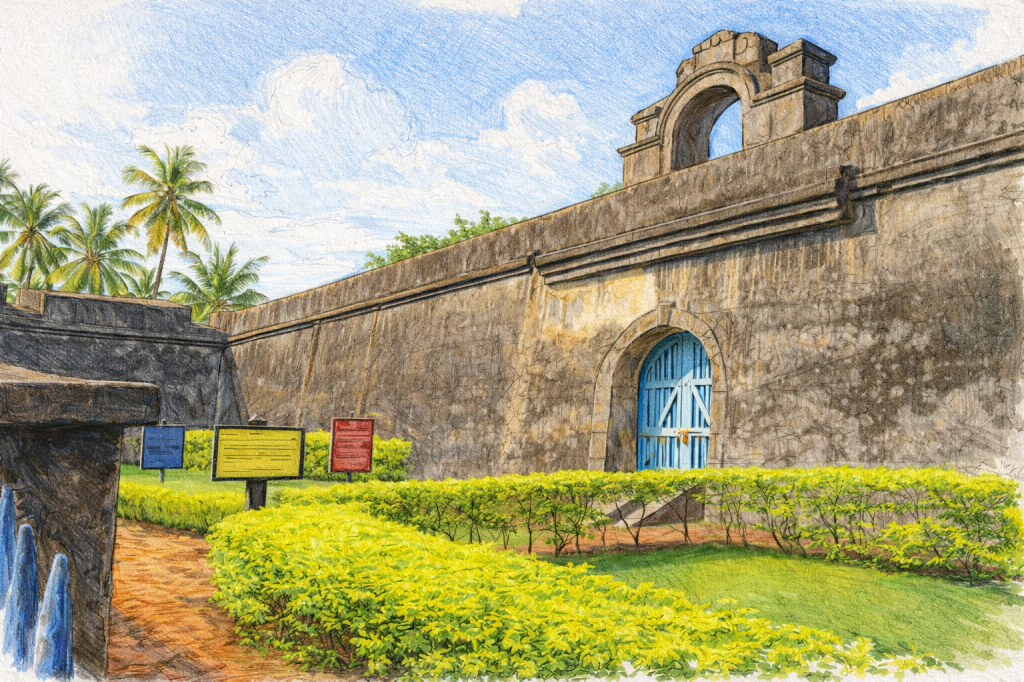
As you step into the fort you will find a square stronghold with towering stone walls, four bastions guarding the corners, cannons pointing out toward the horizon. In its prime each bastion was armed with 18-pounder guns keeping a watch as ships passed on the sea. Inside, you’ll find a sprawling green lawn that once served as a parade ground for British troops while narrow pathways along the walls offer views of coconut groves and the lively settlement that has grown around the fort.
But this is more than just a fort; it is a stage where history’s firsts were written. Built in 1699, it became the first permanent British East India Company post on the Malabar Coast and the first signaling station for ships navigating the region making it the first site of local resistance against British rule.
In the late 17th century, the East India Company was desperate to expand trade. Pepper, cashew and coconut oil were the black gold of Kerala & the Company had its eyes set on the Attingal kingdom. When the formidable Rani Ashure of Attingal granted them land to build a fort near Varkala it was John Brabourne, a shrewd Company officer who wasted no time in raising this massive bastion. But the Dutch, unhappy about losing trade dominance persuaded the queen to withdraw her support. Thus, supplies were cut off but Brabourne outsmarted everyone, he arranged for ships to bring resources directly from Cochin and Calicut. Even when the Rani sent troops to halt construction they were defeated, forcing her to sign an agreement allowing the British to complete the fort. Thus, Anjengo rose, defiant and enduring.
In 1721, the fort became the epicenter of the Attingal Outbreak, one of the earliest organized resistances against the Company. Local feudal lords enraged by unfair trade practices and the arrogance of Company officers ambushed a British procession carrying lavish gifts to the Rani. The siege that followed lasted three long months with locals nearly wresting control of the fort. Though reinforcements from Tellicherry eventually turned the tide in favor of the British, the uprising left an indelible mark, it was the first time the people of Kerala openly defied colonial powers.
During the Anglo-Mysore wars, Anjuthengu served as a strategic bastion and by 1792 it was declared a British residency. Even after the factory closed in 1813, the fort remained a powerful reminder of colonial ambition and local resistance. Today, it stands quietly by the shore, its cannons silenced but its stories alive in every weathered stone.
For a traveler, the experience of Anjuthengu is more than sightseeing, it is time travel. Walk along the ramparts where British soldiers once stood watch, peer over the bastions where cannons once defended trade ships and pause by the sea-facing wall where a secret passage (now closed) once connected the fort to the waters.
If you are a heritage lover, a history enthusiast or simply a traveler in search of stories, Anjuthengu Fort is a must-see. Standing between the backwaters and the sea you realize this fort was never just a military outpost. It was a crossroad of cultures, a battleground of empires and a silent witness to Kerala’s first brush with colonial resistance. So, when you are in Varkala, step off the beaten path and let the sea guide you to Anjuthengu.
 STORIES by HEARITAGE
Leave a comment