Nestled on the banks of the tranquil Valapattanam River in Kannur, the Parassinikadavu Muthappan Temple stands apart from every other shrine in Kerala. Locals fondly call it a Kavu or Madapura, a sacred grove rather than a temple, where rituals, customs, and even the philosophy of worship break the barriers of caste, creed, and religion. It is a living symbol of Vasudhaiva Kutumbakam, the ancient Indian belief that “the world is one family.”
Unlike the grandeur and strict rituals of most temples, Parassinikadavu embraces simplicity and inclusivity. Here, everyone rich or poor, young or old is welcome. The deity, affectionately called Muthappan, represents the spirit of the common man. He is a divine hunter, carrying a simple bow and arrow, content with offerings of toddy and dried fish, the humble staples of the poor. The temple’s atmosphere exudes warmth; offerings are modestly priced, free food and tea are served to all, and the tradition of providing a small bowl of pulses with coconut continues, a practice that has been followed for centuries, symbolizing equality and compassion.
The story of Muthappan begins with a childless Brahmin couple, Ayyankara Devan and Padikutty, who prayed fervently for a child. Their prayers were answered when Padikutty discovered a baby lying on a flat stone near a pond. Overjoyed, they adopted him, believing he was a divine gift. The boy grew up learning the Vedas, but his heart belonged to the forests and the people who lived close to the earth. He hunted, mingled with tribal folk, and shared their food, actions that disturbed his orthodox father. When he was finally banished from the household, the child’s anger blazed; his fiery gaze scorched the land. Only his mother’s compassionate touch, covering his eyes, calmed him. This incident is still remembered in the Theyyam rituals, where Muthappan is seen wearing a silver eye cover called Vellikannu.
Wandering through the countryside, the boy reached Kunnathurpadi, where he found a pot of toddy hanging from a palm tree. Curious, he climbed up and drank from it. When the toddy tapper Chandran scolded him, the boy turned him to stone with his divine power. Chandran’s wife looking for her husband came to the tree she mistaking the boy for an elder of her tribe, addressed him as “Muthappan” meaning the revered elder. Thus, the divine hunter got his name, and the offering of toddy became an inseparable part of his worship even today here.
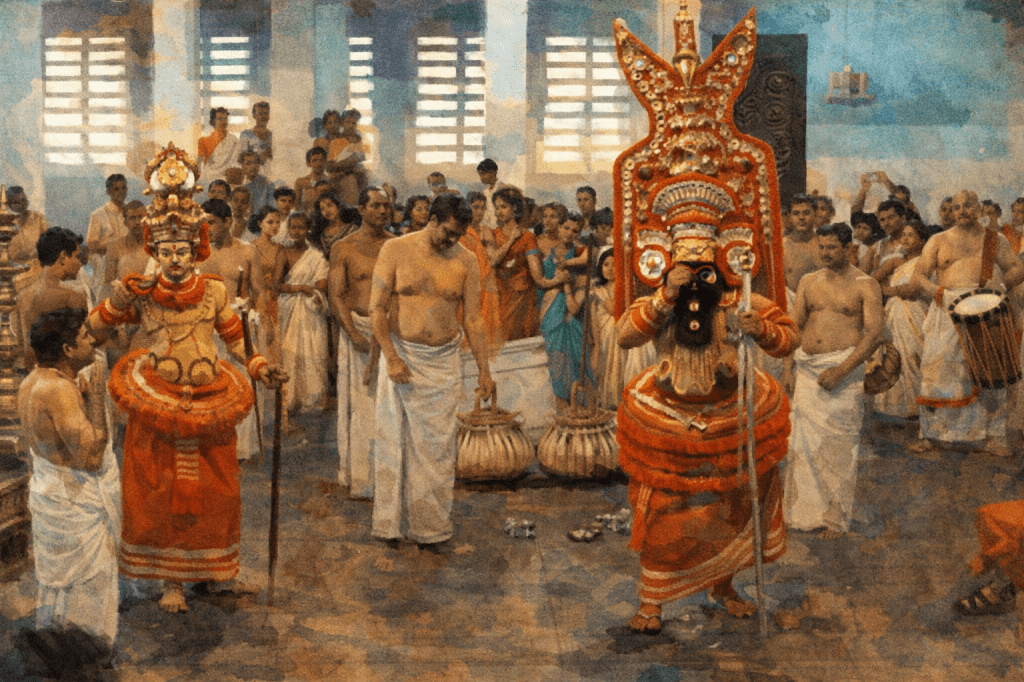
As Muthappan travelled across Kerala, dogs began following him. To this day, dogs roam freely around the temple and are revered as his companions. Muthappan’s journey was not merely spiritual, it was a movement of reform. He gathered the poor and oppressed, giving them dignity and a sense of belonging. To bring them together, he built several Madapuras (shrines), places where faith was open to all. Among them, Parassinikadavu became the most sacred, marking the spot where his arrow shot from afar landed on a Kaniram tree. That very place, by the riverbank, became his eternal abode. During his travels, Muthappan met a young boy at Puralimala, whom he affectionately called Cherukkan. The boy later became Vellattam, and together they are believed to have established 308 Madapuras across Kerala, shrines that carried the message of equality and devotion beyond boundaries. The travel of Muthappan is the basis for the morning & evening theyyam performance which the devotees can witness everyday. Twice a day, the temple comes alive with spectacular Theyyam performances of Thiruvappana and Vellattam, representing Lord Vishnu and Lord Shiva. The rhythmic beats, the flickering torches, and the trance-like movements of the Theyyam fill the air with divine energy. The Parassinikadavu Madapura is unlike any temple you will ever visit. It has no priests, only a Madyan, the eldest from the Thiyya community who performs daily rituals.
What makes this temple even more special is that devotees can directly speak to the Theyyam after the performance. It is believed that in that moment, Muthappan himself listens, offering solace, guidance, or answers to life’s struggles. Few places in the world offer such a deeply personal connection between god and devotee.
 STORIES by HEARITAGE
Leave a comment