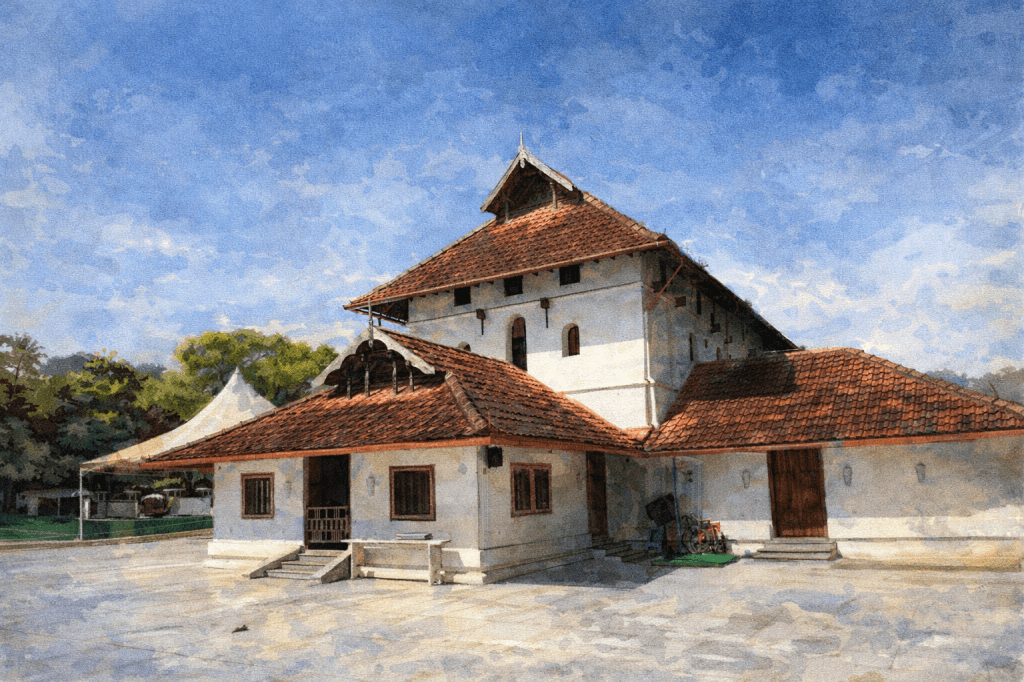
In the historic town of Kodungallur stands a monument that quietly carries the weight of more than a thousand years, the Cheraman Juma Mosque which is widely regarded as the oldest mosque in the Indian subcontinent. Built in 629 AD, this sacred site owes its origin to Malik Deenar, the pioneering Islamic scholar and preacher who first brought the message of Islam to India’s shores. His mission to spread the faith eastward ultimately took root here, on the ancient trade-rich coast of Malabar.
Local lore adds a mystical layer to the story: it is believed that the mosque was constructed over an old, neglected Buddhist shrine that still held a lone hanging lamp. During its earliest days, the mosque uniquely faced the east & not the Kaaba mirroring several ancient Kerala mosques. It was only during the major renovation in the 11th century that the direction was aligned to Islamic tradition. The lamps inside the sanctum, said to be over a thousand years old, remain eternally lit, carrying forward the glow of centuries.
The mosque underwent dramatic transformations over time. First rebuilt in the 11th century in traditional Kerala style, it was completely destroyed by the Portuguese in 1504 and left in ruins for years. Restoration began much later in the 17th century, when the thatched roof made way for minarets. The modern structure we see today took shape with the large-scale renovation of 1984. Yet, amid all these changes, the central sanctum remains untouched as a silent witness to all the histories this land has lived.
A compelling legend surrounds the mosque’s origins with the story of Cheraman Perumal, the last Chera king. Drawn to the teachings of Prophet Muhammad, he is believed to have journeyed to Mecca, embraced Islam, and instructed his followers back home to welcome visiting scholars from Arabia. He entrusted Malik Deenar with a letter to the people of Malabar which is a royal decree that opened the doors for the construction of the earliest mosques. And so, on this ancient port where Arab traders once anchored their ships, the first chapter of Islam in India was written.
Through the centuries, Kodungallur remained a bridge between cultures. Arab merchants frequented the port long before Islam arrived, and the mosque became a spiritual refuge for them. Its spirit of inclusivity continues today, a rare and beautiful example of Kerala’s harmonious traditions. People of all faiths are welcome, and a unique custom practiced here is Vidyarambham, the Hindu ritual of initiating a child into learning. An Imam gently traces the first letters on a child’s tongue with a ring, a symbolic blessing found nowhere else in the world.
Even after nearly a millennium, the Cheraman Juma Mosque remains an enduring symbol of Kerala’s syncretic heritage. Its annual Uroos festival draws devotees and visitors from near and far, turning the quiet town into a vibrant cultural gathering. For any traveller seeking a journey through history, spirituality, and the interwoven stories of civilizations, a visit to this ancient mosque is nothing short of unforgettable. Today the mosque has undergone much more renovations as part of the Muziris project and a newer much bugger mosque is built under the mosque but still keeping the aesthetics of the original mosque intact.
 STORIES by HEARITAGE
Leave a comment