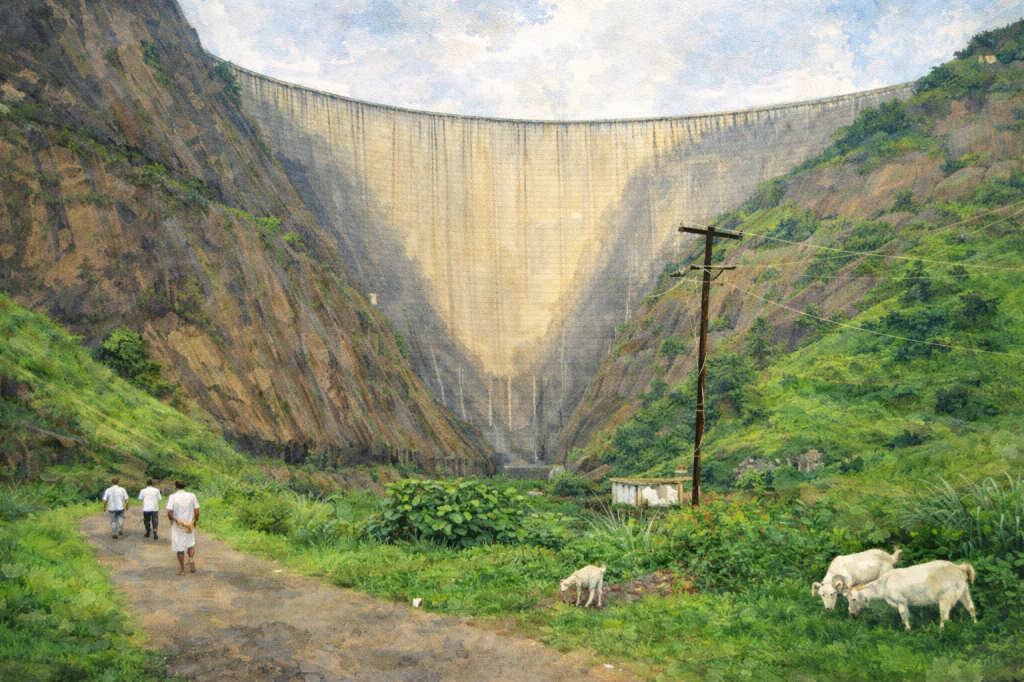
Cradled between the towering granite peaks of Kuravanmala and Kurathimala rises one of India’s greatest feats of engineering, the iconic Idukki Arch Dam. Standing at an astounding 554 feet, this magnificent structure is the third tallest arch dam in the world and the highest in all of Asia. Its graceful parabolic curve stretches across the mighty Periyar River, creating a breathtaking silhouette against the lush Idukki landscape.
More than just a marvel to behold, the dam is the beating heart of Kerala’s power supply. Together with the Cheruthoni and Kulamavu dams, it forms a vast reservoir of nearly 60 sq. km, feeding the Moolamattom Hydroelectric Power Station—one of South India’s most crucial electricity generators with a capacity of 780 MW. The Moolamattom Power Station, carved deep inside a mountain 40 km away, is another testament to human ingenuity. But the real magic awaits atop the arch dam itself.
Though the dam was officially commissioned only in 1976, the dream of taming the Periyar dates back more than a hundred years. The earliest idea came from an Italian engineer named Jacob, who first proposed building a dam here. He is said to have submitted an idea to build a dam over the periyar to the erstwhile Travancore King which was not met with much of an approval back then. But the plan gained shape only when W.J. John, superintendent of the Malankara Estate, was inspired during a hunting expedition. By 1932 he submitted a detailed report of his plan to build the dam to the Travancore government but trouble in finances, the freedom struggle & overall state of the government stopped the King from making any further progress. John kept the plan to him & it was only post independence that the necessity of a dam grew to fulfill the power crisis.
Led by Kolumban, the chief of the Oorali tribe, John was taken to a vantage point between the mountains. One look at the Periyar thundering through the rocky gorge sparked a vision, an arch dam that could power an entire region.
Despite political turmoil and financial obstacles, the idea survived. After India’s independence, the growing demand for electricity pushed the project forward. The central government asked the state to start site inspections for the construction of a dam along
Periyar, the detailed plan was submitted to the government in 1961. Post the inspections, the government started preliminary construction works by 1963.With Canadian assistance and years of meticulous work, construction began in 1969. By 1973 the dam stood complete, and by 1976 it was fully operational—ushering in a new era of energy generation for Kerala.
Today, visitors can walk along the sweeping crest of the dam—valley on one side, shimmering reservoir on the other—feeling dwarfed by the sheer scale of the structure. Boating facilities on the reservoir offer another serene way to experience its beauty, gliding through calm waters surrounded by forested hills.
Yet perhaps the most awe-inspiring sight is the dam as viewed from below: a colossal wall of concrete rising dramatically from the earth, framed by the rugged mountains that cradle it.
 STORIES by HEARITAGE
Leave a comment