In the quiet village of Dharmadam in Thalassery lies a sacred landscape that feels older than time itself called Andalur Kavu, a grove steeped in myth, memory, and the living culture of North Malabar. At first glance it appears like any serene temple enclave surrounded by trees and the sound of birds. Yet, for those who know its legends, Andalur Kavu is far more than a place of worship. It is believed to be a fragment of Ramayana’s Yudhakandam, where the echoes of divine battles still linger in the whispers of the wind. Local traditions lovingly claim that the very people of Dharmadam were once the Vanaras, the monkey warriors led by Sugreeva. And the grove itself is said to be sanctified by the presence of divine weapons that fell upon this land during the time of Lord Rama.
The origins of Andalur Kavu fade somewhere between mythology and ancient memory. According to revered lore, during Sita’s swayamvara, when Rama broke the mighty bow, a spark from the arrow shot through the skies and fell here in a trident-like flash. On the insistence of Sage Narada, Lord Parasurama consecrated this sacred ground, establishing shrines for Rama, Lakshmana, and Hanuman known here as Daivathar, Ankakkaran, and Bappooran. Two major shrines form the heart of this grove: Mele Kavu symbolises Ayodhya, and Thazhe Kavu represents Lanka.
While the temples today have modern structures, the spiritual mood remains intact. The groves once thick with medicinal plants still hold the ambiance of an ancient sacred forest, where rituals continue to be performed under the guidance of local custodians, the Ooralanmaars.
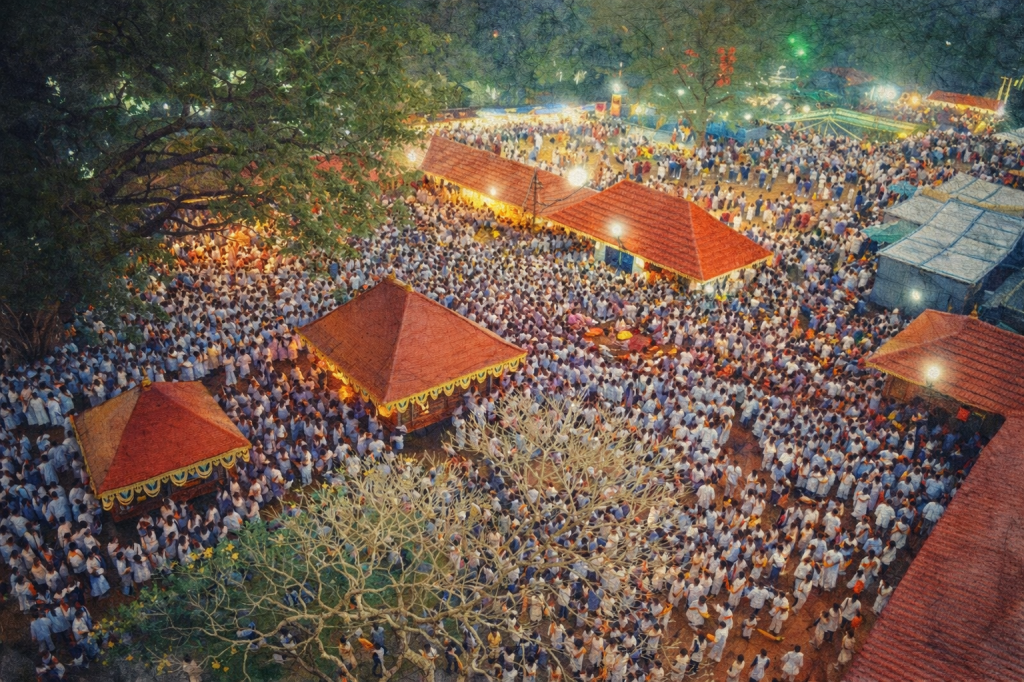
If there is one time to experience Andalur Kavu at its peak, it is during the spectacular Thira festival, held every February. This is when Dharmadam turns into a living canvas of devotion, color, and ancestral traditions. During the festival period, the entire village observes a vow of no meat, no fish, no liquor, honoring the sanctity of the Kavu. Across several days, 39 Theyyams perform here each a vibrant retelling of legends, but 10 of them hold special significance, drawing crowds from all over. The most revered among them is Daivathar, a stunning manifestation believed to embody Lord Rama himself.
One of the most dramatic performances recreates the story of Bali and Sugreeva, ending in Bali’s death from Rama’s arrow, a scene etched in the collective memory of the land. Another colorful depiction brings alive the tender saga of Luv and Kush, and Sita’s exile. What makes the festival even more extraordinary is how the entire village participates. Young men and boys dress in white dhoti and vest, representing the Vanara warriors. They run and dance around the grove in jubilation, celebrating the eternal triumph of good over evil. Whether or not the characters perfectly mirror the Ramayana, the spiritual energy they radiate is as old as folklore itself.
The Andalur Kavu Museum now stands within the premises, a thoughtful space that showcases artifacts, history, and even a stunning life-size Theyyam figure. It helps visitors understand the grandeur of Theyyam as a living, breathing art form that blends devotion, dance, costume, color, and storytelling into a divine experience. Though much of Andalur Kavu’s past survives through oral traditions rather than written records, its spirit has endured through centuries because of the unwavering faith of its people. Here, mythology is not history, it is life, inherited and cherished across generations.
 STORIES by HEARITAGE
Leave a comment