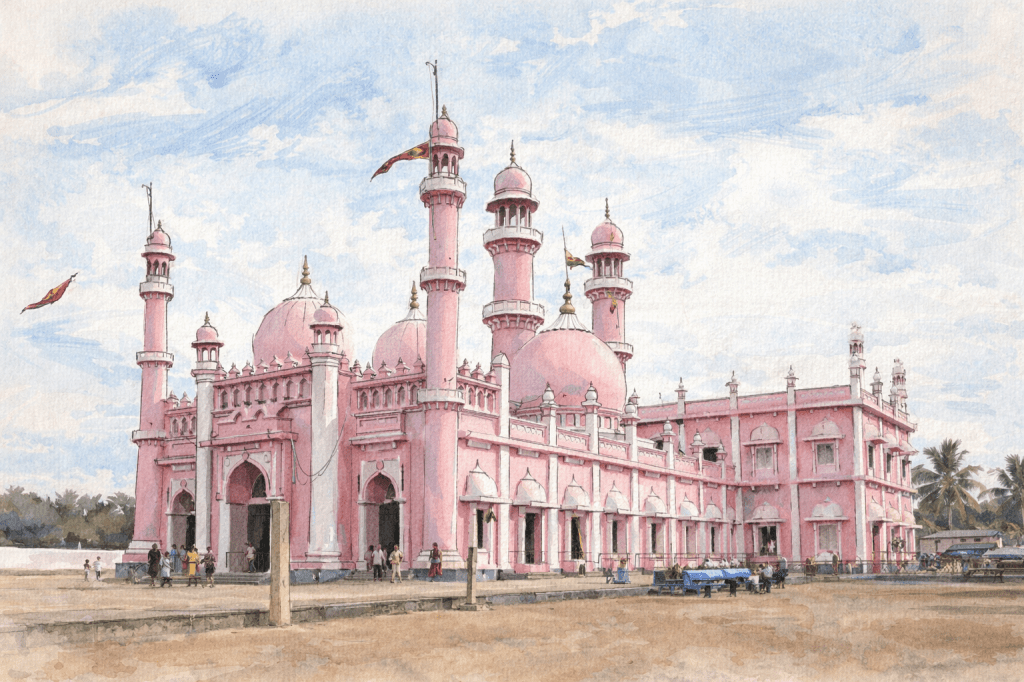
As you travel along the breezy coastline of Trivandrum, where the Arabian Sea kisses the vibrant sands of Shangumugham, you will find a serene landmark that has shaped the identity of the fishing villages around it for centuries, the beautiful Beemapalli Mosque. Standing gracefully between the beach and the backwaters of Valiathura, this pink-hued shrine is not just a place of worship, but a living chronicle of compassion, migration, tradition, and faith.
Beemapalli is dedicated to Beema Umma, a revered woman believed to be from the Prophet’s family. Local lore traces her arrival to Kerala in the 14th century, along with her son Sayyidussaheed Aboobacker, to spread the teachings of Islam. When she reached Valiathura which was then a humble fishing hamlet Christianity had just begun to make its presence felt through missionaries. The people here were simple, hardworking fisherfolk unsure of their religious identity, and Beema Umma’s warm approach and understanding of their daily lives brought many closer to Islam. What began as a small thatched-roof mosque soon became a centre for worship and community life. Beema Umma & her son are said to have been killed under mystery but today, her tomb and that of her son lie within the mosque complex, drawing devotees from across Kerala.
The mosque you see now owes its distinctive style to architect Govindan Gopalakrishnan, renowned for designing the Palayam Mosque. Commissioned in the mid-20th century, the Beemapalli structure took nearly 17 years to complete due to the slow collection of funds. Its striking pink exterior, Mughal-inspired domes, and tall minarets make it unlike any other mosque in Kerala, a harmonious blend of tradition and modernity. Among the many coastal mosques of India, Beemapalli stands out for its sheer grandeur.
But the heartbeat of this shrine truly comes alive during the annual Uroos festival, also known as the Chandanakudam Utsavam. The celebration is a tribute to Beema Umma’s compassion and teachings. Thousands gather to offer flowers, silk cloth, and oil at her tomb, receiving the offerings back as sacred prasad. The festival culminates in a spectacular procession of caparisoned elephants, rhythmic panchavadyam, vibrant crowds, and the ceremonial Beema Umma flag carried in a musical parade. It is one of the most colourful, inclusive festivals of coastal Kerala, where people of all faiths participate with devotion.
Beemapalli also holds memories of a darker chapter in its time. In May 2009, the area witnessed a tragic police firing that took six lives and left many injured. Conflicting narratives ranging from tensions over illegal trade to communal disagreements between neighbouring villages have left the exact cause shrouded in uncertainty. But the closest of the theories is that Valiathura & Beemapalli area was inhabited from long by Muslim fishermen & their families. The influx of foreign goods in the market led to an illegal trade which was kept under wraps for many years until the police took a decision to crack down on the trade. This was not welcomed by the people who never gave access to police within their market; some believe that the firing was to create a sense of discomfort among these people. The official report was never fully disclosed, and the incident remains an emotional scar for locals. Though time has restored peace, the hush in the sea breeze still carries echoes of that difficult day.
Despite this, Beemapalli continues to stand as a symbol of resilience and uninterrupted faith. The wells here are believed to possess a miraculous blend of hot and cold water never once drying up, even during severe droughts. Locals say it is the eternal blessing of Beema Umma upon her people. For any traveller exploring Trivandrum, a visit to Beemapalli is more than just sightseeing, it is an opportunity to witness the mosaic of Kerala’s history, spirituality, and coastal culture. As the waves roll in and the minarets glow in the sunset, you will feel the quiet strength of a place where centuries of belief still flow like the tides.
 STORIES by HEARITAGE
Leave a comment