In the heart of Thiruvananthapuram, guarded by towering stone walls and ancient faith, stands a shrine that moved from quiet divinity to global wonder, the Sree Padmanabhaswamy Temple, today known as the wealthiest temple in the world. But long before treasure vaults captured headlines, this sacred space was revered for something far greater, the eternal presence of Lord Vishnu in Anantha Shayanam, the cosmic yogic sleep upon the serpent Adi Shesha. The very name Thiruvananthapuram means “The City of Lord Anantha”. And centuries before this city rose to prominence, the spiritual roots of the deity lay far north — at the serene Ananthapura Lake Temple in Kasaragod, believed to be the Moolasthanam, the original seat of Padmanabhaswamy.
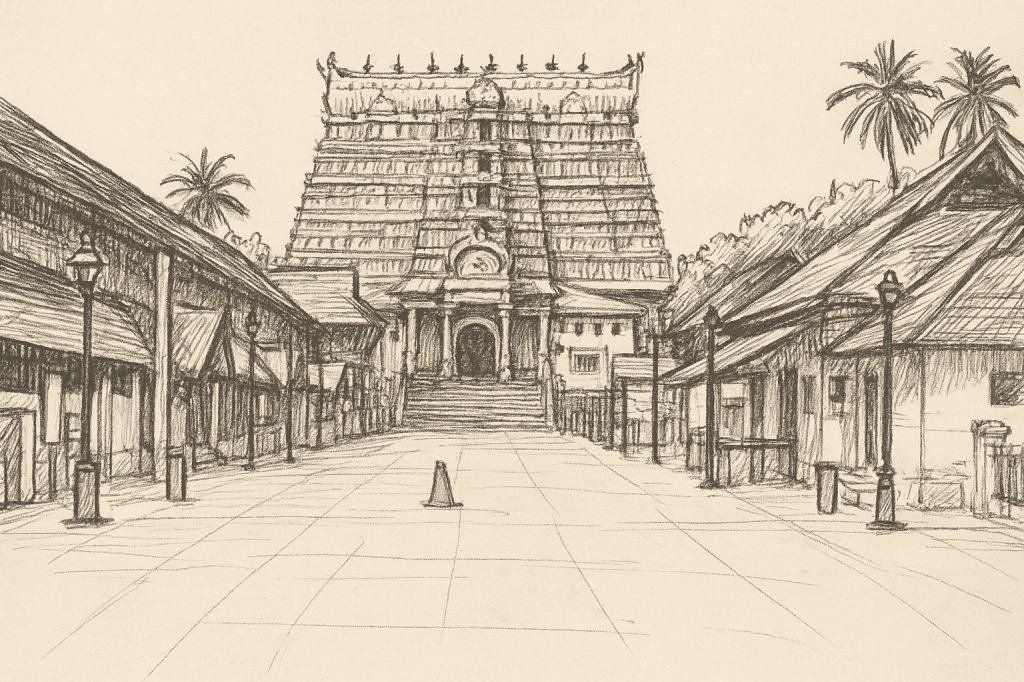
References to Padmanabhaswamy appear in the Skanda Purana, while 9th-century Sangam literature describes a golden temple of Vishnu resting on Anantha. Though its exact consecration date is lost to time, the temple proudly holds its place among the 108 Divya Desams, the holiest of Vaishnavite pilgrim shrines. The earliest major reconstruction is believed to date to the 10th century, when the original massive wooden idol crafted from the sacred Iluppu tree posed serious challenges for preservation. In the 15th century, the Venad kings raised the roof and shifted the idol temporarily. It was during this phase that the breathtaking Ottakal Mandapam with three sacred viewing doors came into being. The gopuram, begun in the 16th century, carries over 2,000 carvings from gods and goddesses to mythical beings. Though a devastating fire in the 17th century reduced the temple to ashes, the idol miraculously remained untouched. What visitors see today is the result of grand reconstruction under Marthanda Varma, the legendary king of Travancore.
Legends say 100 elephants and 4,000 artisans labored for years to complete the reconstruction. The towering flagstaff, carved from a single untouched teak tree and later sheathed in gold, is a masterpiece of sacred engineering. Architecturally, the temple is a stunning blend of: Dravidian gopuram at the eastern entrance, Kerala-style padippuras on the other three sides, 365 granite pillars, each representing a day of the year, the rare Navagraha Mandapam with celestial alignments on its ceiling. The sacred Padmatheertham pond beside the temple mirrors the sky and centuries of devotion.
It is said that Lord Parashurama purified the idol in Dvapara Yuga. Among the many legends that surround Sree Padmanabhaswamy, the most cherished is the story of Vilwamangalam Swamiyar, the Brahmin sage whose life is intertwined with several great temples of Kerala. Closely linked to this is the tale of Diwakar Swami, a Tulu Brahmin from Kasaragod, whose devotion mirrors Vilwamangalam’s and continues to be honoured through the rituals led by Tulu Brahmins at the temple even today.
According to the legend, Lord Krishna Himself once lived in the ashram of the sage, taking the form of a playful young boy. Mischievous yet irresistibly radiant, the child was allowed to stay because of the divine aura that surrounded him. Before settling there, however, He had laid down a condition: if He were ever scolded or struck, He would disappear. For a while, the ashram flourished in the joy of His presence. One day, while playing, the boy kicked the sage’s sacred salagrama, disturbing his penance. Angered by this, Vilwamangalam Swamiyar pushed the child away. In an instant, the boy vanished. Only a divine voice remained, echoing in the stillness, “If you wish to see Me again, come to the forests of Anantha.” Filled with remorse, the Swamiyar set out in search of his lost Lord. He walked along the coast, guided only by the faint sound of anklet bells he remembered from the child. As he wandered, he overheard a mother scolding her son, threatening to throw him into Ananthankadu if he did not behave. Realising that he was close, Vilwamangalam approached the woman, who not only gave him directions but also handed him a small lamp to light his way into the sacred grove. Moving forward with renewed hope, the sage finally reached Ananthankadu. There, he saw the same divine child running into a great Iluppu tree. As the child merged with the tree, it crashed down with a thunderous sound – and before Vilwamangalam’s astonished eyes, the fallen trunk transformed into the most magnificent vision of Lord Vishnu reclining majestically on the serpent king Anantha. The form was so vast that the sage could not take it in at once. It is said that the Lord’s body stretched from Thiruvananthapuram all the way to Kulathoor and Thuckalay.
Overwhelmed, the Swamiyar prayed to the Lord to assume a size that could be beheld and adored. Lord Vishnu answered his plea by shrinking His cosmic form, yet the fallen Iluppu trees still divided the vision into three distinct segments. The daily offering of ripe mangoes at the temple and the sacred role of the Pushpanjali Swamiyar eternally honor this divine encounter. Inside the sanctum, Lord Vishnu reclines on the five-hooded Adi Shesha, all heads turned inward in meditative surrender. Through the three doors of the Ottakal Mandapam, devotees witness: The face (Thirumugham), The body (Thiruvoodal), The feet (Thirupadham). The Lord’s right hand rests on a Shiva Lingam, symbolizing cosmic balance. From His navel rises Brahma on a lotus, giving the Lord his name, Padmanabha. At His feet stand Garuda and Sage Narada, eternal companions. The idol is made from the sacred Katusarkara Yogam, a highly complex amalgam believed to contain 12,008 salagramas, brought all the way from the Gandaki River in the Himalayas.
In its earliest form, the temple of Sree Padmanabhaswamy was likely a modest structure built simply to shelter the reclining idol of Lord Vishnu. There was little to suggest then that it would one day become one of the most magnificent shrines in India. The transformation of this quiet place of worship into a monumental spiritual and architectural marvel began with the rise of Travancore and the extraordinary bond forged between the royal family and the deity they came to serve as masters.
After the decline of the Venad rulers, the rights of the temple gradually passed into the hands of the Travancore family. A defining chapter in both the temple’s and the kingdom’s history began in 1729, when Anizham Thirunal Marthanda Varma ascended the throne. Determined to dismantle the entrenched feudal power structure that threatened the stability of his realm, he acted decisively against the powerful Ettuveettil Pillamaars, a group of nobles who had long controlled court affairs and temple functionaries. When they conspired against him, Marthanda Varma exiled them from Travancore. This bold move ignited clashes with several feudal chieftains and placed the young king in the crosshairs of powerful adversaries. It was at this moment of political turmoil that Marthanda Varma made a decision unlike any other in Indian royal history — a decision that would permanently alter the destiny of Travancore. In 1750, he formally surrendered his kingdom to Sree Padmanabhaswamy in a sacred act known as Thrippadi Daanam. From that moment onward, the ruler of Travancore ceased to be an independent king in the conventional sense. Instead, Marthanda Varma declared himself and all his successors as mere servants of the Lord.
Thus was born the title Sree Padmanabha Dasa for every male ruler, while the women of the royal household became Sree Padmanabha Sevinis. All wealth, conquests, and offerings were henceforth dedicated not to the crown, but to the deity. Travancore became, in essence, a kingdom ruled by God, with human kings governing only as His trustees. The deep devotion of Marthanda Varma found its greatest expression in the grand reconstruction of Sree Padmanabhaswamy Temple, which was undertaken during his reign. The architectural splendour visitors admire today from the towering structures to the sacred mandapams owes much to this period of royal dedication. The spiritual bond between the deity and the royal family was not merely symbolic; it was lived daily through humility and discipline. Even the king, who wielded immense temporal power, could approach the Lord only as a servant. To this day, it is believed that only the King of Travancore is permitted to perform sashtanga namaskaram on the Ottakal Mandapam, a full prostration that signifies complete surrender of body, wealth, and ego. It is a privilege granted not by rank, but by renunciation.
This spiritual kingship forged one of the most unique monarch deity relationships in world history and many festivals which continue to be conducted here. Panguni Festival which is a ceremonial royal escort of the deity, Aaraattu at Shanghumugham Beach where sacred sea bath of the deities is conducted, Navaratri Mahotsavam in which music, devotion & royal traditions are seen, Laksha Deepam (once every six years) the temple glows with one lakh oil lamps, a sight beyond words. Strict traditional dress and faith-based entry rules continue to preserve the sanctity of experience.
In recent times, Sree Padmanabhaswamy Temple has stood not only as a beacon of devotion but also at the centre of global attention for reasons both astonishing and controversial. For centuries, the immense wealth of the temple was regarded as the sacred property of the Travancore royal family, safeguarded not as personal treasure but as offerings made to the deity. However, a petition brought before the Supreme Court of India altered the course of this long-standing tradition. The argument was simple yet profound: since monarchy had ceased to exist, the temple’s assets no longer belonged to a ruling family but to the people of the land, to be administered by the state. This legal battle was rooted in whispered legends that had circulated for generations of unimaginable treasures locked away in secret vaults beneath the sanctum, untouched for centuries. It was believed that Marthanda Varma, in his act of surrender known as Thrippadi Daanam, had gifted not only his kingdom but also its accumulated wealth to Lord Padmanabha, consciously sealing it away from human ambition and political upheaval.
The temple is known to contain six primary vaults, labeled A to F, long guarded by ritual and tradition. In addition, the discovery of two ante-chambers, later named G and H, only deepened the intrigue. Of these, Vault A had been opened in earlier decades and its contents documented by the royal family under strict ritual protocol. But when the Supreme Court ordered a systematic inventory of the remaining vaults, a storm of resistance arose around Vault B, which priests and royal members declared to be sacred, sealed by divine command, and protected by cosmic forces. Their objections were rooted not merely in belief but in centuries of unbroken ritual fear. The Court, acknowledging the sensitive nature of the issue, stayed the opening of Vault B a decision that continues to preserve its mystery even today. As the other vaults were opened under judicial supervision, what emerged stunned not just India, but the world. Before this historic inventory, the Padmanabhaswamy Temple struggled to sustain even its daily operations due to lack of funds. But the contents of just one single vault transformed it overnight into the richest temple on Earth. What lay hidden in the darkness of stone chambers defied imagination: a solid golden idol of Mahavishnu, heaps of diamonds, rubies, emeralds, and precious stones, golden crowns, thrones, armour, and weapons, ancient coins from multiple civilizations, ritual vessels forged entirely in gold, royal household articles adorned with unmatched craftsmanship.
The total monetary value of these treasures remains officially unquantified, yet it is believed to exceed several trillions in today’s valuation, especially when cultural, archaeological, and historical significance are taken into account. More astonishing than the wealth itself is what it silently reveals: the vast global connections of the temple across millennia. Among the recovered items were gifts traceable to Mesopotamia, Rome, China, and Europe, offering undeniable proof that Padmanabhaswamy was not merely a local deity but a divine presence acknowledged by travelers, traders, kings, and empires from far-off lands. Some artefacts even appear to predate recorded history, raising unsettling yet awe-inspiring questions about how such relics found their way into these vaults and how they survived intact for thousands of years. Yet above all the opened chambers looms the enigma of Vault B, the most feared and the most discussed. According to legend, it is guarded by a serpent deity, and its doors are sealed not by iron alone, but by powerful mantras. Popular belief holds that it contains treasures surpassing everything found so far but also that its opening may unleash divine consequences. Myth tells us that Balarama himself placed devas within this vault for eternal protection. Whether these tales are symbolic or literal, fear and reverence have kept Vault B closed to this day.
Today, the temple stands transformed. What was once a quiet place of worship has become a fortress of faith, shielded by armed guards, surveillance systems, and high-security protocols. The corridors that once echoed only with prayer now resonate equally with vigilance. Some view this as protection; others see it as the burden of material wealth upon spiritual space. The vaults may glitter, but the real treasure of Sree Padmanabhaswamy Temple lies in its stories, silence, and sanctity.
 STORIES by HEARITAGE
Leave a comment