Hidden amid the quiet greenery of Lakkidi village in Palakkad district stands a humble ancestral home that changed the course of Kerala’s cultural history. Known as Kalakathu Bhavan, or more famously Killikkurussimangalam, this is the birthplace and residence of Kunchan Nambiar, the legendary Malayalam poet who gave Kerala one of its most beloved art forms, Thullal. Today, this tranquil heritage space is preserved under the Kunchan Smarakam Trust, welcoming travellers who wish to step into the life and legacy of a man who made poetry dance, and satire sing.
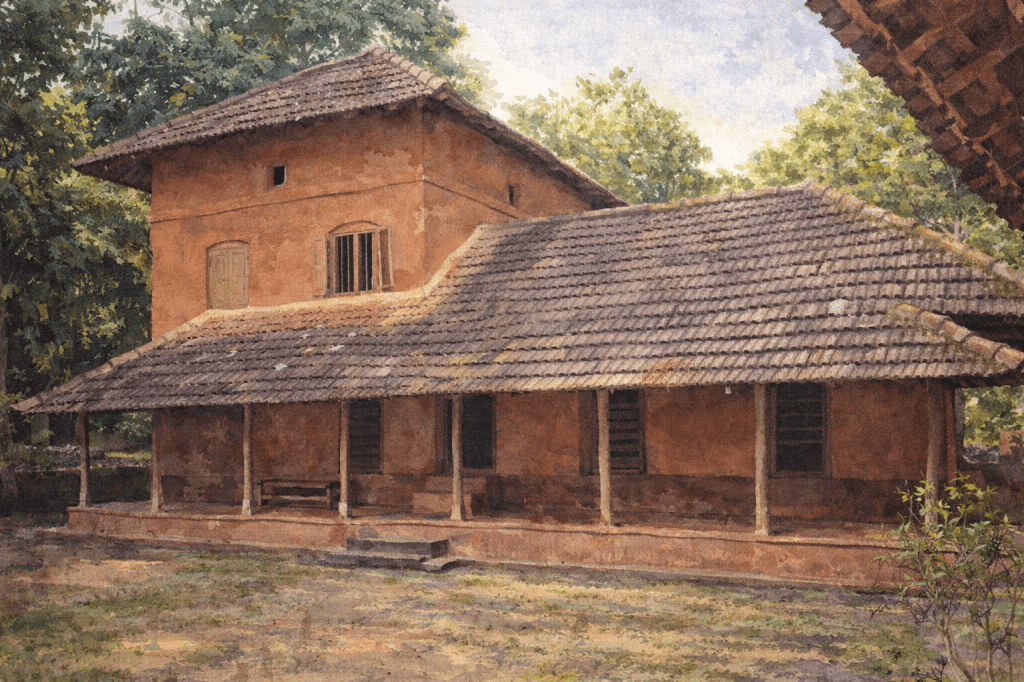
Killikkurussimangalam is not a grand palace and that is precisely its charm. The tiled roof, wooden beams, shaded verandah, and ancestral lamp (kedavilakku) still glowing inside the house reflect the simplicity of 18th-century Kerala life. Born in 1705, Kunchan Nambiar lived a modest life devoted to poetry, rhythm, and wit. His home, now a national monument, allows visitors to walk through: the very rooms where he lived and wrote, his preserved mizhavu (percussion instrument), his writing spaces and daily-use articles, models and displays explaining Thullal traditions. Standing inside this silent house, one feels the presence of words that once echoed with laughter and social truth.
Legend tells us that during a Chakiyarkoothu performance at the Ambalappuzha Temple, Nambiar was playing the mizhavu when he accidentally dozed off. The Chakiyar mocked him in front of the gathered audience. Instead of responding with anger or shame, Nambiar responded with creative rebellion. He returned home that night and by the next day, is believed to have created Thullal, a completely new art form that combined: dance, poetry, music, sharp social satire. Thullal spoke to the common man in the language of the street rather than the court. It questioned inequality, arrogance, hypocrisy, greed, and power using humour as its strongest weapon.
Among hundreds of poems Kunchan Nambiar composed, the most popular Thullal piece is Kalyana Sougandhikam. It narrates the episode where Bhima searches the forest for the mythical flower requested by Draupadi. On his journey, Bhima encounters Hanuman, who humbles him through gentle mockery and wisdom. Through satire, the performance teaches: the danger of ego, the value of humility, the limits of physical strength without wisdom. So powerful is this poetic drama that it remains the most frequently performed Thullal even today.
Thullal evolved into three distinct styles, each crafted for a different type of audience: Ottanthullal – the most popular; fast-paced, high-energy, full of jumps and movement, Seethankathullal – slower, more devotional and narrative, Parayanthullal – dramatic and expressive. Ottanthullal became the favourite as performers literally leap into the air, giving the name Thullal (to jump). The costumes, face paint, bright headgear, and rhythmic recitation create a visually thrilling experience. As Thullal grew popular, it soon overtook Chakiyarkoothu in audience appeal. This angered Chakiyar performers, who complained to the Chembakassery King. Since Thullal boldly parodied kings, landlords, and elites, it was eventually banned from Ambalappuzha Temple, proof of how powerful satire had become.
Kunchan Nambiar served under the Chembakassery King, but political tides soon changed. When Marthanda Varma of Travancore defeated Chembakassery and annexed the region, Nambiar moved to Travancore, where he became a respected figure in the court of Karthika Thirunal, the successor of Marthanda Varma. In his old age, longing for the quiet of his ancestral land, Nambiar sought permission to return to Ambalappuzha. The king granted his wish. He spent his final years in Killikkurussimangalam where his legacy now lives on.
Today, the memorial is not just a museum, it is a living institution of art. The Smarakam runs: Thullal training, Mohiniyattam classes, Mridangam training, Cultural workshops led by teachers from Kerala Kalamandalam. Every year on May 5th, Kerala celebrates Kunchan Dinam here, marking the poet’s birth anniversary with performances, seminars, and artistic tributes. During Navaratri, the memorial comes alive with lamps, recital, and dance turning the village into a gentle stage of devotion and creativity. The upper floor of the house displays life-size models of the three Thullal forms, allowing visitors to study the intricate costumes and expressions closely.
 STORIES by HEARITAGE
Leave a comment