High in the misty folds of Ambukutty Mala, at an elevation of about 1200 meters, lies one of India’s most intriguing prehistoric wonders, the Edakkal Caves. Though popularly called “caves,” Edakkal is not a cave in the usual sense. The name itself reveals the truth: Edakkal means cleft in Malayalam. What visitors walk through is a naturally formed passage created when a massive boulder wedged itself over another rock, leaving behind an opening that has guarded secrets of human history for thousands of years.
Reaching Edakkal requires a steep hike of about 45 minutes, but every step of that climb feels like a journey backward in time. As the forest thickens and the rocks grow more dramatic, one senses a connection to ancient footsteps that once climbed these very slopes. And then it appears, the narrow, towering passageway, a dramatic geological marvel that has sheltered stories older than the earliest known civilizations.
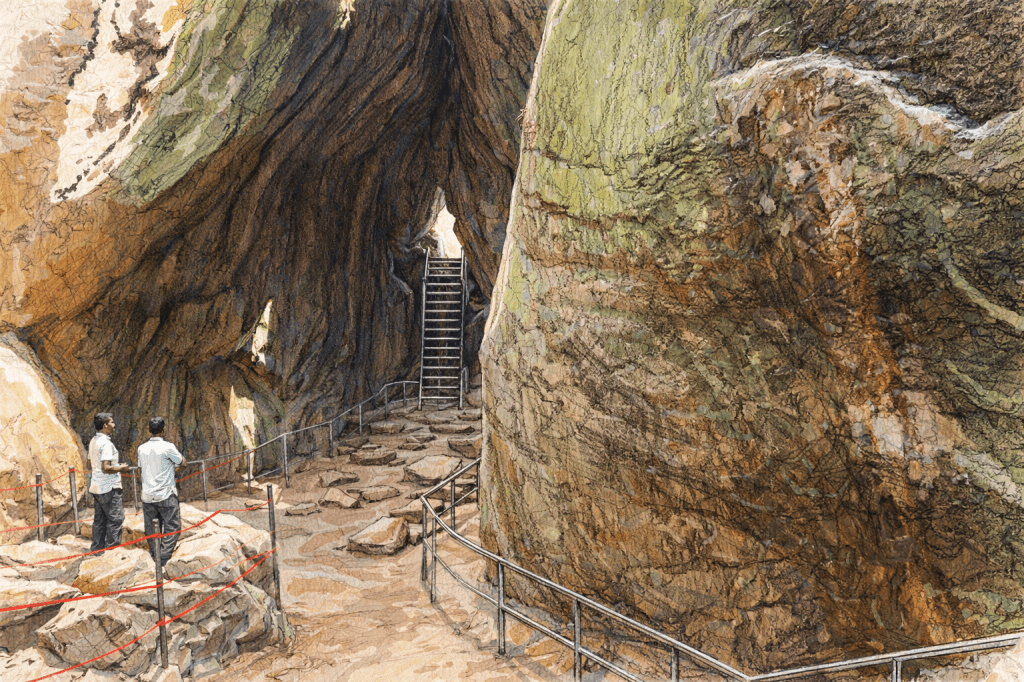
What truly sets Edakkal apart are the extraordinary petroglyphs etched inside its chambers. These carvings, considered to be more than 6000 years old, are among the few prehistoric rock engravings found in South India. Historians believe some of them even predate the Indus Valley Civilization, long thought to be the cradle of urban life on the subcontinent. The cleft itself plunges 30 feet deep, with the upper rock forming a natural roof over the lower formation. While the cave’s origin remains mysterious, anthropologists believe it could have resulted from weather upheavals or seismic activity. Local folklore, however, offers a more poetic explanation to Luv and Kush, the sons of Lord Rama, are said to have split the mountain with a single arrow to impress their teacher, creating the dramatic fissure we see today.
Though the caves have existed for millennia, they were only “discovered” in 1890 by Fred Fawcett, a police officer of the erstwhile Malabar state. During a hiking expedition, he came across the cleft and instantly recognized the significance of the carvings. His published article drew the attention of historians, archaeologists, and anthropologists from around the world. What they found within the two chambers, lower and upper astonished them: depictions of humans, animals, tools, symbols, household items, and enigmatic markings created with remarkable skill and precision. The artistry raises compelling questions: Who were these early settlers? What tools did they use? How advanced was their understanding of art and communication? Researchers now believe the caves were once home to Neolithic communities, possibly even ancestors of the people who later formed the Harappan culture. One of the most significant discoveries is the carving of the “man with jar cup,” a motif strikingly similar to one uncovered at Harappa. This has led scholars to explore possible cultural links but the mystery remains unresolved, adding to Edakkal’s allure.
Around the region, one can also find several muniyaras, stone shelters believed to have served as temporary dwellings. Excavations of these structures revealed pottery and artifacts, all of which are now preserved at the Wayanad Heritage Museum. Together with the caves, these findings paint a vivid picture of a sophisticated prehistoric community that once thrived in the Western Ghats.
A visit to Edakkal Caves is not merely a sightseeing stop, it is an encounter with the earliest chapters of human existence. Standing inside the cool, shadowed cleft, gazing at carvings made by hands thousands of years old, you feel a profound connection to humanity’s shared ancestry. These walls remind us that long before modern civilizations, people lived, created, imagined, and left behind stories for us to discover. It is a place where history whispers through stone, where nature and time have collaborated to preserve a priceless legacy.
IMPORTANT: The visit to Edakkal is only for abled bodied persons as there is a steep rugged walk up the caves. Please take rest and hike with care.
 STORIES by HEARITAGE
Leave a comment