High above the serene landscapes of Varkala, on a hill washed in golden light, stands one of Kerala’s most profound spiritual landmarks, Sivagiri Mutt, the eternal abode of the great social reformer, philosopher, and spiritual visionary Sree Narayana Guru. For countless devotees who lovingly address him as Gurudevan, Sivagiri is not just a pilgrimage destination but a place where hearts are unburdened, minds are uplifted, and souls discover an abiding sense of equality and purpose. It was Gurudevan himself who chose this tranquil hill as his spiritual center. Enchanted by its bubbling springs, gentle waterfalls, and the mystical ambiance reminiscent of Mount Kailasa, the Guru requested the Travancore Government to grant him the land. The people around the hill, moved by reverence, gifted their plots to him in devotion. Thus, in 1904, the Sivagiri Mutt came into being, with its very first building dedicated to education symbolizing the Guru’s lifelong mission to spread knowledge.
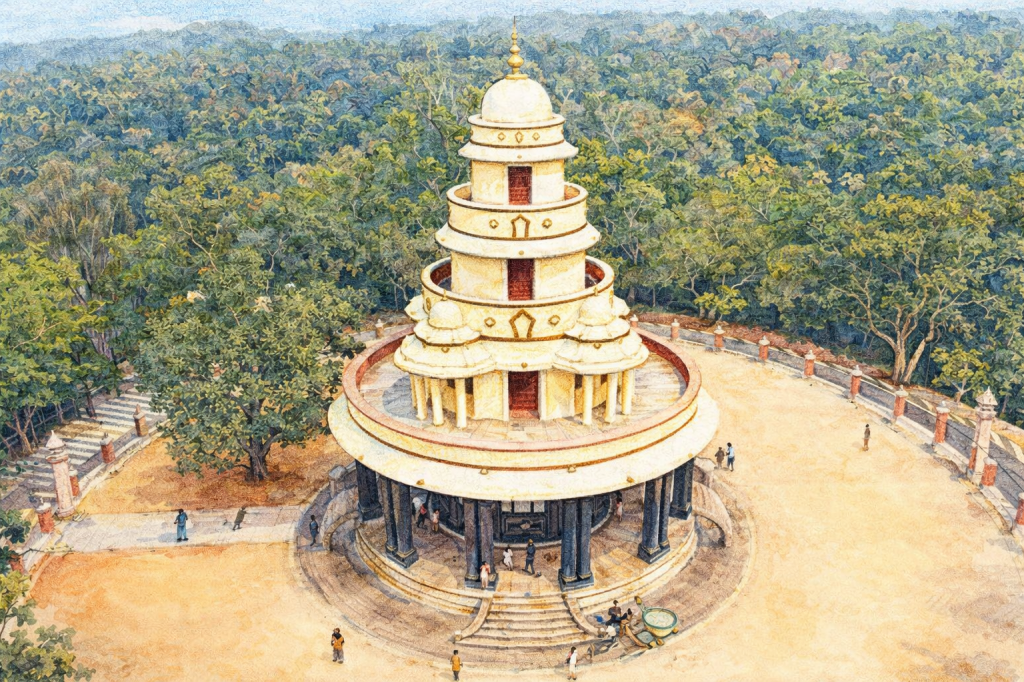
As Sivagiri grew into the heart of the Sree Narayana movement, disciples sought Gurudevan’s consent to build a temple. He agreed but with a revolutionary idea. The temple would be for the Goddess of Knowledge, free of rigid rituals, and open to all. Thus, in 1912, the Sarada Temple was consecrated under his guidance. Octagonal in form, with windows on all sides, the temple allows divine light to flow freely. Inside, the exquisite idol of Goddess Saraswati, seated upon a white lotus, radiates purity and grace. Devotees simply recite hymns, no elaborate rites, no restrictions revealing Gurudevan’s belief that spirituality must embrace everyone.
At the summit of Sivagiri stands the Mahasamadhi Mandiram, built in 1953, housing the mortal remains of Sree Narayana Guru. In 1968, a magnificent white-marble statue of the Guru was installed here. With eyes gazing softly at the horizon, the sculpture gives visitors the profound impression that he still watches over humanity and guides it. Nearby is the Vaidika Mutt, the Guru’s hermitage. It was here that he received visitors, meditated, and ultimately attained Samadhi in 1928. Today, his walking stick, footwear, water pots, portraits, and the sacred kedavilakku are preserved lovingly, offering pilgrims a deeply personal connection with Gurudevan’s life. The ancient Hong Kong made rickshaw gifted to him by a devotee still rests in a glass casing and is taken out reverently during annual processions. Another significant shrine here honours Swami Bodhananda, the Guru’s chosen successor and foremost disciple. Unable to bear separation from his Master, he attained Samadhi merely three days after the Guru’s passing.
The Sivagiri Pilgrimage, now one of Kerala’s most iconic spiritual journeys, was permitted by Gurudevan in 1928. But he redefined what a pilgrimage should be. According to him, a true pilgrim must walk with: a pure body, a pure diet, a pure mind, pure words, pure deeds echoing the Pancha Dharma ideals of Buddhism. Pilgrims wear yellow garments, symbolizing peace and simplicity. Gurudevan insisted that the cloth need not be expensive, one could dye ordinary cotton in turmeric and still embody devotion. The first pilgrimage began from Elavumthitta, where five disciples walked all the way to Sivagiri, chanting Kumaranasan’s “Swaathanthrya Gadha”. Mocked as Manjakillikal (“yellow birds”) along the way, they completed their journey with steadfast faith. Their footsteps have since inspired millions.
Sivagiri Mutt is not merely a religious site, it is the cradle of a strong social awakening. Gurudevan’s teachings emphasized hygiene, education, equality, and compassion. He believed temples must foster overall human wellbeing, not just ritualism. His impact was so profound that the greatest minds of India were drawn to him: Mahatma Gandhi visited thrice, Vinoba Bhave called him “Avathar”, Rabindranath Tagore, awestruck, said he had never met a greater spiritual soul. Today, Sivagiri stands as a timeless tribute to a man who transformed Kerala’s social fabric and gave dignity, hope, and identity to millions.
A visit to Sivagiri is not just sightseeing—it is an awakening. As you climb the sacred hill, the breeze carries whispers of Gurudevan’s message: “One Caste, One Religion, One God for Man.” Here, surrounded by serene landscapes and the enduring presence of the Guru, you feel inspired, equal, empowered—and deeply connected to a legacy that changed history.
 STORIES by HEARITAGE
Leave a comment