Tucked away in the heart of Kochi’s legendary Jew Town stands a timeless monument of faith, culture, and coexistence—the Paradesi Synagogue, one of the oldest active synagogues in India. Locally known as Paradesi Palli, the very name “Paradesi” evokes its origins: a sanctuary shaped by the hands and hopes of “foreigners”, the Spanish and Dutch Sephardic Jews who rebuilt their lives on Kerala’s welcoming shores. More than a place of worship, the synagogue has long served as a center for learning, community gathering, and cultural exchange, making it one of Kochi’s most treasured heritage landmarks.
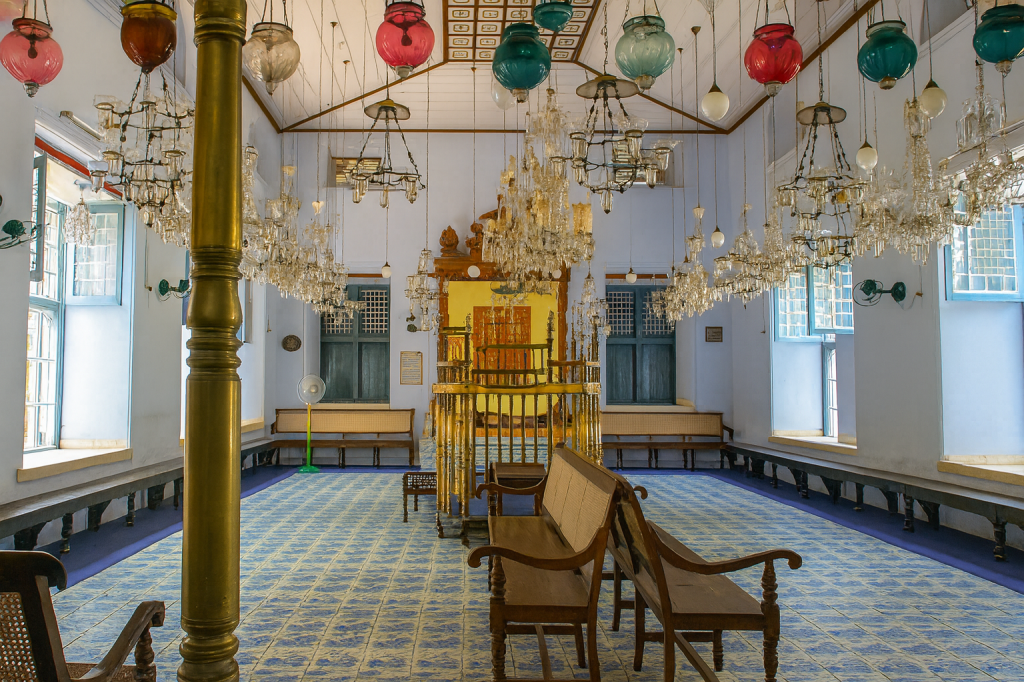
Built in 1598, the synagogue stands as a testament to centuries of Jewish presence in Kerala. Its architecture is a beautiful blend of global influences of European, Chinese, Indian, and Arabic reflecting the diverse histories of the Jewish families who called Cochin their home. Unlike many other synagogues across the world, the Paradesi Synagogue was built by what were referred to as the White Jews, a community of Sephardic Jews who arrived after fleeing persecution in Europe and the Middle East. From the outside, the building appears modest: a white-walled rectangle with a sloping tiled roof and an iron gate adorned with the Star of David. But step inside, and the centuries unfold before your eyes.
At the heart of the complex rises the iconic clock tower, adorned with four clocks each face bearing numbers in a different script: Hebrew, Roman, Malayalam, and Arabic. This tower was an elegant addition by the Dutch East India Company during the synagogue’s reconstruction in the 18th century, symbolizing the multicultural life of Cochin’s Jewish community. Inside, the synagogue dazzles with an array of priceless artifacts: Gold and silver-adorned Torah scrolls, lovingly preserved, a handwoven rug gifted by Emperor Haile Selassie of Ethiopia, exquisite Belgian glass chandeliers and ornate brass lamps suspended like floating jewels. The legendary blue-and-white hand-painted Chinese tiles, each unique in design, laid across the entire floor which is an artistic treasure unmatched elsewhere in India. And perhaps the most extraordinary of all, the 2000-year-old copper plates inscribed in ancient Kannadiyezhuthu script, documenting the privileges and independence granted to the Jewish community by the benevolent Cochin Raja. A rare piece of legal and cultural history, it stands as a reminder of Kerala’s long tradition of embracing diversity. The synagogue’s central brass pulpit, the intricately carved teak women’s gallery, and the two stunning crown-topped Torah cases presented by the Kings of Kochi and Travancore, complete this tapestry of devotion and craftsmanship.
The story of the Paradesi Jews is woven deeply into the heritage of Kerala. Jewish traders first arrived in the region as early as the 4th century, settling in the prosperous port city of Kodungallur. Over time, their community grew, joined by Malabari Jews and later by those fleeing persecution from European powers, especially the Portuguese. When the Portuguese began disrupting trade and targeting Jewish settlements in Kodungallur during the 14th and 15th centuries, the Jews were forced southward. The King of Kochi welcomed them with kindness and granted them land near his Mattancherry Palace to build a new sanctuary. The synagogue that rose here became a symbol of hope. But its peace was short-lived when Portuguese aggression peaked in 1662, the synagogue was burnt down. Salvation came when the Dutch captured Kochi, ushering in what is remembered as the golden age of Kochi’s Jews. Under their patronage, the synagogue was magnificently rebuilt into the form we admire today.
Though the Jewish population in Kerala has diminished over the decades especially after the formation of Israel in 1948 the Paradesi Synagogue continues to welcome visitors from around the world. Traditional services are held only when a quorum of ten male members is present, but the serenity of the sanctuary remains, echoing the voices of centuries. Walking through Jew Town today, past spice shops, antique stores, and art galleries, one feels an intangible sense of nostalgia. The Paradesi Synagogue stands at the end of this storied lane as a guardian of memory, a reminder of a community that once shaped the rhythms of Kochi’s trade, culture, and cosmopolitan spirit.
Visiting the Paradesi Synagogue is more than a historical experience, it is an emotional journey through the shared heritage of Kerala and its Jewish community. Every artifact, every wall, every shadowed corner tells a story of resilience, migration, faith, and acceptance. For any traveler seeking to understand the soul of Kerala, a visit here is essential. The Paradesi Synagogue is not just a monument of the past, it is a luminous testament to a land that welcomed strangers and made them its own.
 STORIES by HEARITAGE
Leave a comment