Standing gracefully on the serene banks of the vast Vembanad Lake is one of Kerala’s most powerful and ancient temples, the Vaikom Mahadeva Temple, lovingly called the abode of Vaikathappan. For pilgrims and devotees of both Shaivism and Vaishnavism, this temple is not merely a place of worship but a spiritual universe filled with legends, miracles, and historical milestones. It is here that time stands still, inviting every pilgrim to witness a rare blend of mythology, architecture, and social transformation. of the state.
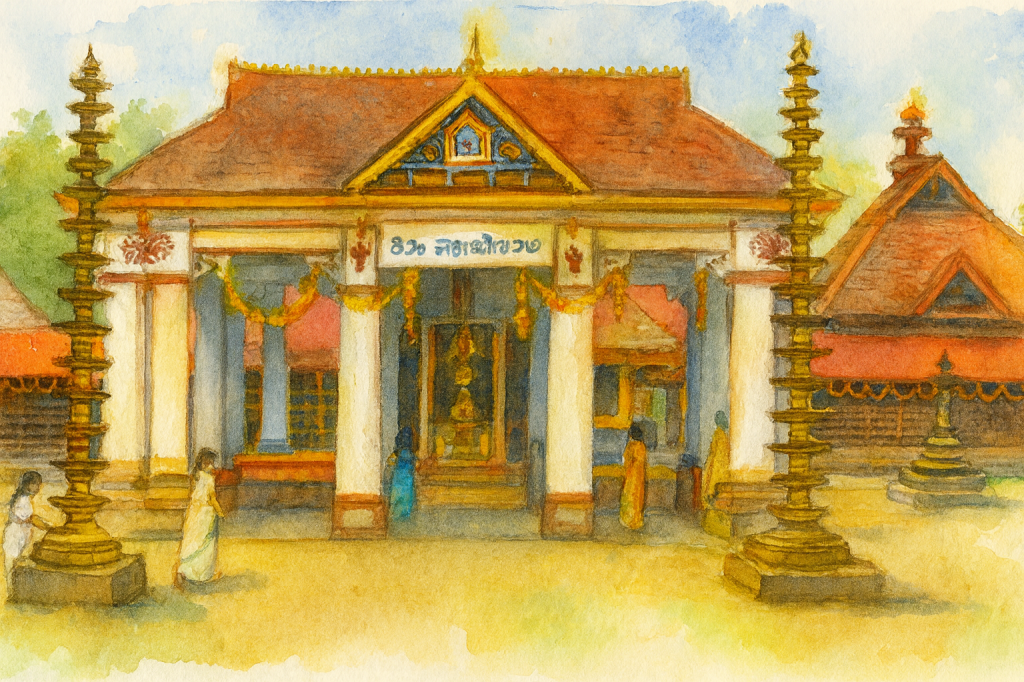
The origins of the temple trace back to Treta Yuga, making its beginnings so ancient that history itself bends in awe. The story begins in the Himalayas, where the demon Kharasura, despite his terrifying reputation, was a devout follower of Lord Shiva. His intense penance brought Shiva before him, who blessed him with three sacred Lingas, promising to reside in them eternally. Kharasura journeyed south, carrying the Lingas one in each hand and the third tied around his neck. Reaching the dense forests of present-day Kottayam, he rested for a while. When he tried to resume his journey, the Lingas remained rooted to the earth. Realizing Lord Shiva’s intention, he accepted this divine will, and the places where he set the idols became the three temples of the Vaikom–Ettumanoor–Kaduthuruthy trisome. Visiting these three temples before noon is believed to grant all desires of the devotee. The Vaikom Linga, the one carried in his right hand is where the majestic Vaikom Mahadeva Temple now stands. Kharasura attained liberation here, and the rituals were entrusted to Sage Vyaghrapada, later consecrated formally by Lord Parasurama. The uniqueness of Vaikom lies in Shiva being worshipped in three different forms each day: in the morning as Dakshinamoorthy who is the divine teacher, at noon as Kirathamoorthi in the hunter form, by evening as Shakti in the powerful cosmic energy.
From the moment you enter the temple courtyard, the structure reveals stunning examples of Kerala temple architecture infused with unique design elements: the Sreekovil (sanctum) appears circular from afar but is actually elliptical, a design unmatched in Kerala, vibrant mural paintings wrap the outer walls of the sanctum, illustrating tales of Shiva, the Mukha Mandapam made from a single block of stone and wood, leads to the square sanctum built fully in stone. Devotees must walk up six symbolic steps representing the six vices (kama, krodha, lobha, moha, mada, matsarya) before gazing upon Vaikathappan.
Inside the temple complex lies a treasure of Kerala craftsmanship, the Namaskara Mandapam which holds beautifully carved wooden panels illustrating episodes from the Ramayana. The Koothambalam, attributed partly to the legendary architect Perunthachan, showcases the skill and artistic legacy of Kerala’s builders. One mysterious and moving feature is the permanently closed western door. Centuries ago, a temple officer once defiled the sanctum’s offerings by entering through this entrance. As he attempted to leave, a snake bit him, and he died instantly. The door was sealed and remains shut to this day as a silent reminder of the temple’s sanctity. The temple’s spiritual heartbeat is felt intensely during Vaikom Ashtami, celebrated in the month of Vrischikam. This festival commemorates the divine vision of Vyaghrapada Maharishi, who is said to have seen Shiva and Parvati together on this holy night. The celebrations include grand processions, rituals, and offerings that illuminate Vaikom’s sacred town with unmatched devotion.
Beyond its mythological magnificence, Vaikom is etched in the history of modern India as the birthplace of a social revolution. In the early 20th century, caste-based restrictions prevented lower-caste Hindus from even walking on the temple roads. The Vaikom Satyagraha, guided by Sree Narayana Guru, Mannath Padmanabhan, and supported by Mahatma Gandhi, became a defining struggle for equality and temple entry rights. Their perseverance led to the historic Temple Entry Proclamation, allowing all Hindus to enter the temple. Vaikom thus stands as a shining symbol not only of faith but also of human dignity.
Walking through the temple grounds, the gentle sound of temple bells blending with the cool breeze from the Vembanad Lake creates a rare serenity. The pillars, lamps, murals, and courtyards, each narrates stories that span millennia. To visit Vaikom Mahadeva Temple is to step into a living legend. It is to witness the grace of Lord Shiva, the courage of reformers, the devotion of sages, and the architectural brilliance of ancient Kerala. Whether one seeks spiritual upliftment, historical insight, or the sheer beauty of a timeless tradition, Vaikom offers it all.
 STORIES by HEARITAGE
Leave a comment