There are places you visit, and there are places that make you pause & inviting you into a deeper world where language, culture, and history breathe together. Thunchan Parambu in Tirur, the birthplace of Thunchath Ramanujan Ezhuthachan, is one such sacred ground. Revered as the Father of the Malayalam language, Ezhuthachan’s legacy continues to echo through every sound, script, and syllable spoken in Kerala today. A visit to this memorial is not just a journey through heritage; it is a pilgrimage into the heart of Malayalam itself.
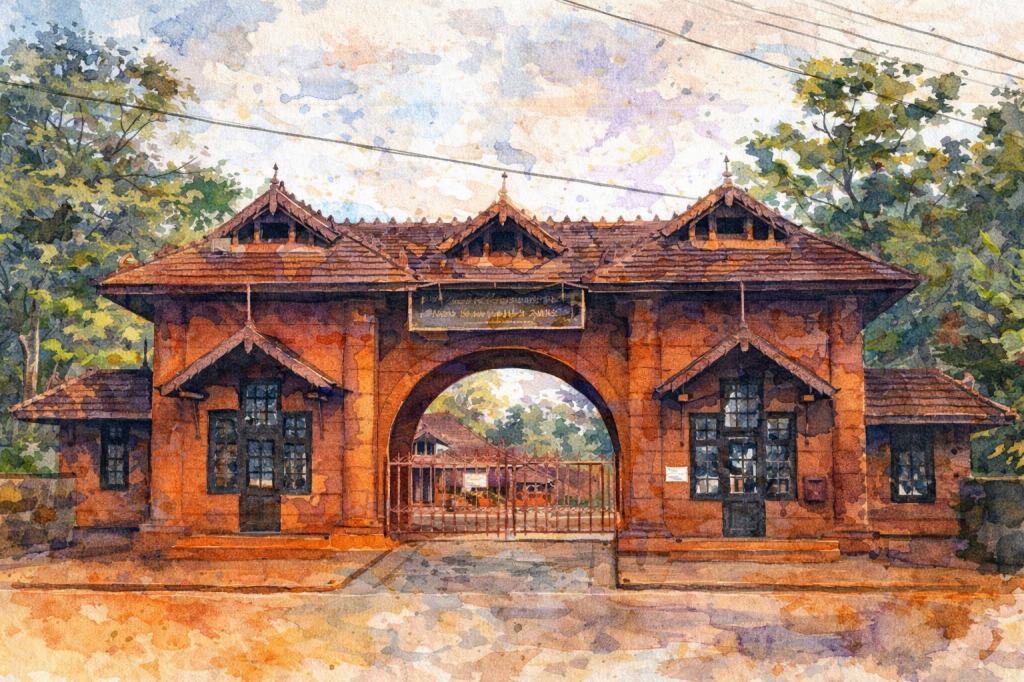
Stepping through the graceful laterite gateway of the Thunchan Memorial, one enters a serene grove to a place where stories whisper in the breeze and the soil itself feels sanctified. Though Ezhuthachan lived in the 16th century, his influence is timeless. This is the very land where he is believed to have lived, taught, and shaped Malayalam into the form we recognize today. The memorial, established in 1964, stands as a tribute not just to the man, but to the evolution of a language. After centuries of neglect, it was the vision of the Zamorin crown prince in 1901 that set the foundation for this institution. The dream took decades to materialize through donated land, state involvement, and the guidance of literary giants like S.K. Pottekkatt and M.T. Vasudevan Nair. Today, the site flourishes as a centre for learning, research, and cultural celebration.
The complex is a beautifully designed cultural hub that reflects Kerala’s traditional architectural charm. Travelers can explore: the Saraswati Mandapam which is a serene space dedicated to the goddess of learning, the children’s library nurturing young lovers of language, the palm-leaf manuscript library home to rare texts including the personal collection of Mahakavi Ulloor, the Malayalam language museum which traces the evolution of the script, literature, and Ezhuthachan’s monumental contributions, the Parrot statue which traces the story of Killipattu. Each structure blends seamlessly with nature, surrounded by trees, open courtyards, and quiet study spaces that invite introspection.
Much of Ezhuthachan’s life remains a mystery from his birth, upbringing, even caste are debated. What remains undisputed is his extraordinary intellect. Fluent in Tamil, Telugu, Sanskrit, and Malayalam, he dedicated his life to making sacred texts accessible to the common people. His works, including his Sri Mahabharata and streamlined versions of the Mahabharata, were written not for scholars but for everyday men and women. His poetry resounded with devotion, simplicity, and clarity, fueling the Bhakti movement in Kerala and giving Malayalam literature a new direction. Ezhuthachan is also credited with: standardizing Malayalam using the Arya-ezhuttu script, creating the Kilippattu (parrot-song) style of narration, possibly authoring the Keralolpathi, detailing the mythical origins of Kerala.
One of the most enchanting experiences at Thunchan Parambu is the Vidyarambham ceremony during Vijayadashami. Children from across Kerala arrive to write their first letters in the sand beneath the legendary Kanjiram tree, the same spot where Ezhuthachan is said to have taught his students. The tree stands robust, its leaves sweet to taste, carrying centuries of stories within. Inside the memorial, another priceless treasure awaits called the Ezhuthani, the iron stylus Ezhuthachan used to write on palm leaves. It is a quiet but powerful reminder of the monumental legacy carved with the simplest of tools.
Every corner of Thunchan Parambu feels like a living classroom, an open book meant for every visitor. Whether you are a devotee of literature, a student of history, or a traveler seeking meaning beyond monuments, this place offers something precious. The memorial echoes the spirit of a man who democratized knowledge, challenged social barriers, and carved a literary identity for a state. For anyone who cherishes Malayalam, this is sacred ground. As you leave the memorial, the rustle of palm leaves and the rhythm of written words linger within, urging you to return to language, to its beauty, its history, and its heart.
 STORIES by HEARITAGE
Leave a comment