In the heart of Kozhikode, at Mananchira which once reflected the bustle of ancient trade stands a monument that tells a quieter, more intimate story one of compassion, service, and unity. The CSI Cathedral of Calicut, originally built by the Basel Evangelical Mission, is more than a church; it is a testament to how faith and humanity reshaped the social landscape of 19th-century Malabar. During those days, the area around Mananchira Maidan was not the manicured city centre we see today. It was a stretch of barren ground where the poor and homeless wandered without shelter or dignity. Seeing their suffering, missionaries of the Basel Evangelic Mission appealed to the British authorities to grant a piece of land where they could build a refuge. With the approval of the East India Company and the generosity of the Zamorin of Calicut, this land became the birthplace of what is now Kozhikode’s beloved CSI Cathedral.
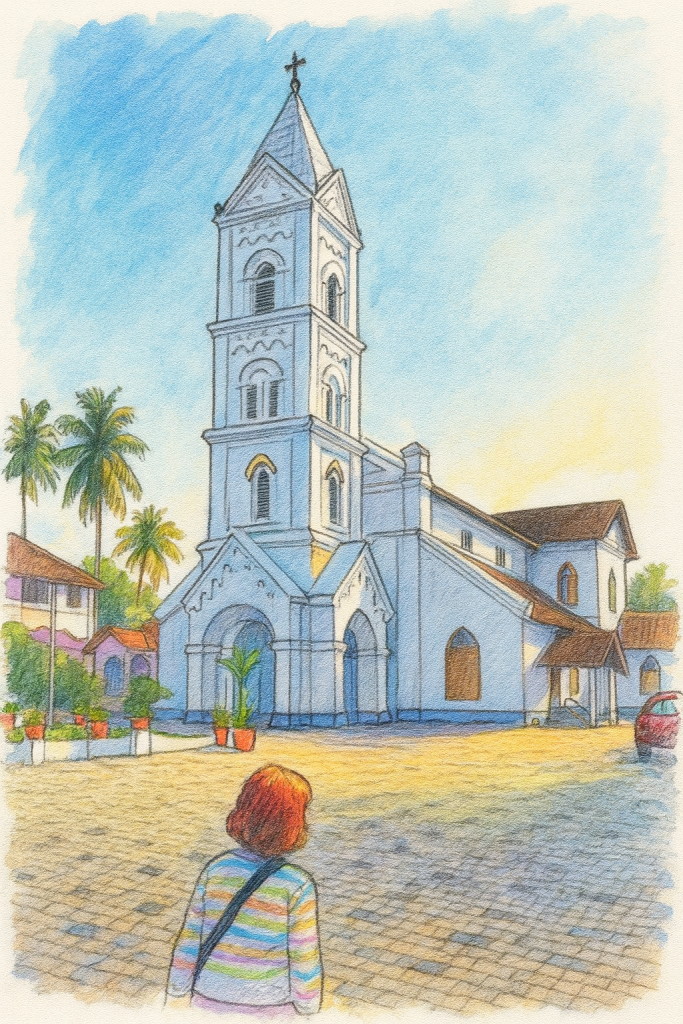
Construction began in 1842 under Rev. John Fritts, a devoted Basel Mission pastor. When the church opened its doors in 1856, there were merely seven Christian families in the area. Yet the church was built with astonishing foresight having spacious, symmetrical, and cross-shaped, blending European structural aesthetics with subtle Kerala craftsmanship. The elegant Gothic arches, the high gabled roofs, and the serene white façade come together to create an atmosphere of calm reverence. The airy galleries running around the interior and the simple, dignified wooden pews remind visitors of the Mission’s purpose of service, humility, and inclusivity. Stepping onto the grounds, one’s eyes are instantly drawn to the three-tiered belfry, added in 1908. Its commanding gong once echoed across the entire town, calling worshippers, travellers, and even curious onlookers to gather. Today, the tower stands proudly as one of Kozhikode’s most recognizable architectural gems.
The CSI Cathedral also has a unique distinction. It is part of the Church of South India (CSI), a union formed on 27 September 1947, shortly after India’s independence. The idea behind the CSI was revolutionary. From the mid-19th century onward, several Christian missionaries in South India realized that denominational divisions with a question – If Christ is one, why should His followers be divided. This groundbreaking union brought together: Anglicans. Methodists, Presbyterians, Congregationalists. This union was unlike anything seen before because the CSI united churches with episcopal traditions (with bishops) and non-episcopal traditions (without bishops). They created a structure that respected both. This structure was designed to retain the richness of each tradition, while functioning as one body. As part of the above arrangement, the BEM church was renamed to CSI Cathedral.
The cathedral today is not just a place of worship & it is a symbol of environmental stewardship. As a Green Parish, it has completely eliminated plastic usage. Even during weddings and gatherings, only ceramic plates and steel tumblers are used, reinforcing the church’s commitment to sustainability. Adjacent to the cathedral is the BEM School, one of many institutions founded by the Basel Mission to uplift the masses through education. Generations of students owe their academic foundations to this visionary movement. Among the treasures inside the cathedral sits a rare musical marvel, the only functioning pipe organ in Kerala. Acquired from St. Ayden’s Church in Cheltenham, England, when that church was being rebuilt, this majestic instrument was installed here in 2004. On Sundays, the organ is still played & hearing the organ play is a moment of transcendent beauty, one that connects continents, cultures, and centuries.
A visit to the CSI Cathedral is not about grandiosity; it is about grace. It is about seeing how faith can shape a city’s conscience. As you walk through its tranquil courtyard, listen to the bell tower, or sit for a moment of reflection inside its luminous white interior, you feel the touch of a history shaped by empathy and service. For over 150 years, this beautiful cathedral has been a silent guardian of Mananchira, a place where strangers were once welcomed, the neglected were cared for, and where unity, music, and faith continue to thrive.
 STORIES by HEARITAGE
Leave a comment