The Jagannatha Temple of Thalassery is a sacred space, where faith meets reform, devotion merges with dignity, and history stands boldly as a witness to social awakening along with discovering places where humanity itself took a step toward enlightenment. Nestled near the railway line that slices through the heart of Thalassery, this vibrant temple painted in hues inspired by the saffron robes of Buddhist monks is more than a shrine to Lord Shiva. It is a monument to a revolution, the first temple in Kerala where devotees of all castes were allowed to worship together.
At the turn of the 20th century, Kerala’s social fabric was fragile. Untouchability, caste-based segregation, and ritual discrimination had denied lower communities the basic human right of worship. While South Kerala witnessed countless struggles, the people of Malabar too longed for change and that change came in the form of a humble sage: Sree Narayana Guru. His teachings had begun inspiring the Ezhava community of North Kerala, who faced exclusion from local temples. A devoted follower, Kanniyil Kunhikannan, traveled all the way to Sivagiri to seek the Guru’s blessing for a temple in Thalassery. Initially reluctant since education and living standards in Malabar were comparatively better Gurudevan was eventually moved by Kunhikannan’s appeal: “We have progressed materially, but spiritually we still remain outside the gates.” Guru agreed and entrusted his beloved disciple, the poet Kumaranasan, to oversee the work. With the help of Moorkoth Kumaran, another ardent follower, land was acquired from the Cheruvari Krishnan Nambiar family. The foundation was laid not just for a temple, but for a new chapter in Kerala’s social history.
Sree Narayana Guru had heard of the great Puri Jagannatha Temple in Odisha, famous for welcoming devotees from all backgrounds. Inspired by this universal spirit, he named the Thalassery shrine Jagannatha Temple, symbolizing a God belonging to all. When conservatives objected to the consecration of a Shiva idol for lower-caste devotees, Guru responded with gentle but firm wisdom: “This is not your Shiva; this is Ezhava Shiva.” By doing so, he made the idol and the temple belong to those who were denied dignity elsewhere. He also instructed the Ezhava community to welcome upper-caste devotees, making this temple a living example of unity.
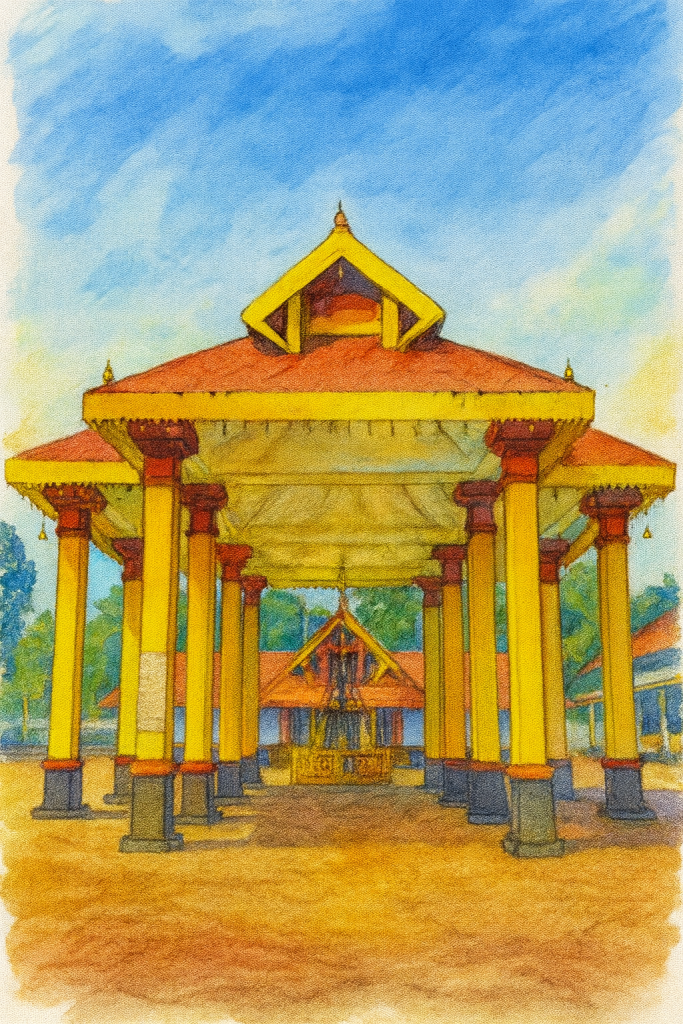
Built in classic Kerala style, the temple radiates charm through its: sloping tiled roofs, elegant wood carvings, spacious mukhamandapam for festivals, central Srikovil with no windows emphasizing inner reflection, tall mandapam pillars now a striking landmark, Turmeric-yellow color palette, chosen by Guru himself. A short walk from the railway track, the temple welcomes visitors into a peaceful courtyard that blends spirituality with heritage. The gopuram houses the temple’s pride, a majestic panchaloha statue of Sree Narayana Guru, sculpted in Italy by the renowned artist Thavarali using just a single photograph. Installed in 1927, this was the first statue ever created of the Guru. When asked to attend the installation ceremony, Gurudevan simply said with his characteristic humility: “There is no need for me—I am already there.”
While the temple is a beacon of harmony, it also carries memories of tragedy. During the 1986 annual festival, villagers sitting along the railway track to watch fireworks were struck by an incoming train whose signals were drowned by the noise. The engine driver cleared for the track honked desperately on seeing a crowd on the track but unfortunately the brakes could not slow the train & it hurled into the villagers. The place which was a venue for celebrations turned to tragedy as around 27 people died & many suffered grave injuries. Twenty-seven people lost their lives, one of the darkest moments in Thalassery’s history & a major rail tragedy in Kerala. To honor their memory, the railway later opened the nearby Temple Gate station.
The Jagannatha Temple is not just a spiritual center, it is a monument to social justice. Long before the Temple Entry Proclamation changed Kerala forever, this temple opened its doors to all communities. Though a mid-20th-century restriction briefly barred Muslim visitors, public sentiment and the principles of Sree Narayana Guru restored the temple’s original philosophy: “One caste, one religion, one God for mankind.” Stepping into the Jagannatha Temple is to step into a chapter of Kerala’s social renaissance. It is where devotion met equality, where courage challenged tradition, and where a single temple reshaped the story of faith for thousands.
 STORIES by HEARITAGE
Leave a comment