On the quiet banks of the Madhuvahini River stands an ancient sanctuary of wisdom, devotion, and national significance, the Edneer Mutt. For centuries, this sacred ashram has been a spiritual lighthouse for devotees who follow the Bhagavatha tradition and the profound philosophy of Advaita Vedanta as taught by the revered Adi Shankaracharya. The lineage of Edneer traces itself back to Totakacharya, one of Shankaracharya’s foremost disciples, and it is this unbroken tradition that lends the mutt its spiritual depth and historical gravity.
As pilgrims enter the serene premises, they are greeted by an ambience untouched by the rush of the outside world. The mutt houses two beautiful temples one dedicated to Dakshinamurthi, the benevolent guru-form of Lord Shiva, and the other to Gopalakrishna, worshipped with immense reverence by the Sivalli Brahmin community who have safeguarded the mutt for centuries. The quiet rituals, the chanting of scriptures, and the humility of the resident sanyasis offer every visitor a chance to step away from life’s clamor and immerse themselves in spiritual clarity. The mutt has also been a center for education and upliftment. The elementary school within the premises, founded by Srimadiswaranda, continues to serve the community as a government upper primary school symbolizing the union of spiritual and social consciousness.
Through the ages, many enlightened Swamijis have guided the mutt, but it was during the times of Satchidananda Bharati and subsequently Balakrishna Bharati that the institution saw remarkable growth and organization. Their contributions laid the foundation of a mutt that embraced both spiritual instruction and social responsibility. Among the illustrious heads of Edneer Mutt, Kesavananda Bharati Swamiji remains the most renowned, not just in spiritual spheres but in the judicial history of India. His leadership spanned over six decades, during which he became a symbol of conviction, humility, and courage.
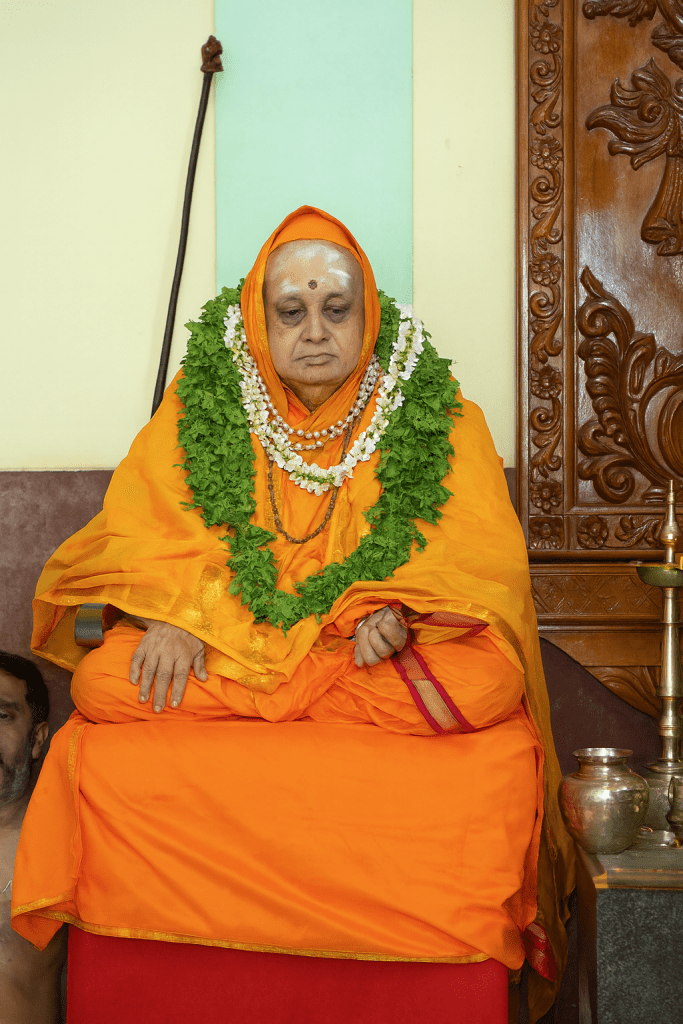
His name is forever etched in Indian legal history through the landmark judgement Kesavananda Bharati vs. State of Kerala (1973) a case that continues to influence the very functioning of Indian democracy. In 1969, the Kerala Government amended land reform laws, allowing it to take control of temple and mutt properties, including that of Edneer. Disturbed by the lack of consultation and fearful of the mutt losing its autonomy, Kesavananda Bharati Swamiji sought legal help. His case was argued by the legendary Nani Palkhivala, who challenged the amendments as a violation of fundamental rights—freedom of religion, property, and religious practice. What followed was the longest and most significant constitutional hearing in Indian history: 13 judges on the constitutional bench, 69 days of arguments, a judgement that reshaped India’s democracy. The Supreme Court ruled that the basic structure of the Constitution cannot be altered by any government, a doctrine that protects Indian democracy even today. Swamiji later invoked this principle again during the controversy surrounding the opening of the sacred vaults of the Padmanabhaswamy Temple, arguing for the protection of religious traditions and autonomy. Thus, Edneer Mutt is not just a place of religious importance, it is a site where the rights of millions of Indians were safeguarded.
Visiting Edneer Mutt is not just about exploring an ancient spiritual center, it is an opportunity to stand at the crossroads of faith, philosophy, law, and national identity. Sit under the ancient trees where sanyasis have meditated for generations, Listen to the serene chanting that echoes through the stone halls, reflect upon the courage of a monk who changed the course of constitutional history. The mutt remains a thriving center of Advaitic learning, cultural preservation, and spiritual retreat. The river flowing gently beside it seems to whisper the wisdom of the sages who once walked its banks.
 STORIES by HEARITAGE
Leave a comment