Tucked away on a quiet stretch of the Customs Road near the Kozhikode Beach stands a place unlike any other in the region is a small, serene sanctuary that preserves the gentle light of Buddhism in a land where the religion once flourished centuries ago. The Kozhikode Buddha Vihara, though modest in appearance, radiates a spiritual warmth that immediately embraces every visitor who steps inside. Founded in 1935 by Bhikshu Dharma Skandha of the Ceylonese Mahabodhi Vihara, this humble shrine served for decades as a cultural lighthouse, drawing monks, scholars, and truth-seekers from across the world. While Kozhikode has always been known for its maritime trade, diverse religions, and intellectual vibrancy, the Vihara quietly added another dimension a soft reminder of Kerala’s buried Buddhist past and its message of compassion, clarity, and inner stillness.
Unlike grand monasteries with ornate gateways, the Buddha Vihara is housed in a simple, unassuming structure almost like stepping into someone’s peaceful ancestral home. This simplicity is intentional, for it reflects the Buddhist ideal that truth does not require grandeur; it only requires an open heart.
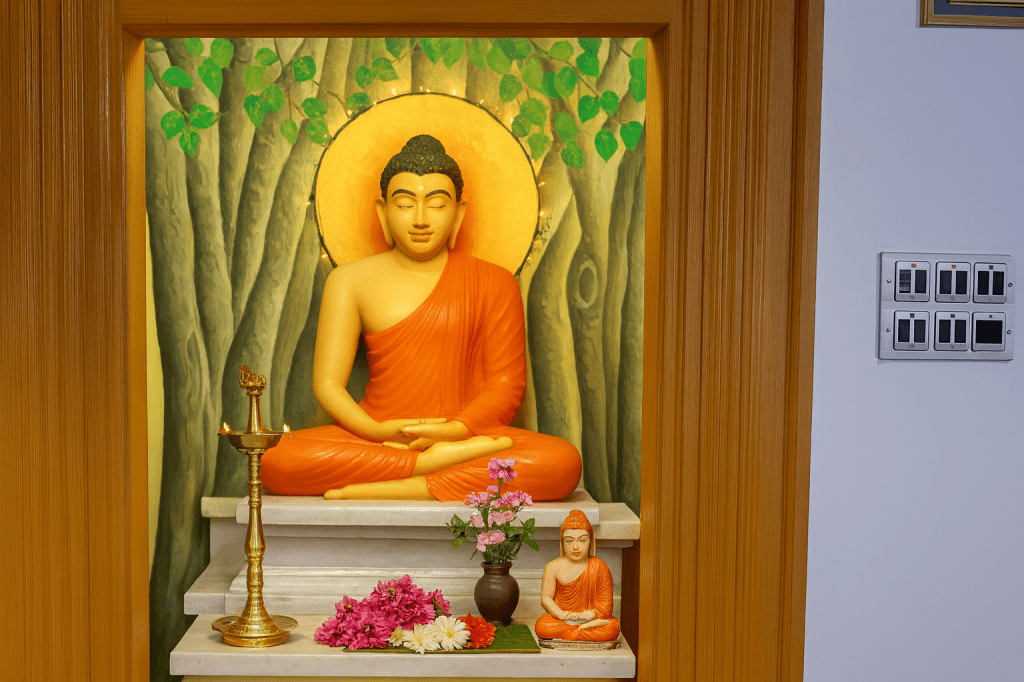
Inside, the curator often someone deeply connected with the history of the Vihara welcomes visitors warmly and takes them through the rooms that breathe stories of resilience, reform, and spirituality. A striking image of the Buddha, carved by master sculptors from Sri Lanka and gifted by the C.C. Brothers, sits as the central sanctum. Bathed in soft light, the statue exudes a calm that silently commands stillness. The quiet here is not empty, it is nurturing. Standing by the statue, one cannot help but feel the echoes of the monks and social reformers who once filled this place with conversations on truth and liberation.
The Vihara houses a remarkable library of over 5000 books, from rare Pali manuscripts to modern interpretations of Buddhist philosophy. Many of these books provide insights into the Mahabodhi movement and the revival of Buddhism in South India. Scholars once travelled great distances just to access this vast repository. Today, pilgrims and readers still lose themselves in its pages, each book a doorway to timeless wisdom. This peaceful sanctuary also holds tremendous historical value. It is here that Sahodaran Ayyappan, C.V. Kunhiraman, and Mithavadi Krishnan Vakil, three giants of Kerala’s social reform movement gathered to discuss paths toward equality, human dignity, and a casteless society. Their debates on Buddhism as a path to social emancipation still linger in the air. A statue of Krishnan Vakil, honoured within the Vihara, reminds visitors of his fearless spirit and his devotion to spreading Buddhist ideals among the oppressed.
Within the compound stand two historic Bodhi trees, saplings originally brought from Sri Lanka and planted by Manjeri Rama Ayyar and Krishnan Vakil. Although only one survives today, it continues to flourish as a living symbol of enlightenment. Pilgrims often sit under its shade, contemplating the journey of the sapling from ancient Ceylon to modern Kozhikode mirroring their own inner journeys. For those seeking spiritual insight, historical curiosity, or simply a few moments of peace, the Buddha Vihara in Kozhikode offers something rare: a place where the past, present, and inner self converge.
The Kozhikode Buddha Vihara is not a conventional tourist spot; it is a place to slow down, to breathe deeply, and to listen to the silence that exists behind the noise of daily life. There are no crowds here, no loud rituals only a quiet invitation to explore the path of compassion and clarity that the Buddha taught. Entry is free but respectfully regulated. Visitors are encouraged to maintain the sanctity of the space after all, this is not just a monument; it is a living reminder of a spiritual legacy.
 STORIES by HEARITAGE
Leave a comment