If there is one place in Kozhikode where history continues to breathe, walk, argue, sweat, and bargain just as it did centuries ago, it is the legendary Valiyangadi, the oldest functioning market in Kerala. This bustling bazaar stretching from the South Beach all the way toward the railway station has been the beating commercial heart of Kozhikode since the age of the Zamorins. And remarkably, its essence has remained unchanged.
No one knows exactly when the market began, because it was never built in a single stroke; instead, it grew organically. The Zamorins envisioned a trade passage linking the palace-side market to the pier, where ships from Arabia, China, and the Mediterranean once anchored. Godowns rose along the waterfront to store pepper, ginger, coconuts, spices, and forest produce. Merchants set up small shops on either side of the narrow corridor-like lanes, creating a maze that guided goods smoothly from ship to shop to cart. Even today, the architectural remnants tell the story, wooden doors still open with their old shutters, long corridors still guide the flow of trade, and some pandikasalas remain robust reminders of Kerala’s maritime past.
What sets Valiyangadi apart is its living tradition of multicultural trade. Walk through its lanes and you meet: muslim merchants, jain traders, sindhi shopkeepers, gujarathi Marwaris, Tamil and Andhra Chettiars, hindu Seths. This cosmopolitan blend has existed for centuries, each community carving its own niche in the trade ecosystem. Inside the shops, you’ll still see accountants using the ancient finger-code method of calculation, a silent language perfected to communicate numbers even amid the constant roar of traffic and shouting loaders. This bazaar feels like a living museum of commerce.
Valiyangadi’s uninterrupted prosperity is tied to a curious local legend. It is said that Mangatt Achan, the First Prime Minister of the Zamorins, performed a strict penance to please Goddess Lakshmi, the deity of fortune. When she appeared and granted him a boon, he asked her to stay in the bazaar until he returned. After receiving the blessing, Mangatt Achan went home and took his own life ensuring that Goddess Lakshmi would remain in Valiyangadi forever. Whether myth or memory, the bazaar’s merchants still believe that prosperity resides here because Lakshmi never left.
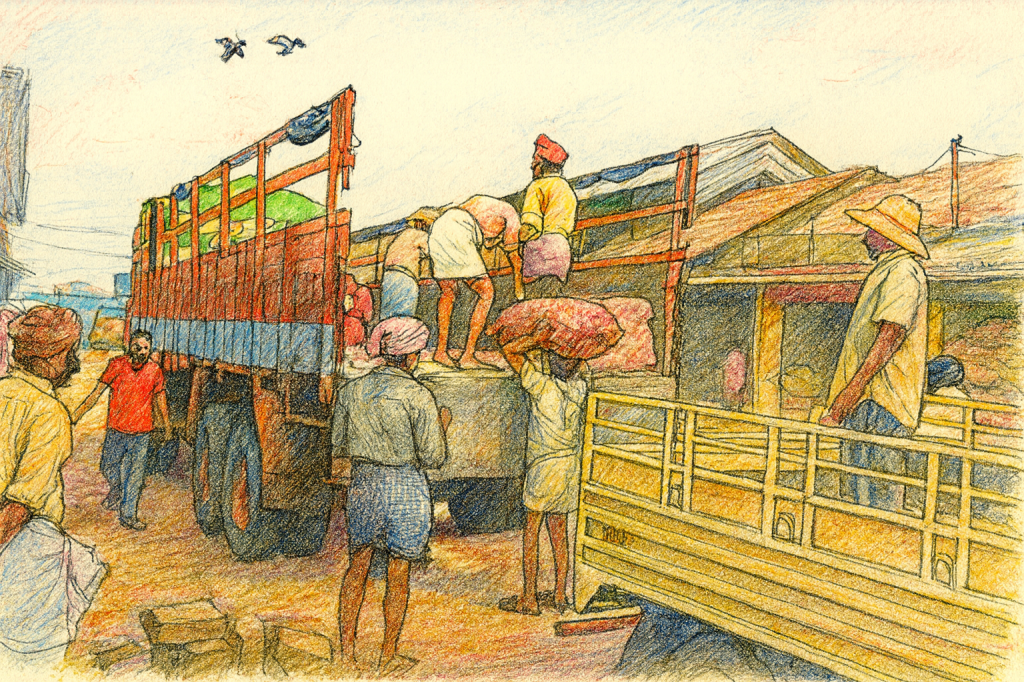
Visit the market on a working morning and you find yourself inside a whirlwind: trucks reverse skillfully through tight spaces honking as they come to load and unload grains and spices, head loaders who are the real heroes of the bazaar carrying huge gunny sacks using nothing but brute strength and balance which is the only mode of transporting the bags across the market, spices spill into the air with pepper, cumin, tea dust, lentils creating a fragrance that belongs only to Kozhikode, merchants shout across lanes, negotiations happen at lightning pace, and ledgers fill up with numbers written in looping Malayalam calligraphy. Follow any one loader and you’ll witness a masterclass in navigation with every turn, every shop, every trader knowing it like the back of their hand. If weekdays are thunderous, Sundays are surreal. With no trading allowed, the 1.5 km stretch becomes eerily quiet. The very streets that echo with enterprise all week suddenly lie empty. For a moment, you can stand still and imagine how this lane must have looked in the 14th century when Chinese sailors unloaded silk and Persian traders sheltered under the tiled roofs.
In 1930, the British expanded the roads, giving Valiyangadi the long concrete stretch we see today. Over time, supplies expanded from food grains and pulses to modern plastic goods but the traditional trade culture stayed intact. The old godowns along the beach that once housed horses from Arabian ships are now coconut collection centers, but they are still linked to Kozhikode’s maritime identity. Every brick, every shutter, every ledger carries the stamp of time.
Valiyangadi isn’t just a market; it is: a heritage corridor where ancient trade practices live on, a cultural melting pot unchanged across centuries, a monument to human endurance, especially of the head-load workers, a testament to Kerala’s maritime history and commercial brilliance. Walking through Valiyangadi is like stepping into a living documentary full of noise, color, character, stories, and the unmistakable heartbeat of Kozhikode.
 STORIES by HEARITAGE
Leave a comment