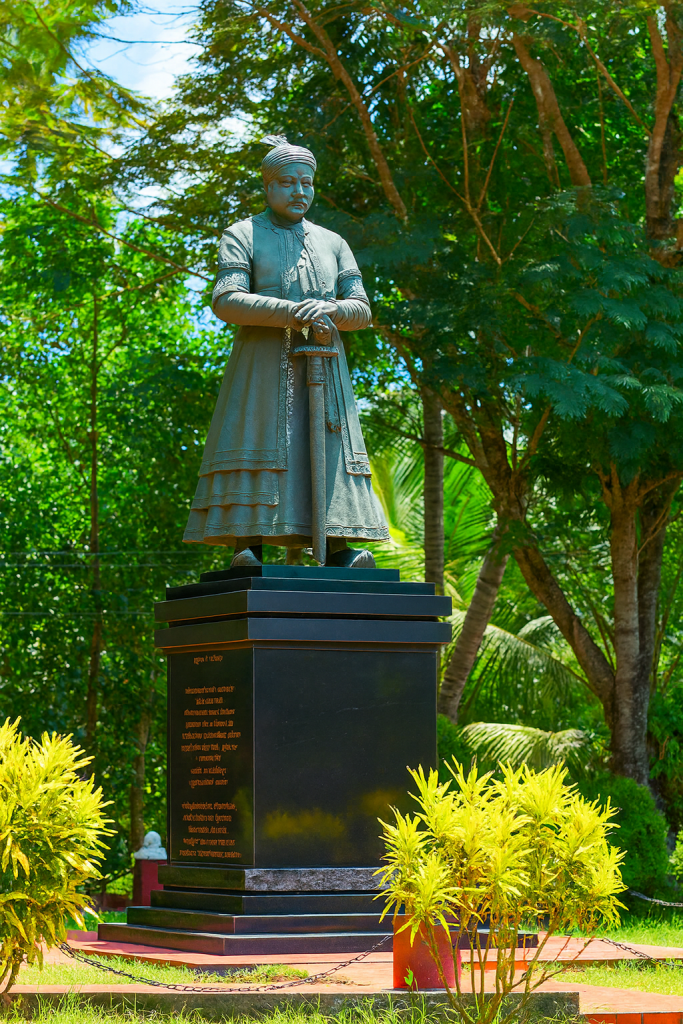
In the quiet village of Mannady in Pathanamthitta stands a museum that echoes the bravery of one of Kerala’s most uncompromising warriors, Velu Thampi Dalawa the man who dared to challenge both corruption within his kingdom and the expanding might of the British Empire. As you walk into the lush grounds, the imposing life-size statue of Velu Thampi Dalawa greets you with a piercing silence, a reminder of the intensity with which he lived and fought. Inside the museum, visitors will find relics of a turbulent era like weapons, palm-leaf manuscripts, rare coins, royal portraits, and even a serene stone statue of the Buddha that brings a touch of calm to the room. Yet the spirit of Velu Thampi lingers everywhere, especially in the weapons he once wielded, each carrying tales of revolt, sacrifice, and unwavering courage.
Velu Thampi Dalawa born Velayudhan Thampi in the 18th century belonged to a respected Nair family that held the hereditary title Chempakaraman in the Travancore kingdom. Even as a young man, he displayed a sharp understanding of governance and justice. His abilities won him the role of Tahsildar of Mavelikkara, placing him at the heart of Travancore’s administration. His rise, however, unfolded against the backdrop of turmoil. After the death of the brilliant Dewan Raja Kesavadas, Travancore fell into the hands of corrupt ministers, especially Sankaran Nampoothiri, whose misrule plundered the treasury and bled the people dry through unreasonable taxation. Velu Thampi, deeply troubled by the state of the kingdom, appealed to the young ruler Bala Rama Varma, but when his pleas were ignored, he turned to the masses. In a bold act of civil defiance unusual for the time, Velu Thampi rallied the people of Travancore. Together, they encircled the palace in protest, demanding justice. The king relented, banishing the Dewan and elevating Velu Thampi to the position of Dalawa, or Prime Minister.
As Dalawa, Velu Thampi tried to restore discipline and order, but his methods were often harsh. With a reputation for unforgiving punishments and uncompromising decisions, he earned admiration and fear in equal measure. Yet it was not internal politics but British intervention that shaped his destiny. After a mutiny by Nair soldiers in 1804, the British forced Travancore into a suffocating treaty, increasing the presence of British troops and imposing heavy financial obligations. Dalawa recognised the gravity of this agreement & it threatened the very independence of the kingdom. His relationship with Major Macaulay, the British Resident, soon deteriorated beyond repair.
Velu Thampi found an ally in Paliath Achan, the powerful Dalawa of Cochin. United by a common resentment toward British dominance, the two leaders plotted coordinated uprisings. The first attack in Cochin Fort in 1808 failed, but Velu Thampi responded with one of the most stirring calls to resistance in Indian history, the Kundara Proclamation. From the village of Kundara, he urged the people to rise up and drive out the British. His words electrified the land, igniting one of the earliest organised armed rebellions in South India. What followed was a series of fierce battles. At Quilon, his forces clashed with British troops but were defeated after heavy losses. Forced to retreat into the mountain passes of Travancore, Velu Thampi continued to resist, refusing to surrender even as the British pressure intensified.
Condemned by the British and disowned by the Travancore king, Velu Thampi went into hiding near the Mannady Temple. When his location was betrayed, British troops closed in. Realising escape was impossible, Velu Thampi chose death over dishonor. Within the temple walls, he took his own life, preserving the dignity he fought for till the very end. The British, enraged and vindictive, displayed his body on the gallows to make an example of him. His property was confiscated, his ancestral house was razed, and his family was exiled—yet the legend of Velu Thampi only grew stronger with time.
Though he fell, Velu Thampi Dalawa left behind a powerful legacy: he proved that organised rebellion against British power was possible, his uprising inspired later freedom fighters during the Indian independence movement, his sword, preserved by the Kilimanoor family, was gifted to the Indian government after Independence, Mannady came to be recognised as a site of historic resistance. Today, the museum and memorial at Mannady stand as living tributes to a man who valued his land’s freedom above his own life. Walking through the calm premises, you can almost hear the echo of his proclamation, urging future generations to rise against injustice.
For tourists, historians, and patriots alike, Mannady is more than a stop on a travel map, it is a place where Kerala’s fiery spirit of resistance is etched into its soil. Visit the museum, stand before Velu Thampi Dalawa’s statue, and take a moment to appreciate the courage of a leader who dared to dream of freedom long before India united for independence.
 STORIES by HEARITAGE
Leave a comment