In the serene, sea-washed town of Mahe stands a shrine unlike any other. a place where history, legend, and faith blend seamlessly into a single spiritual experience. The Church of St. Teresa of Avila, lovingly called “Mother of Mahe,” is today one of the most important pilgrim destinations in the region. Yet for centuries, its true origins remained a mystery, hidden in the sands of time. It was only when archival records of Carmelite missionaries surfaced in Rome that the birth of this sacred shrine finally came to light. The story begins in 1723, when the Italian Carmelite priest Rev. Fr. Dominic of St. John of the Cross arrived on Mahe’s shores. Impressed by the sincerity of the missionary’s work, King Bayanor of Kadathanadu granted him land to establish a small church. By 1736, a humble chapel made of coconut leaves and bamboo had risen, built by the early converts who embraced the message of peace and compassion preached by the missionaries.
The soul of the shrine, however, is its revered wooden statue of St. Teresa of Avila, the 16th-century Spanish noblewoman turned mystic who later became a celebrated reformer, healer, and eventually a Doctor of the Church. Her arrival in Mahe is wrapped in beautiful legends. Some say fishermen found her statue in their nets, drawn mysteriously from the sea and handed it reverently to Rev. Dominic, who installed it in the chapel. Another tale speaks of Carmelite missionaries transporting the statue by ship; when the vessel reached Mahe, it inexplicably refused to move forward. Understanding this as a divine sign that the Saint wished to remain here, they entrusted the statue to the mission. Regardless of which legend one believes, the truth remains that the presence of St. Teresa transformed Mahe forever. Her statue revealed to the public only on feast days became the centre of profound devotion, healing, and hope.
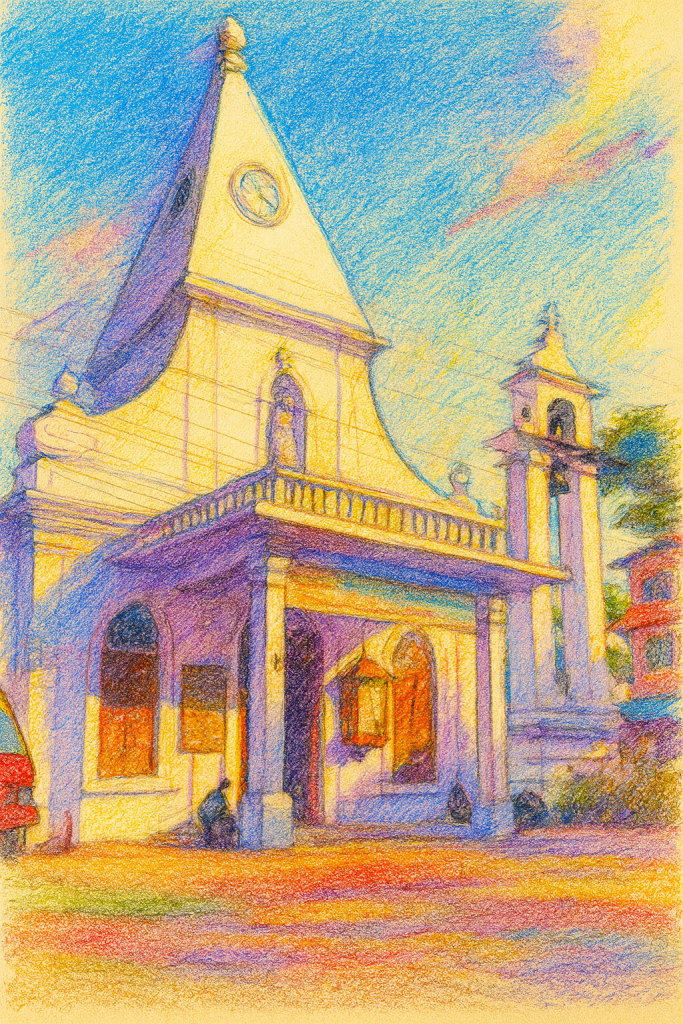
Mahe, caught between the battles of the French and the British, witnessed the complete destruction of the original church. But in 1788, the shrine rose again, this time sturdier and more enduring, built with wood and stone. The iconic Mangalore-tiled roof came later in 1874, replacing nearly a century of thatched roofing. The elegant clock tower, gifted by the French Navy, added grandeur to the façade and served as the town’s unofficial timekeeper. Over the decades, the shrine continued to evolve when new pews were added, a graceful parish hall was built, and the sacred precinct expanded to include the primary school, Avila Bhavan, and the new presbytery. Yet the atmosphere of quiet devotion remains unchanged.
More than architecture, it is faith that defines this shrine. Locals firmly believe that the Mother of Avila protects her children, especially during epidemics and hardships. Historical accounts suggest that while diseases ravaged nearby regions, the areas around the shrine remained mysteriously untouched strengthening belief in the Saint’s divine guardianship. On feast days, these sentiments swell into a moving spectacle. Tens of thousands gather, including people of all religions, to honour the Saint. Devotees express their gratitude in deeply symbolic ways rolling across the road before the church, walking on their knees from the entrance to the altar or simply lighting a candle to seek comfort or guidance. Even travellers passing through Mahe pause briefly to light a candle, whisper a prayer, and resume their journey under her blessing.
The church interior complete with its Gothic-inspired altar, serene ambience, and gentle glow of candlelight sets a tone of peace seldom found in bustling towns. The statue of St. Teresa, with her calm expression and motherly presence, has long been a silent confidante to thousands who seek solace within these walls. A replica of the fabled wooden statue greets the visitors at the entrance with all the grace and compassion she is known by. The shrine also has added few new institutions like the Parish hall, Primary school, Avila Bhavan, New Presbytery around the church.
A visit to the Shrine of St. Teresa of Avila is not merely a religious experience, it is a journey into the spiritual soul of Mahe. It is where legends breathe, where compassion triumphs, and where the warmth of the Mother of Mahe touches every heart. The shrine stands today not only as a monument of faith but also as a reminder of how deeply spirituality, healing, and human hope are interwoven in Kerala’s cultural tapestry.
 STORIES by HEARITAGE
Leave a comment