Kerala is celebrated for its temples of ornate sanctums with carved stone bases, sloped terracotta roofs, vivid murals, and exquisite wooden architecture. Yet, hidden in the quiet village of Anchal in Kollam district stands a temple that breaks every convention. It is neither sculpted in wood nor built brick by brick. Instead, it rises from the earth as a single giant monolith, carved with a mastery rarely seen in the region. This is the Kottukal Cave Temple, a magnificent rock-cut shrine that transports every visitor back to the artistic zenith of ancient South India.
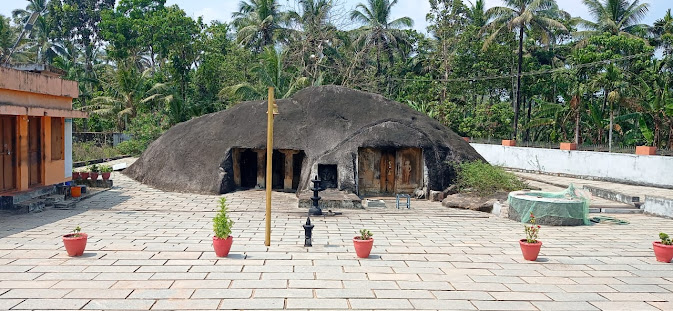
Spread across lush paddy fields and shaped remarkably like an elephant resting on the ground, the temple takes its name from the Malayalam words kothiya-kallu meaning “carved rock.” Dedicated primarily to Lord Ganapathi, the temple holds an aura of antiquity and mystique. There are no written records to indicate when or by whom it was built, but historians believe it to date back to the 7th century CE, possibly contemporary with the rock temples of Mahabalipuram built by the Pallavas. The craftsmanship here is unmistakably aligned with that tradition, making Kottukal a rare treasure in Kerala’s architectural landscape. The temple consists of two caves, one small and one slightly larger, both containing monolithic Shivalingams. The larger cave resembles a complete temple in miniature featuring a Mukha Mandapam, four-sided garbhagriha, and the majestic presence of Nandi, the bull of Lord Shiva, carved at the entrance. The smaller cave is adorned with a striking figure of Hanuman, depicted in his vanara form, as described in the Ramayana.
The coexistence of Nandi and Hanuman here is symbolic, evoking the ancient legend of their encounter referenced in Hindu lore. Just beside these caves stands a beautifully carved stone image of Lord Ganapathi, not housed inside the cave but sculpted directly onto the rock’s face breathtaking in its simplicity and elegance. Adding to the temple’s charm is a smaller boulder nearby known as Chummadu Para, meaning “the supporting rock.” Local lore narrates that Nandi himself placed the gigantic monolith here and rested his head on the smaller stone, leaving it behind as a relic of divine play. Beside the temple lies a well whose waters, it is believed, never run dry, even during harsh summers. This water is traditionally used for rituals, anchoring the temple in the rhythm of daily worship.
Although spiritually significant, the temple is equally a historical and archaeological marvel, today protected by the Archaeology Department of Kerala. Its rock-cut form, ancient iconography, and serene setting make it a living museum of Kerala’s lesser-known past. A visit to Kottukal Cave Temple is not only a journey into worship but also a step into the creativity, devotion, and engineering brilliance of ancient craftsmen. Here, in the silence of the stone, lies the story of a civilization that shaped divine forms out of immovable rock and left them behind to inspire generations.
 STORIES by HEARITAGE
Leave a comment