Kerala is a land where faith flows & among its many sacred narratives, none is as deeply etched into the landscape as the journey of St Thomas the Apostle, who is believed to have brought the message of Christ to the shores of Kerala in 52 AD. Every place he touched became sanctified by memory and belief, and among them, the forested hills of Malayattoor stand apart not for grand architecture, but for an enduring spiritual presence.
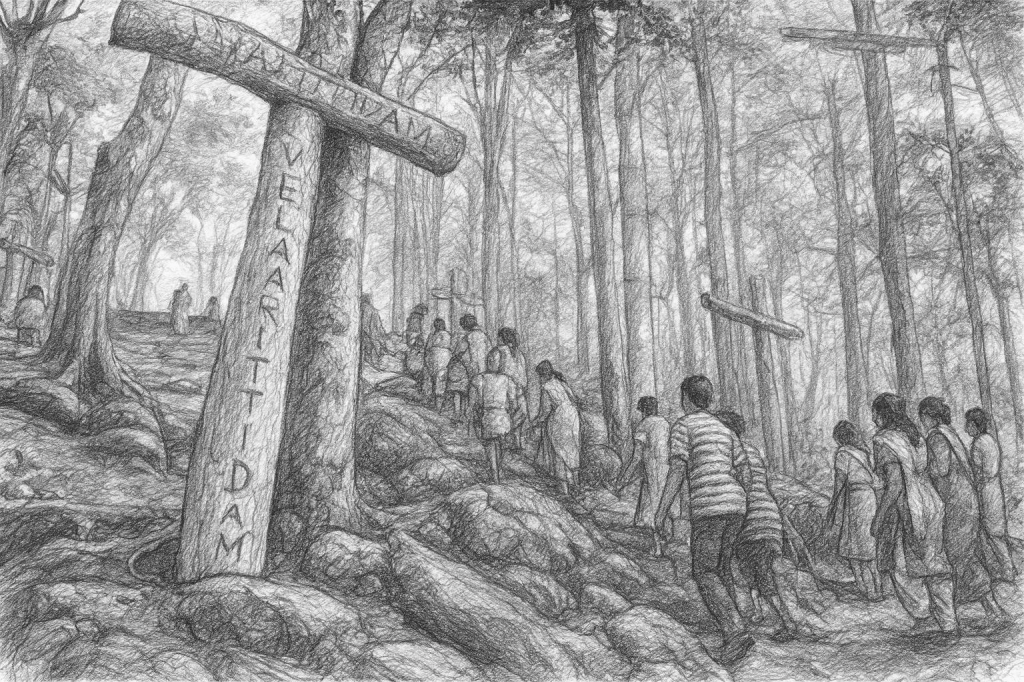
After establishing the famed Seven and a Half Churches of Kerala, St Thomas is believed to have passed through this land embraced by mountains and river. Today, the Malayattoor Church is revered as one of the eight International Shrines of St Thomas worldwide and the only one in Asia. It is also the largest pilgrim centre dedicated to the Apostle in India. Nestled beside the flowing Periyar River, the church and its surrounding landscape create a setting where nature and devotion exist in harmony. The heart of this pilgrimage lies uphill, at Kurisumudy, reached by a demanding forest trek. This sacred ascent commemorates one of the most dramatic episodes in the Apostle’s life.
Tradition holds that during his second visit to Malayattoor around 62 AD while journeying toward Mylapore St Thomas faced hostility from locals who feared his influence. Stones were hurled, abuses shouted, and his life threatened. Fleeing for safety, the Apostle ran into the dense, unpaved hills, bleeding and exhausted, hiding behind trees and boulders as his pursuers eventually lost their way and turned back. Alone and injured, St Thomas finally reached the summit. There, resigned to his fate, he prayed fervently and carved a cross on the rock with his finger. According to belief, the Virgin Mary appeared to him, assuring him that his mission was not yet complete. Strengthened by faith, the Apostle descended the mountain and continued his ministry for another decade, until his martyrdom in 72 AD.
Centuries passed before the sanctity of Kurisumudy became widely known. Local tribal hunters are said to have discovered a glowing cross carved into the rock at the summit. When they struck it with a spear, blood reportedly flowed, revealing the divine nature of the site. The cross came to be known as the Ponnin Kurishu (Golden Cross), and later, in the 18th century, a larger golden cross was installed within the shrine. Even today, pilgrims are shown the footprints and knee marks believed to have been left by the Apostle during prayer, as well as a mountain spring said to have emerged when he struck the rock for water. The Kurisumudy trek itself is a moving spectacle of devotion. Men carry heavy wooden crosses, while women carry brooms symbols of prayer for prosperity, well-being, and youthful vitality. The forest path is lined with crosses, each marking a pause for prayer at spots where the Apostle is believed to have rested. The climb is not merely physical; it is an act of endurance meant to mirror the suffering and perseverance of St Thomas himself.
Two churches mark this sacred geography: the Mele Palli, perched atop Kurisumudy and intimately associated with St Thomas, and the Thazhe Palli, located at the foothills, serving daily worshippers and those unable to undertake the arduous climb. Both are believed to have been established around the 10th century. Near the summit stands the Anakuthi Palli, where marks resembling elephant tusk impressions are visible on rock, another reminder of the wild terrain that frames this pilgrimage. At the base, the Thazhe Palli reveals a different beauty, architectural rather than rugged. Built in a Greco-Roman style, the church features a Greek-inspired altar and Roman exterior design. Inside, intricately carved wooden altars, depictions of the joyful mysteries of Christ, an ancient baptismal pond, pulpit, and dedicated spaces for confession and adoration speak of centuries of uninterrupted worship.
What makes Malayattoor truly timeless is that it transcends religious boundaries. Pilgrims from all faiths walk these paths, drawn by the quiet power of belief and sacrifice. The journey to Kurisumudy is not merely about fulfilling vows; it is about walking in the footsteps of a man whose life was defined by selflessness and service to humanity. A visit to Malayattoor is, therefore, more than a pilgrimage it is a communion with history, nature, and unwavering faith. To stand at Kurisumudy, amid whispering trees and ancient rock, is to feel the enduring presence of St Thomas, reminding every traveller that true devotion is found in humility, endurance, and love for mankind.
 STORIES by HEARITAGE
Leave a comment