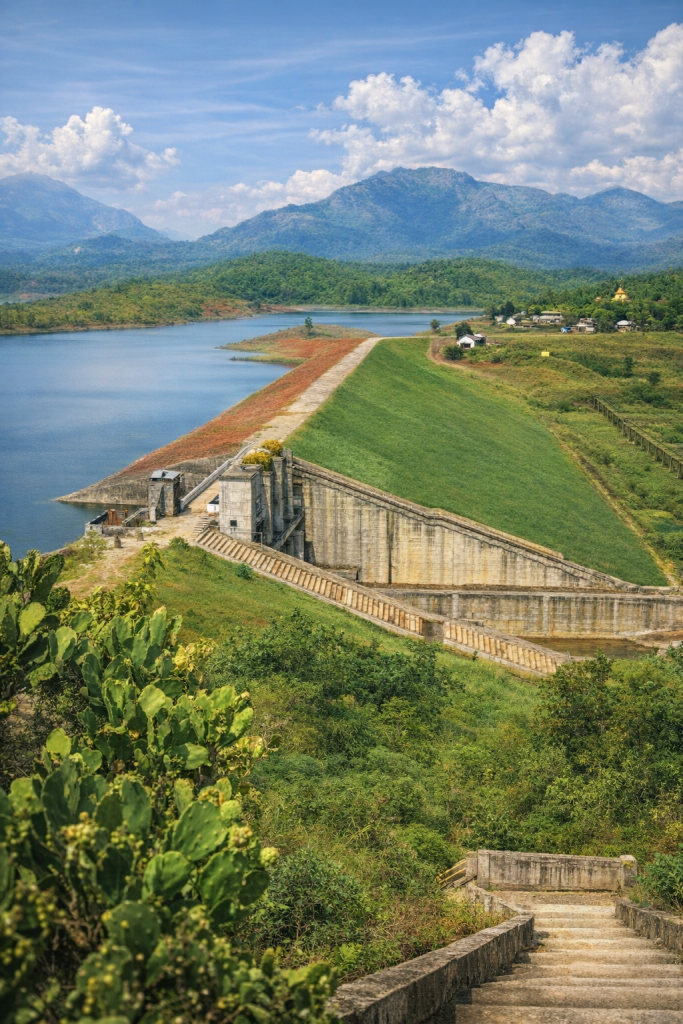
Kerala’s landscape is gently shaped of water by its rivers, backwaters, and reservoirs silently sustaining life across the state. Among the many dams that dot this beautiful land, none commands the same quiet grandeur as Banasura Sagar Dam, the largest earth dam in India and the second largest of its kind in Asia. Built almost entirely of stones and massive boulders, the dam does not dominate its surroundings; instead, it blends seamlessly into the rolling hills of Wayanad, as though nature itself had shaped it. Constructed across the Karamanathodu tributary of the Kabini River, Banasura Sagar was completed in 1979 with a dual purpose to support the Kakkayam hydroelectric project and to meet the irrigation needs of the region. Over the decades, it has evolved beyond its functional role to become one of Wayanad’s most cherished attractions, a place every traveller feels drawn to, whether for its engineering brilliance or its tranquil beauty.
The name of the dam is deeply rooted in mythology. It takes inspiration from Banasura, the legendary demon king who is believed to have succeeded Kerala’s most beloved ruler, King Mahabali. Local belief holds that Banasura performed intense penance in these very hills, lending his name to both the mountains and the dam that now rests among them. This interweaving of myth and geography lends the landscape a timeless quality, where stories of the past feel as present as the hills themselves.
Yet, the history of Banasura Sagar is not without sacrifice. The creation of the reservoir submerged the small village of Thariode, once located along the banks of the Karamanathodu. Families were relocated to higher ground, marking a quiet chapter of loss beneath the serene waters. Long before this, the British had explored these hills in search of gold, only to abandon the effort. The region also echoes with memories of resistance and courage, Tipu Sultan is said to have marched his troops through the Thariode–Vythiri route, while Pazhassi Raja and his fearless Kurichiya bowmen once used these forests as refuge during their struggle against colonial rule. Today, the dam stands as a harmonious blend of human effort and natural design. Its spillway doubles as a narrow road, offering visitors sweeping views of the reservoir. During the monsoons, the rising waters partially submerge the many small islands scattered across the lake, creating a breathtaking mosaic of water and green. In drier months, these islands re-emerge, adding texture and depth to the scenery.
For travelers, Banasura Sagar offers more than just views. Boat rides glide quietly across the reservoir, while trekking and nature walks invite visitors to explore the surrounding hills at an unhurried pace. The stillness of the water, broken only by the call of birds or the rustle of leaves, makes it an ideal place to pause and absorb Wayanad’s gentle rhythm. To many, the dam is simply a place of leisure and recreation. To others, it is a reminder of the delicate balance between development, history, and nature. But for all who visit, Banasura Sagar leaves behind a sense of calm, a feeling that here, amidst myth-laden hills and reflective waters, time slows down.
 STORIES by HEARITAGE
Leave a comment