In the gentle town of Tirur, place of prayer and tradition, stands the revered Mampuram Mosque. More than a place of worship, Mampuram Palli is a living testament to Kerala’s centuries-old tradition of communal harmony. While it remains a spiritual sanctuary for Sunni Muslims, its doors and its spirit are open to people of all faiths who come seeking solace, understanding, and blessings. At the heart of this sacred place lies the legacy of Sayyid Alavi Thangal, fondly remembered as Mampuram Thangal. It was he who transformed this quiet land into a centre of spiritual awakening and social reform.
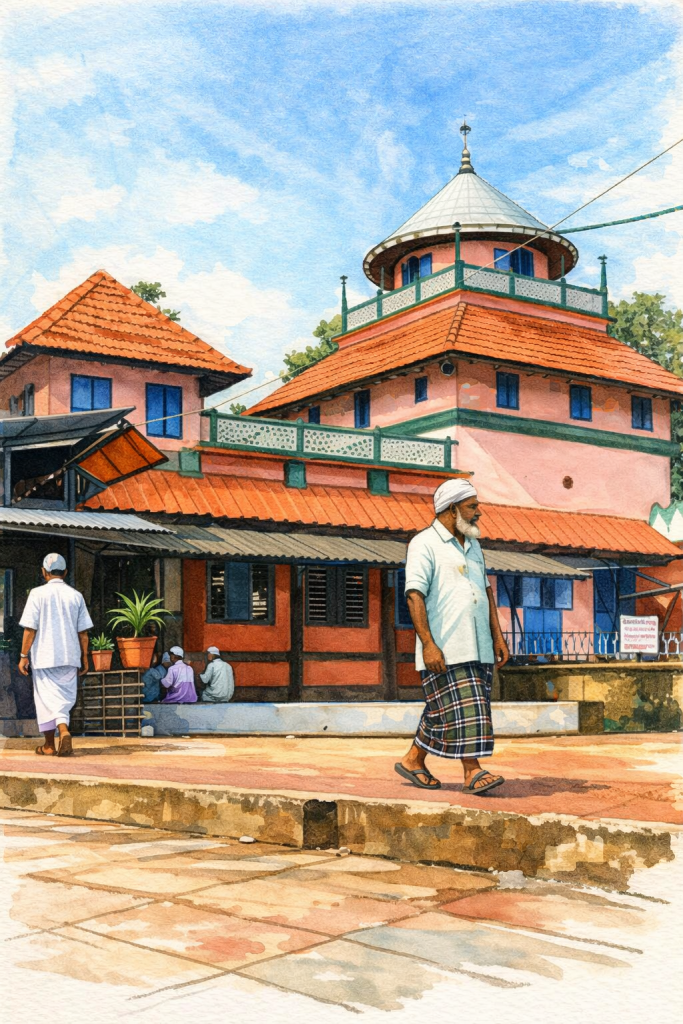
Arriving on the shores of Kerala from Yemen in the 19th century, Thangal entered a land that had already witnessed the presence of Islamic scholars, yet his approach set him apart. His message was not limited to faith alone it was rooted in education, equality, and compassion. At a time when education was a privilege reserved for a few, Thangal believed knowledge should be accessible to all, regardless of social standing. By opening the doors of learning to the marginalized, he reshaped lives and communities, drawing many toward Islam not through force, but through wisdom and inclusion. To serve the spiritual needs of the Sunni community, a modest thatched-roof structure was built, the early form of what is now known as the Mampuram Makham. After his death, Thangal was laid to rest here, and the site became a sacred kabr, drawing pilgrims who seek forgiveness, healing, and relief from life’s burdens. Over time, the mosque evolved architecturally, yet retained its soul of simplicity. Unlike grand, ornate mosques, Mampuram Palli stands graceful in its restraint with a pagoda-style dome, double-tiered hallways, and sloping roofs adorned with traditional Mangalore tiles. Its understated beauty mirrors the humility of the saint it honours.
For over a century, the mosque has also stood as a beacon of interfaith unity. Revered by his followers as Qutub Zaman, Thangal shared deep bonds with the Hindu community, which formed the majority in the region. When marginalized castes were denied entry into temples, they sought his help not as an outsider, but as a trusted guide. With the support of the Hindu nobleman Konthu Nair, Thangal helped establish the Kaliyattakavu Temple, dedicated to Ammancheri Amma. This act of spiritual inclusiveness was unheard of in Malabar at the time and elevated Thangal’s stature across communities. That bond endures even today. Before the annual Thalappoli Utsavam, temple priests are believed to seek blessings from Mampuram Palli, a gesture that beautifully reflects Kerala’s shared spiritual landscape.
The annual Mampuram Palli Aandu Nercha is among the largest religious gatherings in the Malabar region. During this time, pilgrims from all faiths arrive in great numbers, united by belief and hope. Devotees trust that the blessings of Thangal can bring healing, and the sacred oil distributed at the mosque is taken with deep faith, often applied to the sick as a symbol of prayer and care.
Whether one believes in miracles or not, what cannot be denied is the profound reverence Thangal commands even centuries later. He arrived in Kerala with no worldly ambition. only a mission to spread love, learning, and unity. Mampuram Palli today stands as a reflection of that mission. For pilgrims, a visit to Mampuram is not merely about ritual or belief. It is about standing in a space where compassion once walked, where faith bridged communities, and where prayer continues to rise above all divisions. To sit quietly among the devotees, listening to whispered prayers and shared hopes, is to experience the true essence of Mampuram, a sacred place where humanity itself is the highest form of worship.
 STORIES by HEARITAGE
Leave a comment