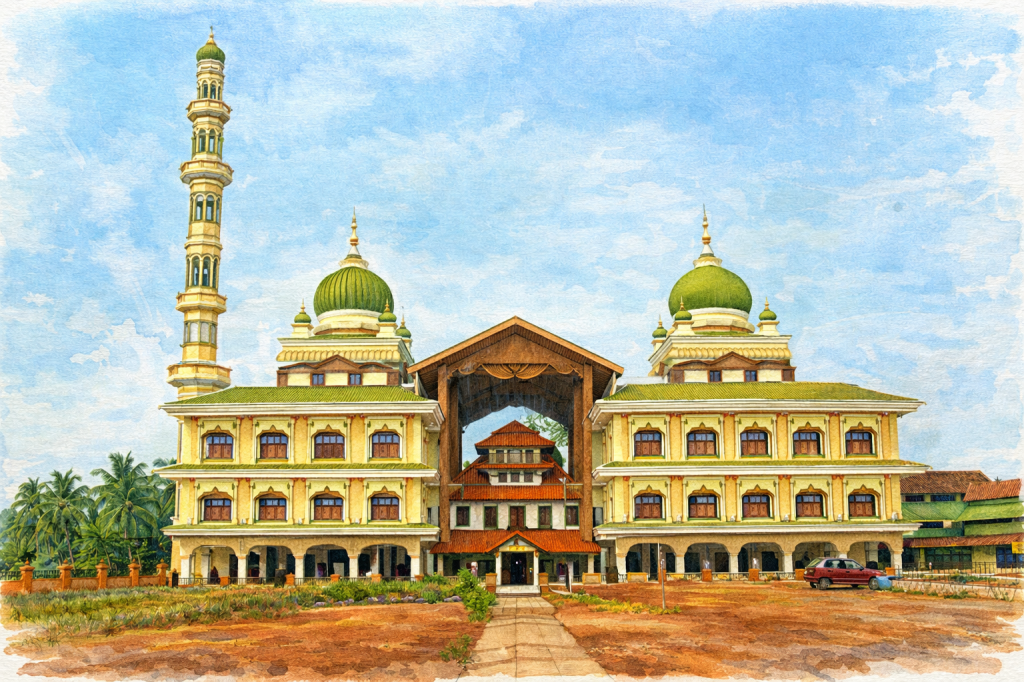
Kerala’s coastline has long been a meeting place of worlds, merchants guided by monsoon winds, travellers curious about distant lands, and seekers who arrived bearing ideas that would reshape societies. Among the most revered of these early visitors was Malik Ibn Dinar, believed to be the man who introduced the way of Islam to the Indian subcontinent. His legacy lives on quietly and powerfully at the Malik Deenar Mosque, a sacred destination for pilgrims and seekers alike. Tradition holds that Malik Ibn Dinar arrived on the Malabar Coast in 624 AD, accompanied by twelve associates. Their ship is said to have anchored at Kanjiracode, the ancient name of Kasaragod.
Though trade was part of their journey, it soon gave way to deeper bonds with the local people. The teachings of the Prophet, rooted in truth, discipline, and compassion, resonated strongly with the communities of northern Kerala, and Islam gradually found a home here through dialogue rather than force. So profound was Malik Ibn Dinar’s presence that news of his wisdom reached the royal court. He was summoned by Cheraman Perumal, the Chera ruler of the time. The conversations that followed are woven into Kerala’s most enduring legends. Fascinated by the principles of Islam and the moral clarity of the Quran, the Perumal is believed to have embraced the faith. His conversion led to the construction of what is considered India’s first mosque at Kodungallur, before he departed for Mecca in search of the Prophet never to return.
Years later, Malik Ibn Dinar returned to Kasaragod and established a modest mosque in 642 AD, known then as the Jama Masjid. That humble structure, built of mud, stone, and wood provided by local rulers, still survives within the present complex. Over centuries, especially during a major reconstruction in the 19th century, the mosque evolved architecturally while preserving its spiritual core. Today, the mosque bears the name of Malik Ibn Dinar, owing to the revered tomb within its precincts. The makhbara is among the most sacred in Kerala’s Islamic tradition, though history remains uncertain about who exactly rests there, some believe it is Malik Ibn Dinar himself, others his son Malik Ibn Mohammed, the first Qazi of the mosque, or one of the missionary companions. What remains unquestioned is the peace pilgrims feel upon prayer here. Nearby, the cemetery holds the graves of many Islamic saints who chose this blessed land as their final resting place.
Architecturally, the mosque reflects the simplicity of early Islam in Kerala. Wooden carvings adorn the structure, floral motifs grace the roof beams, and Arabic inscriptions embellish doors. The mimbar remains understated, echoing the humility of the man whose name the mosque bears. These elements mirror the design of the other mosques Malik Ibn Dinar is believed to have established across Kerala, each built with the willing support of local communities who trusted him as a man of truth. The spiritual life of the mosque reaches its height during the annual Uroos, held in the sacred month of Muharram. Spanning nearly a month, the festival commemorates the arrival of Malik Ibn Dinar and transforms the mosque into a vibrant centre of devotion and culture. Pilgrims from all faiths gather to witness the celebrations, which include religious discourses, cultural programs, charity through annadanam, and acts of service to the poor. The festival reflects the inclusive spirit that has defined the mosque since its inception.
More than a monument, the Malik Deenar Mosque is a living chronicle of Kerala’s openness to ideas, to faith, and to coexistence. Malik Ibn Dinar, remembered as a Tabi‘in, one who lived close to the time of the Prophet was accepted here not because of power or persuasion, but because of integrity and compassion. That same spirit continues to draw pilgrims today. To visit this mosque is not merely to pray, but to step into a chapter of history where faith arrived by sea, was welcomed by the land, and took root through peace. In the quiet courtyards of Malik Deenar Mosque, one understands why this sacred place still speaks softly, enduringly across centuries and beliefs.
 STORIES by HEARITAGE
Leave a comment