History is not preserved by monuments alone. It lives equally in ideas, rituals, and art forms that shape the soul of a people. In Kerala, few places embody this truth as profoundly as Kerala Kalamandalam, a sacred ground where endangered traditions were rescued from silence and given new life. To walk through Kalamandalam today is to step into a living chronicle of cultural resistance, artistic discipline, and national pride.
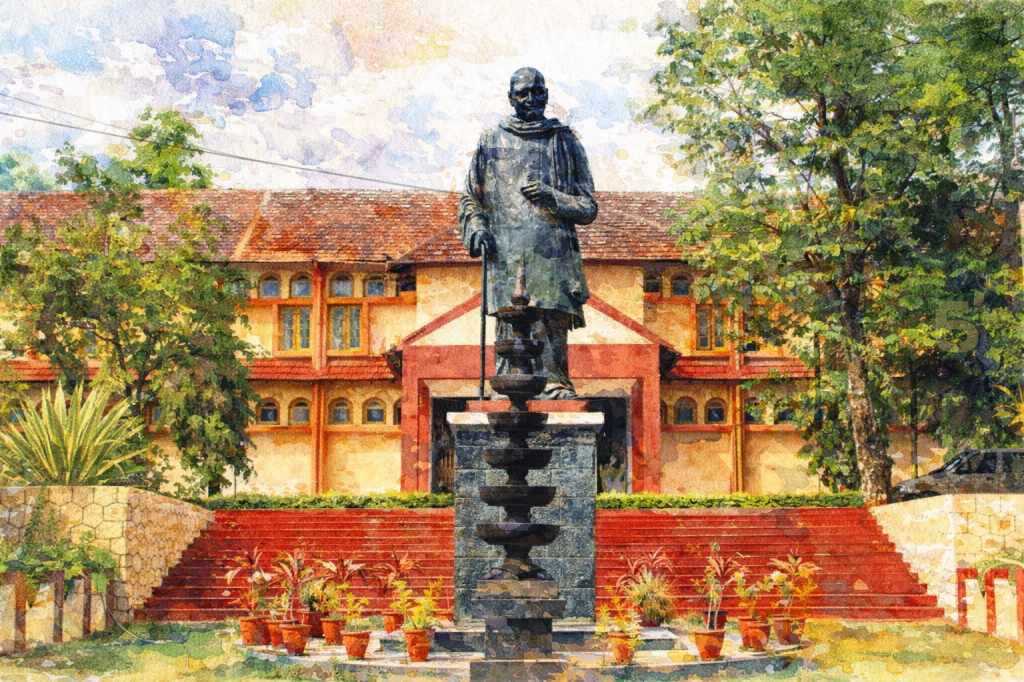
There was a time when the very survival of Kathakali seemed uncertain. Once deeply woven into Kerala’s social fabric performed in temple courtyards during festivals and in the homes of feudal patrons Kathakali slowly lost its space as political and social landscapes changed. When colonial powers replaced local rulers, temple activities came under strict control. By the early 20th century, as freedom movements began using temple gatherings to organise resistance, the British administration denied permission for performances altogether. What followed was cultural erosion: fewer patrons, fewer performers, and an art form pushed to the edge of extinction. This looming silence was foreseen by Vallathol Narayana Menon, one of the most revered literary figures of modern India.
Vallathol believed that Kathakali could survive only if it was liberated from exclusive temple spaces and made accessible to the public. For such a renaissance, royal patronage was essential. He found an ally in the Maharaja of Cochin, a great connoisseur of art, who wholeheartedly supported the vision. Along with his trusted associate Manakkulam Mukundaraja, Vallathol set out on a demanding mission raising funds, convincing patrons, and shaping an institution that could nurture talent systematically. After more than two years of effort, the dream took form in November 1930, when Kalamandalam began functioning at Kakkad Karanavars Mappad House in Kunnamkulam. The early years were devoted almost entirely to identifying and appointing the finest gurus of Kathakali.
As the institution grew, it briefly moved to Sreenivasam Bungalow near Mulankunnathukavu. Impressed by its progress, the Maharaja urged Vallathol to expand beyond Kathakali to other endangered art forms such as Ottam Thullal and Chakyar Koothu. To realise this broader vision, a permanent home was chosen along the serene banks of the Bharathapuzha. In 1936, Kalamandalam moved to Cheruthuruthy, where it stands today, its architecture inspired by traditional Kerala temple design. Among its most remarkable features is the Koothambalam, the first ever built outside a temple complex, adorned with 108 karanas sculpted onto granite pillars.
Kalamandalam follows the ancient Gurukul system of education. Students live with their gurus, learning through rigorous daily practice that begins before sunrise and often extends late into the evening. Discipline here is not optional, it is the foundation of mastery. Every student is expected to manage personal chores, reinforcing humility and self-reliance. Most importantly, Kalamandalam remains radically inclusive: caste, religion, nationality, and social status have no bearing on admission. Over the decades, the institution expanded to include classical dance forms such as Mohiniyattam, Bharatanatyam, and Kuchipudi. A dedicated percussion wing trains students in instruments like the mizhavu, chenda, and panchavadyam. The defining moment in a student’s journey is the Arangettam, where years of discipline culminate in a public performance before gurus, scholars, family, and connoisseurs.
One of Kalamandalam’s most revolutionary contributions was opening Koodiyattam to students beyond the traditional Chakyar and Nambiar communities. This single act transformed an exclusive ritual art into a global heritage, attracting learners from across the world. It was this spirit of openness that made it possible for artistes like Kalamandalam Hyderali and Kalamandalam John to rise who are symbols of Kalamandalam’s secular and humanistic ethos. Today, Kalamandalam offers more than twelve specialised courses in classical performing arts and is recognised as a Deemed-to-be University of Arts and Culture by the Government of India. Scholars from around the world arrive here for advanced research and doctoral studies. In the performing arts world, the prefix “Kalamandalam” before a name is itself a mark of excellence.
For visitors, it is important to remember that Kalamandalam is not a museum, it is a living school. Silence, respect, and discipline are integral to the space. Yet even as a visitor, the rhythms of practice, the stamping of feet, the resonance of drums, the measured chants follow you long after you leave. A walk through Kerala Kalamandalam makes one realise how a single vision altered the course of cultural history. Against the threat of extinction, this institution stood firm and ensured that some of the most elegant, complex, and spiritual art forms of India continue to breathe, evolve, and inspire the world.
 STORIES by HEARITAGE
Leave a comment