Most temples in Kerala are celebrated for their harmony with nature in stone sanctums nestled within groves, rituals unfolding to the rhythm of forests and hills. Yet few places evoke the same depth of stillness and spiritual gravity as Thirunelli Temple, an ancient shrine set high amid the mountains of northern Kerala. Perched in a secluded valley and embraced by the ranges of Udayagiri, Karimala, Brahmagiri, and Narinirangimala, Thirunelli is revered not only for its antiquity, but for the profound role it plays in Hindu spiritual life.
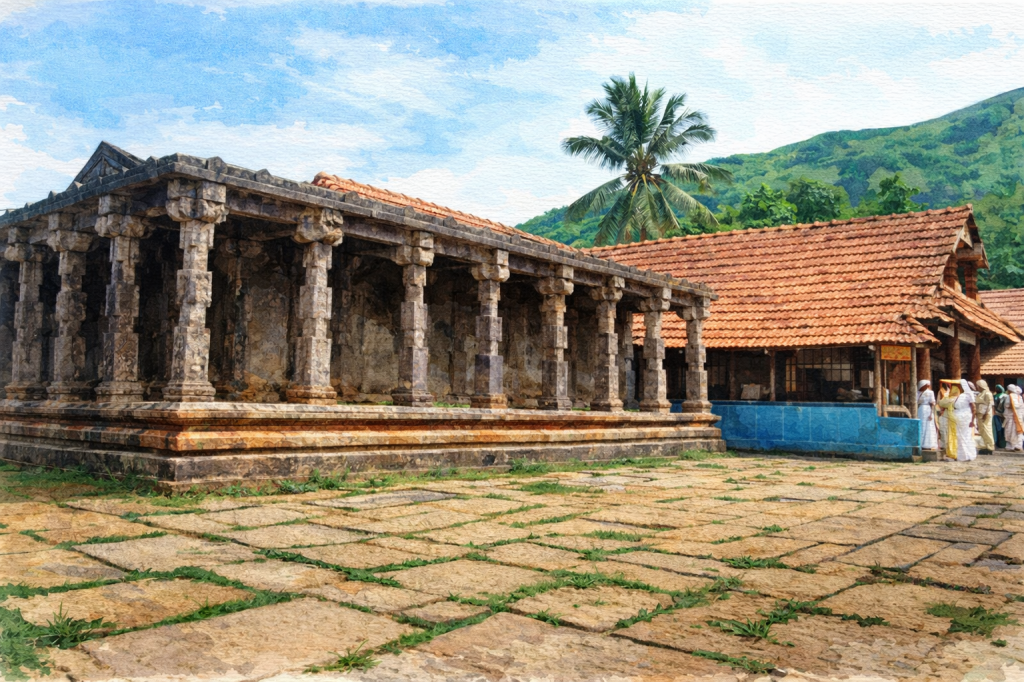
Bathed by the first rays of dawn, this shrine is known as Sahyamala Kshethram and is dedicated to Lord Vishnu. It is also revered as the Kashi of the South, for here, according to belief, the presence of the Holy Trinity of Brahma, Vishnu, and Shiva converges in a single sacred geography. Surrounded by dense forests and echoing only with birdsong and flowing water, Thirunelli invites pilgrims into a rare state of inner quiet, where the boundaries between nature and devotion dissolve. The name Thirunelli is derived from the Malayalam word nelli, meaning gooseberry. Tradition holds that this region was once a flourishing grove of gooseberry trees, lending the temple its alternate names of Amalaka Temple and Siddha Temple both mentioned in the Hindu Puranas. Though historical records remain sparse, legend offers a luminous account of the temple’s origin. It is said that Lord Brahma, during his wanderings, discovered the idol of Vishnu resting upon the branches of a gooseberry tree. Brahma himself is believed to have performed the vigraha pooja and consecrated Vishnu here in his Chaturbhuj (four-armed) form, along with the accompanying upadevatas.
The sanctity of Thirunelli extends beyond its deity to its waters. The stream that flows beside the temple originates in the Brahmagiri hills and is known as Papanasini, meaning “the destroyer of sins.” It is believed that Vishnu blessed these waters with the power to cleanse all sins of the living and the dead. Even today, pilgrims bathe here with faith, seeking spiritual release and inner renewal.
Local belief holds that Lord Brahma continues to be intrinsically linked to the temple’s daily rituals. Priests say that ritual items appear mysteriously used during the night, suggesting that Brahma himself performs worship before dawn. To the west of the temple lies the cave shrine of Lord Shiva, known as Gunnika. Mythology associates this cave with Shiva’s journey to Kottiyoor, where he destroyed Daksha following the death of Sati. Thus, within this secluded landscape, Vishnu presides, Brahma consecrates, and Shiva bears silent witness. Thirunelli holds exceptional importance in Hindu ancestral rites. Within the temple complex lies a sacred rock upon which Pitru Bali rituals for departed souls are performed. Legend narrates that this rock is part of a demon’s body slain by Vishnu. At the demon’s plea for forgiveness, Vishnu divided the body: the head fell at Gaya, the torso at the Godavari, and the feet rested at Thirunelli. This belief gained deeper sanctity when Lord Parasurama performed the last rites for his father Jamadagni here. Burdened by the sin of having slain many Kshatriyas, Parasurama is said to have bathed in the Papanasini to attain absolution.
The epic lineage continues with Lord Rama and Lakshmana, who are believed to have performed Pitru Bali for their father Dasharatha at this very spot, in the presence of Brahma himself. It is this unbroken chain of sacred acts that draws devotees from across India, who come to Thirunelli to perform ancestral rites within the temple pond near the holy rock.
Architecturally, Thirunelli follows the austere elegance of traditional Kerala temple design. The sanctum is enclosed by tiled-roof verandahs and open courtyards, while cube-shaped granite pillars with subtle carvings line the outer walls. Some structures appear intentionally incomplete such as the granite lamp post lacking a dwaja stambha while the cloistered walkway around the temple remains unfinished. Local tradition attributes this to a historic dispute between the Vellattiri king and the Coorg Raja, halting construction midway. Epigraphical evidence and literary references credit the temple’s construction to Chera King Kulasekhara, who ruled between the 8th and 9th centuries. His Sanskrit work Mukundamala, written after renouncing his throne, contains verses expressing deep devotion to Vishnu at Thirunelli.
One of the temple’s most intriguing features is its ancient stone aqueduct system, ensuring uninterrupted water supply for rituals. Supported by pillars and adorned with faint murals, this engineering marvel traces its origins to a legend involving the Chirackal Raja. When his queen visited the temple and discovered the scarcity of water, she urged the Raja to provide a permanent solution. Engineers initially used bamboo channels to divert forest water, later replacing them with stone conduits that remain functional even today. Thirunelli’s sanctity has echoed through centuries of literature, finding mention in classics such as Unniyachi Charithram and Kokila Sandesham. Near the Papanasini lies the sacred Panchatheertham, believed to be fed by five streams. Pilgrims often bathe here, irrespective of whether they perform ancestral rites, seeking peace for themselves and blessings for departed souls.
Through changing eras, shifting kingdoms, and fading empires, Thirunelli has remained constant as a silent guardian of faith, memory, and release. For pilgrims, it is not merely a destination, but a threshold between worlds, where the living seek peace and the departed are gently guided onward. In the hush of its forests and the purity of its waters, Thirunelli continues to offer what few places can: solace for the soul, across lifetimes.
 STORIES by HEARITAGE
Leave a comment