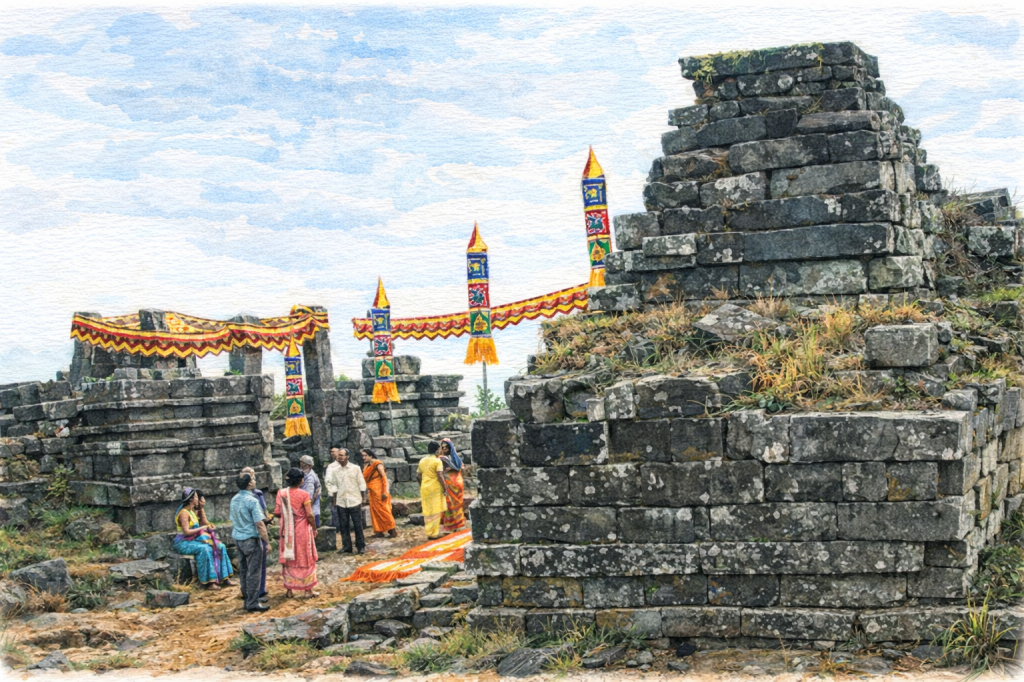
High in the forested hills of Idukki, within the deep greens of the Periyar Tiger Reserve, stands a temple unlike any other in South India. Built of massive stone blocks and guarded by wilderness, the Mangala Devi Temple also known as the Kannagi Temple is open only once a year, during the full moon of Chitrapournami. Reaching it requires official permission, physical endurance, and spiritual intent, making the journey as significant as the destination itself. This remote shrine holds deep meaning for devotees from both Kerala and Tamil Nadu. Protected today by the Archaeological Department of Kerala, the temple stands as a rare confluence of history, literature, devotion, and landscape. From its hilltop, pilgrims are rewarded with sweeping views of the Periyar forests untouched, silent, and timeless.
The soul of this temple lies in one of Tamil literature’s greatest epics, Silappathikaram, composed between the 1st and 4th centuries by the Jain monk-poet Ilango Adigal. The epic narrates the tragic and powerful story of Kannagi and her husband Kovalan, residents of the port town of Poompuhar. Kovalan, once prosperous, falls into ruin after abandoning his wife for the dancer Madhavi. When he returns, Kannagi forgives him without hesitation. Seeking a new beginning, the couple travel to Madurai, where Kannagi gives Kovalan her anklet to raise capital. Tragically, the anklet is mistaken for one stolen from the queen. Without trial, Nedunchezhiyan, the Pandya king, orders Kovalan’s execution. Kannagi’s response is one of the most powerful moments in Indian literature. She proves her husband’s innocence by breaking open the anklet revealing emeralds instead of the queen’s pearls. The king collapses in remorse, followed by the queen. Yet Kannagi’s righteous fury burns on, and legend says Madurai itself was reduced to ashes by her curse. When her anger subsides, she leaves the city, walking for fourteen days through forests and hills, until she reaches this very mountain. Here, she is believed to have reunited with Kovalan and ascended to heaven. Moved by this story of chastity, justice, and feminine power, the Chera ruler Senguttuvan is said to have consecrated a temple at the site of Kannagi’s final earthly journey. Thus, Kannagi came to be worshipped here as Mangala Devi, a benevolent yet powerful manifestation of the Goddess.
Architecturally, the temple reflects Pandyan stone construction, using massive rectangular blocks stacked without mortar, a remarkable feat considering the terrain. The complex consists of multiple shrines: the main sanctum for Mangala Devi, along with temples for Karuppuswamy, Lord Shiva, and Lord Ganesha. The Shiva shrine is the largest, and interestingly, rituals there are conducted by priests from Kerala, while priests from Tamil Nadu officiate at the Mangala Devi sanctum symbolising shared heritage beyond political boundaries. The original idol of Mangala Devi was crafted in silver. Fearing damage during centuries of neglect and ruin, the idol was moved to Kambam and is brought back only during the annual festival, a tradition still followed. Stone passages within the complex are now sealed, believed to have once connected the temple to Pandya territories. Four towering stone pillars, over ten feet tall, stand mysteriously within the compound possibly remnants of a mandapam, their purpose still unknown.
Inscriptions dating to the 11th century, attributed to Rajaraja Chola I, further affirm the temple’s antiquity, placing it at over 1,500 years old. Rituals here are simple and austere with no grand processions, no elephants, no elaborate ceremonies. Devotees offer porridge (kanji) to the Goddess, reflecting humility and equality. Kannagi is revered as an incarnation of Bhadrakali, worshipped elsewhere at Kodungallur and Attukal, but uniquely venerated here as Mangala Devi. The annual Chitrapournami festival transforms the silent ruins into a vibrant pilgrimage site. After months of inaccessibility, devotees arrive some by forest jeeps, others completing the final stretch on foot. Due to a long-standing ownership dispute between Kerala and Tamil Nadu, the festival is jointly conducted, turning the event into a symbol of shared devotion. On this day, the silver idol is adorned with flowers and ornaments. Women perform Pongala, and married women pray for the longevity and wellbeing of their husbands by offering worship to their thaali.
Visiting Mangala Devi Temple is not a casual journey. It requires preparation, permissions, respect for forest laws, and reverence for heritage. Yet those who make the effort discover more than a temple, they encounter a story carved in stone, a landscape untouched by time, and a powerful reminder of justice, dignity, and the sacred strength of womanhood. To stand among these ruins is to remember Kannagi not merely as a character from an epic, but as an eternal symbol of truth and moral courage. The Mangala Devi Temple is thus not only a place of worship, but a pilgrimage into conscience, history, and harmony with nature.
 STORIES by HEARITAGE
Leave a comment