In the bustling heart of Kozhikode, at Nadakkavu, stands a church that quietly preserves a chapter of colonial history and Anglican tradition with remarkable dignity. Popularly known as the English Church, St. Mary’s Church, Nadakkavu is not merely a place of worship it is a living monument where architecture, faith, and an unusual story of compromise come together. What makes this church unique is not just its graceful Gothic presence, but the thoughtful logic behind its location. The site of the church lies equidistant from the old Military Barracks and the Civil Station of Kozhikode, an intentional choice born out of disagreement. When plans for a central Anglican church were first drawn during the British period, both the military authorities and civil officials wanted the church close to their own establishments. The disagreement grew so intense that the original plan was abandoned, and smaller churches were proposed instead.
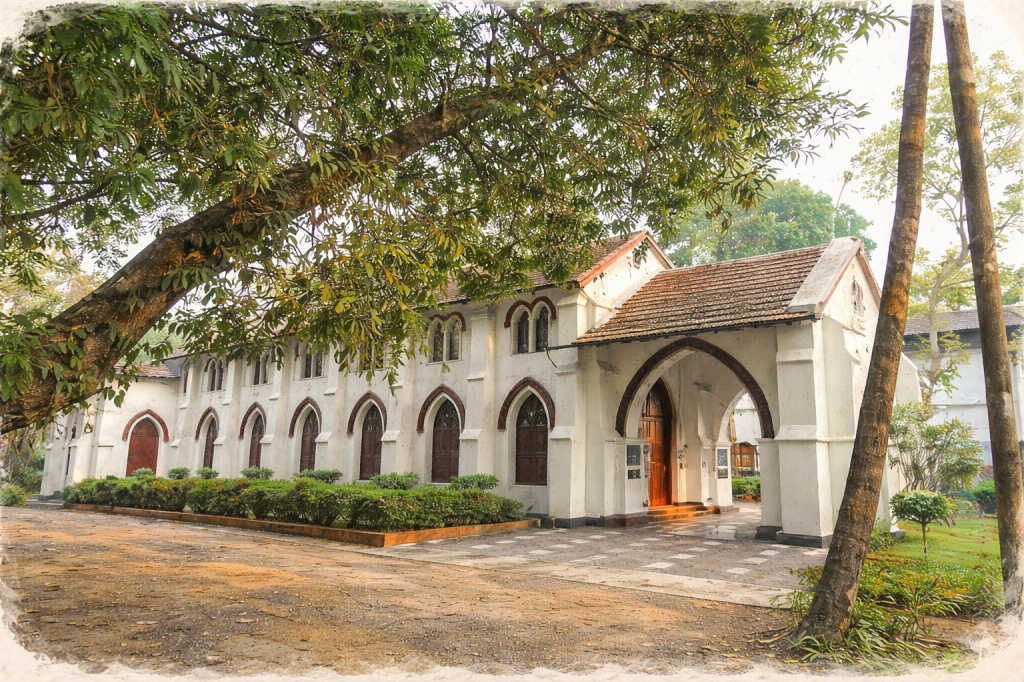
Years later, the original design resurfaced in the hands of Reverend Mickee, who offered an elegant solution placing the church exactly midway between the two rival centres. Nadakkavu became the ideal answer. Construction began in 1860 and was completed in just a year, made possible through the combined efforts of the British Government, the church committee, and the local community. Thus, a space meant to divide quietly became one that united. The architectural design of the church was prepared by Colonel Faber, a celebrated engineer of the British administration. His vision gave Kozhikode one of its finest Gothic structures. From the outside, the church immediately draws attention with its pointed arches, tall windows, and elegant belfry that crowns the structure. The symmetry and proportions are restrained yet striking but unusual for North Malabar, where Gothic churches are relatively rare.
Stepping inside reveals an atmosphere of calm and order. Gothic pillars line the interior, mirroring the exterior arches and creating a strong linear perspective that naturally leads the eye toward the altar. The baptismal font is a remarkable piece of craftsmanship, carved from a single solid block of mahogany, an extraordinary detail rarely seen today. The wooden tie-beam roof truss, also crafted entirely from timber, adds warmth to the otherwise formal Gothic space. The altar is one of the most visually engaging elements of the church. Designed in classic English style, it features an altar-piece inspired by Madonna del Granduca, the famous work by the Renaissance master Raphael. This subtle artistic reference connects the church in Kozhikode to a broader Christian and European artistic tradition, adding another layer of cultural depth. Dedicated to the Blessed Virgin Mary, the church today has a close-knit parish of around 300 families. What truly sets St. Mary’s apart, however, is its steadfast adherence to Anglican traditions. Candles are always lit during prayer and Eucharistic services, maintaining a ritual continuity that dates back to the church’s founding. Even more distinctive is the continued use of English during Eucharistic services, a practice that has endured since the 19th century and firmly preserved the church’s identity as the “English Church” of Kozhikode.
For visitors, attending a service here is not only a spiritual experience but also a cultural one. The measured rhythm of Anglican worship, the glow of candlelight against pale walls, and the quiet dignity of the Gothic space offer a striking contrast to the vibrant energy of the city outside. St. Mary’s Church, Nadakkavu, is thus more than a historic structure it is a reminder of how thoughtful design can resolve conflict, how tradition can be preserved without rigidity, and how a city like Kozhikode quietly holds layers of history within its everyday life. For tourists, a visit here is a gentle pause & a moment to step back in time and experience a living heritage that continues to breathe through prayer, architecture, and memory.
 STORIES by HEARITAGE
Leave a comment