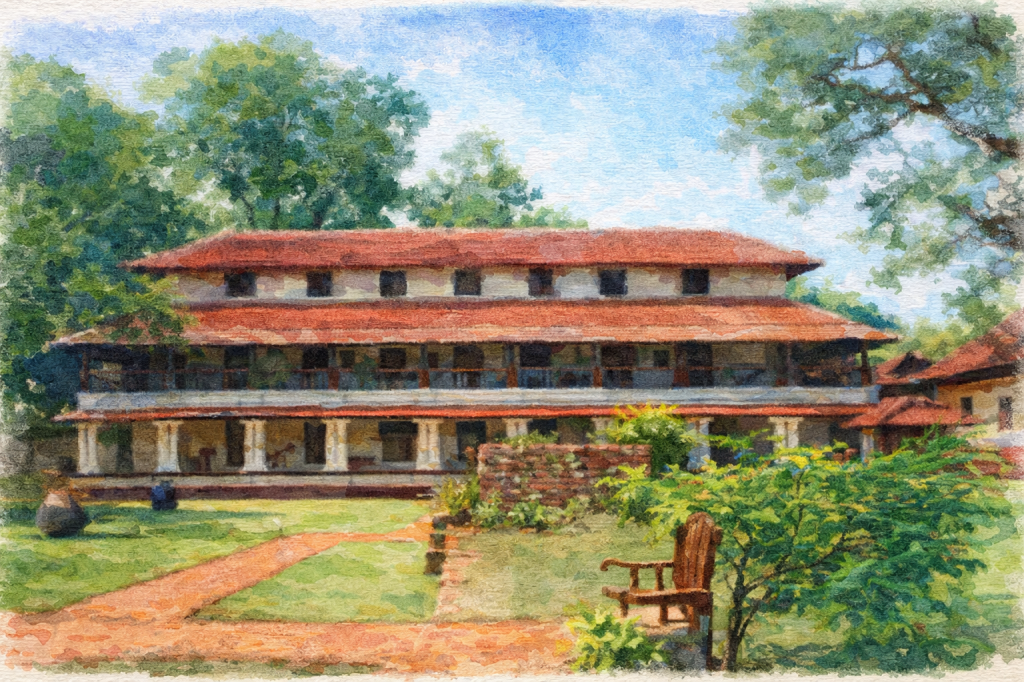
In Kerala, the word Ayurveda is more than a system of medicine, it is a philosophy deeply entangled with life, nature, and discipline. While the roots of Ayurveda stretch back thousands of years, its flourishing in Kerala owes much to a few great lineages who preserved, practised, and refined this ancient science. Among them, none is as revered as Poomully Mana, a historic Namboothiri household that stands as a living testament to Kerala’s intellectual and healing traditions. The term Mana refers to the ancestral homes of Kerala Brahmins, the Nambothiris, who were traditionally custodians of ritual, scholarship, and science. The Poomully Mana that visitors see today has witnessed over five centuries of cultural and medicinal history. It was never merely a residence; it was a centre of learning where Ayurveda, Vedic studies, martial arts, music, literature, and philosophy coexisted in harmony.
The story of Poomully Mana is also steeped in divine legend. The family originally hailed from Peruvanam, under the patronage of the Kochi Raja. Tradition narrates that an elder Namboothiri of the family was a devoted worshipper of Kamakshi Amman at Kanchipuram. Pleased by his devotion, the Goddess is believed to have accompanied him back to Kerala, unseen, resting atop his palm-leaf umbrella. When the Namboothiri reached his Mana and placed the umbrella down, it would not move again. Through prayer and divine revelation, the Goddess instructed him to build a temple on that land and relinquish his worldly possessions. Obeying her command, he consecrated the deity said to have been discovered in a nearby well and left the place entirely, entrusting the temple to the Kochi Raja. The family then settled in the present region of Palakkad, where Poomully Mana would rise to prominence. For this act of renunciation, the Goddess is believed to have blessed the lineage with enduring prosperity, knowledge, and influence. Over time, the Poomully family became one of the most respected landlord families of Malabar. Their authority was recognised not only by the Kochi Raja, but also by the Zamorins of Calicut in the north and the rulers of Travancore in the south.
The lineage of the Poomully family includes remarkable scholars and artists. One such figure was Poomully Raman Namboothiripad, a gifted disciple of the legendary Carnatic maestro Chembai Vaidyanatha Bhagavatar. Yet, towering above all others in the family’s history is Poomully Neelakandan Namboothiripad, fondly remembered as Aaramthamburan. He is regarded as one of the greatest Ayurvedic physicians Kerala has ever known. During the era of Aaramthamburan, Poomully Mana reached its intellectual and spiritual zenith. His mastery of Ayurveda extended beyond human medicine to Hastayurveda, the treatment of elephants, and to toxicology, where he cured poison-related ailments. His knowledge of Kalaripayattu complemented his medical expertise, while his command over the Natya Shastra made him an authority in temple arts (kshetra kala). He was also a scholar of yoga, literature, and aesthetics earning him the revered title Arivinte Thampuran (Lord of Knowledge). His disciples and descendants have carried forward this legacy with humility and discipline.
Architecturally, Poomully Mana is a classic example of traditional Kerala design. The structure features expansive terracotta-tiled roofs, multiple tiers, long linear verandahs, and double-pillared halls that allow air and light to flow freely. Within the compound stand a padippura (gateway), a kalari (martial arts training space), and a koothambalam (theatre hall). The spacious courtyards are filled with medicinal plants and trees, reflecting the Mana’s inseparable bond with nature and healing. What makes Poomully Mana truly special is that its upkeep and spirit are sustained not in isolation, but with the involvement of the local community preserving it as a shared cultural space rather than a private relic.
Today, Poomully Mana welcomes visitors seeking authentic Ayurvedic consultation, therapy, and residential treatment. For others, it offers a rare opportunity to understand the philosophical foundations of Ayurveda as practised in Kerala. Treatments here follow the unique Poomully tradition, rooted in the teachings of Aaramthamburan emphasising discipline, personalised care, and adherence to classical principles. The Mana also supports the training of young artists, particularly in mural painting, ensuring that visual traditions thrive alongside medicinal ones. A visit to Poomully Mana is not merely a journey into the past. It is an encounter with a living heritage where healing, art, devotion, and knowledge continue to flow seamlessly, just as they have for centuries. For travellers, scholars, and seekers alike, this sacred household stands as a reminder that true wellness arises when body, mind, and culture are nurtured together.
 STORIES by HEARITAGE
Leave a comment