In a world often divided by boundaries of belief and identity, there exists a serene space in northern Kerala where spirituality rises above religion and humanity takes precedence over doctrine. Nestled amid greenery in Kanhangad, Anandashram welcomes every visitor not as a follower of a faith, but simply as a fellow human being seeking peace. For nearly a century, this gentle vision has guided the life of the ashram, making it one of Kerala’s most spiritually inclusive destinations. Anandashram was founded by Swami Ramdas, lovingly known as Papa by his followers. A saint, pilgrim, and mystic, Swami Ramdas dedicated his entire life to the love of Lord Rama, expressing his devotion through the simple yet powerful chant “Om Sri Ram Jai Ram Jai Jai Ram”. This mantra, which one encounters even at the entrance of the ashram, forms the heartbeat of Anandashram’s spiritual rhythm.

Swami Ramdas’s journey into renunciation began after a deep retreat at Arunachala, from where he emerged with the realisation, “All is Ram, nothing but Ram.” Living as a wandering pilgrim thereafter, he eventually felt called to establish an ashram in his birthplace. Thus, he arrived in Kanhangad and, along with his brother, founded a modest spiritual centre on Pilikunji Hill in 1928. This first Anandashram was a humble house with small rooms and an open verandah overlooking the Payaswini River, filled with birdsong and the gentle echo of hymns. In its early days, the ashram was devoted to sadhana or inner discipline and spiritual practice. Just four days after its inauguration, a young widow named Krishnabai arrived and became Swamiji’s disciple. Later revered as Mataji, her presence challenged the rigid social norms of the time and sparked controversy. Despite warnings and resistance, Swami Ramdas stood firm in his belief in universal acceptance. In 1930, when Mataji was physically attacked by intruders, Swamiji chose not confrontation but compassion leaving the original ashram and relocating with his followers to nearby Manjapai Hill.
In 1931, the present Anandashram was established simple in form, yet profound in spirit. Over time, additional structures were built, some with the help of devotees, others through government-supported welfare initiatives. Yet the ashram never lost its essence of simplicity and service. Architecturally understated, Anandashram opens itself through wide verandahs that invite rather than impress. The Bhajan Hall is its spiritual heart, where life-size images of Swamiji and Mataji are placed as they once sat during devotional singing. The walls are adorned not only with Hindu saints but also with images of Jesus Christ, Guru Nanak, Zoroastrian figures, and other spiritual leaders quietly affirming the ashram’s secular and universal ethos.
There is no ritual compulsion here. Chanting of the Ram mantra flows continuously, but visitors are never forced to participate. Instead, life at Anandashram follows a simple discipline famously described by Swami Ramdas himself: when the bell rings four times a day, everyone regardless of status or belief comes together for meals. For the rest of the time, one is free to study, meditate, reflect, or simply rest. In keeping with the ashram’s belief in caring for both body and soul, free food is served to all for breakfast, lunch, evening tea, and dinner. What is especially touching is that the once-barren land of Anandashram was transformed entirely by the efforts of its residents. Every tree and garden path was nurtured by hand. As visitors walk through the grounds, they encounter Panchavati, a quiet corner marked by five trees planted by Swami Ramdas himself, where satsangs were once held under open skies. Behind the Bhajan Hall lie the samadhi mandirs of Swami Ramdas, Mataji, and Swami Sachidananda, who guided the ashram after Mataji until his passing in 2008. Swami Ramdas attained samadhi in 1963, after which Mataji selflessly carried forward his vision, ensuring that Anandashram remained a sanctuary of love and equality.
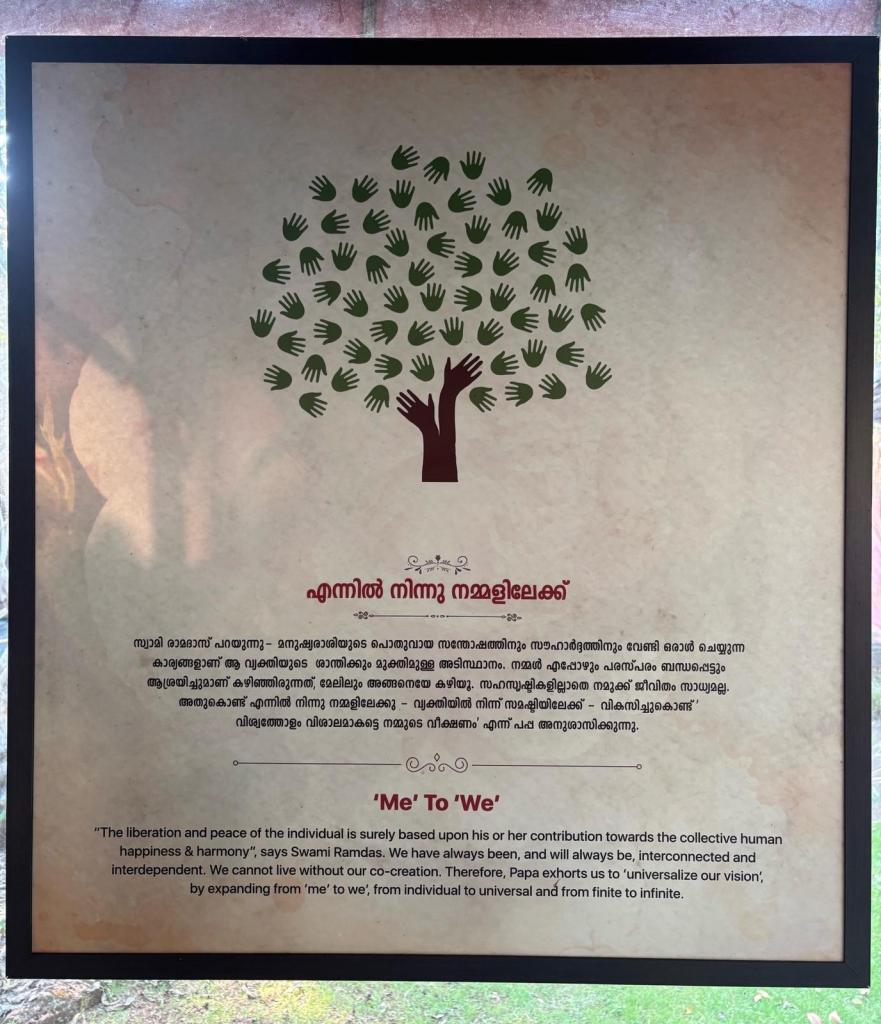
For visitors, a visit to Anandashram is not about sightseeing in the conventional sense. It is about slowing down, observing silence, sharing a meal, and reflecting on the simple truth that spirituality need not be complex or exclusive. The thought of “Me to We” bringing every person together for collective humanity & love is the primary ideal of the place and every visitor certainly can understand this idea here. Anandashram teaches that faith begins with self-belief, compassion, and service to others. In the calm of its gardens and the gentle rhythm of daily life, Anandashram offers something rare, a lived experience of universal love. To walk through its paths is to be reminded that peace is not found in grand declarations, but in quiet acceptance of all that life brings.
 STORIES by HEARITAGE
Leave a comment