On the gentle hillock in the heart of Thiruvananthapuram stands Kowdiar Palace, a majestic reminder of a royal house that once shaped the destiny of Kerala. Though its gates remain closed to the public, the palace continues to inspire awe in its very presence narrating a story of enlightened rule, refined taste, and architectural brilliance. For travelers and heritage lovers, Kowdiar Palace is not merely a structure to be seen, but a legacy to be understood. The Travancore rulers were far more than sovereigns guarding territorial power. They were reformers, patrons of art, and architects of social change. Among them, Chithira Thirunal Balarama Varma stands tall as one of India’s most progressive monarchs. Revered for his visionary governance, he ushered in sweeping reforms that transformed society most notably the historic Temple Entry Proclamation, which opened Hindu temples to all castes and dismantled centuries of exclusion. It is said that Mahatma Gandhi himself acknowledged the Maharaja’s moral courage, remarking that Chithira Thirunal embodied true greatness in action.
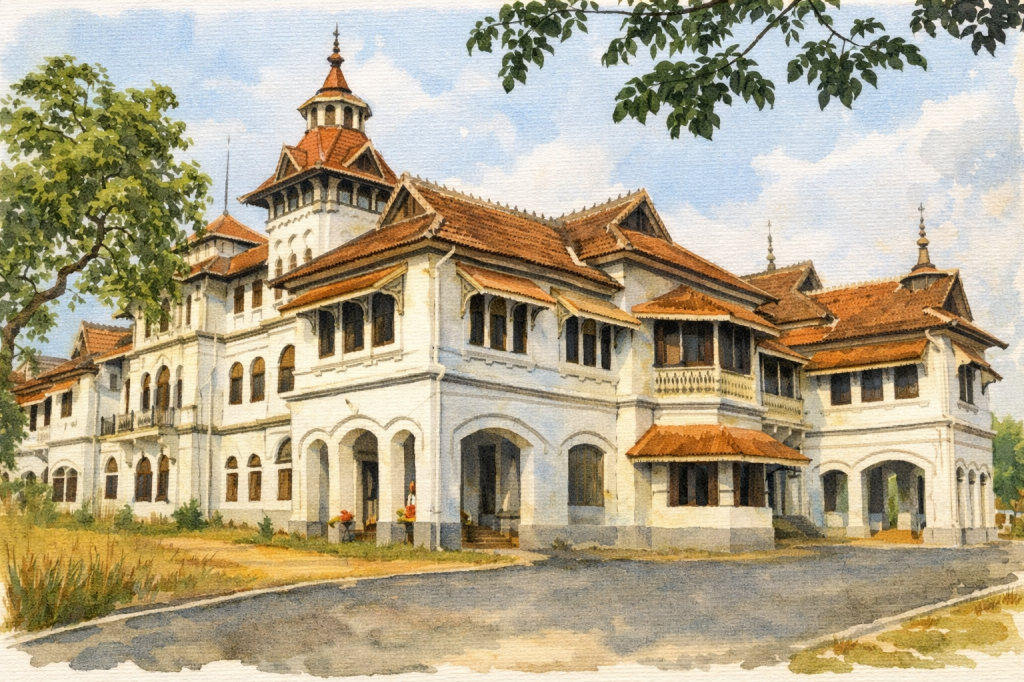
In 1934, the Maharaja commissioned Kowdiar Palace as a wedding gift for his sister, Karthika Thirunal Lakshmi Bayi, upon her marriage to Colonel G. V. Raja. Conceived during the twilight years of princely rule in India, the palace holds the distinction of being among the last royal palaces built in the country. It was envisioned not only as a residence but as a flawless structure aligned with the principles of Vastu Shastra as an important consideration, especially after the royal family chose to move away from earlier residences deemed inauspicious. Sprawling across nearly a hundred acres, the palace crowns a carefully chosen elevation that allows sea breezes and monsoon winds to flow freely through its corridors.
The site selection itself reflects the Maharaja’s deep sensitivity to nature and climate. Constructed using locally sourced materials from the Western Ghats and shaped by the hands of master craftsmen, the palace embodies a harmonious blend of Kerala vernacular architecture with subtle European and East Asian influences. The three-tiered structure houses nearly 150 rooms ranging from intimate private chambers to expansive halls designed for royal gatherings. Long corridors lined with intricately carved pillars encourage natural ventilation, while arched windows set with stained glass filter sunlight into gentle hues. Wooden staircases, ingeniously cantilevered without visible supports, connect the upper floors, showcasing remarkable engineering skill. Inside, floors transition gracefully from mosaic patterns to Italian marble and traditional tiles, reflecting the palace’s layered aesthetic sensibility. The interiors once echoed with courtly discussions and celebrations. The grand dining hall could seat nearly five hundred people, while the vast kitchens were designed to serve an extended royal household. The southern wing, still inhabited by the family, opens into an impressive foyer adorned with portraits of Travancore royalty and rare European furniture, gifts that speak of global connections and diplomatic exchanges.
Among the palace’s most fascinating treasures is what is believed to be India’s oldest functioning elevator, crafted entirely from teakwood. Complete with a wooden bench, it stands as a symbol of early technological adaptation blended seamlessly into tradition. Equally evocative is a ceremonial white casket crowned with a golden ship presented by the people of Travancore to commemorate the royal family’s sea voyage to England, an act once believed to defy sacred prohibitions. Encircling the palace are landscaped gardens designed by a German engineer, once likened to the famed Brindavan Gardens of Mysore. Square corner towers topped with pagoda-style roofs punctuate the skyline, each crowned with copper lightning conductors, a practical necessity in an era when the palace stood as the tallest structure in the region. Terracotta-tiled roofs complete the composition, grounding the palace firmly in Kerala’s architectural tradition.
Following India’s independence and the constitutional changes of 1971, royal privileges were formally dissolved. Ownership of Kowdiar Palace passed to the descendants of the Travancore family, and it remains their private residence today. The Maharaja himself ruled from these halls until his passing, and his final resting place lies within the palace grounds at a serene spot known as Panchavati. Though access to Kowdiar Palace is restricted, its silhouette against the city skyline continues to tell a powerful story. For visitors, even a distant view is enough to evoke the values of an era when governance was guided by compassion, culture flourished under royal patronage, and architecture became a silent chronicle of history. Kowdiar Palace stands not merely as a royal residence, but as a living testament to the enlightened legacy of Travancore, a legacy that continues to shape Kerala’s identity.
 STORIES by HEARITAGE
Leave a comment