Tucked away in the gentle landscape of Kasaragod lies the small town of Kumbla, a place where time feels layered with devotion. Here stands the ancient Kanipura Sree Gopalakrishna Temple, a shrine whose sanctity, according to belief, stretches across three yugas of Treta, Dwapara, and Kali. For pilgrims, the journey to Kanipura is not merely a visit to a temple; it is a passage into legend, history, and living faith.
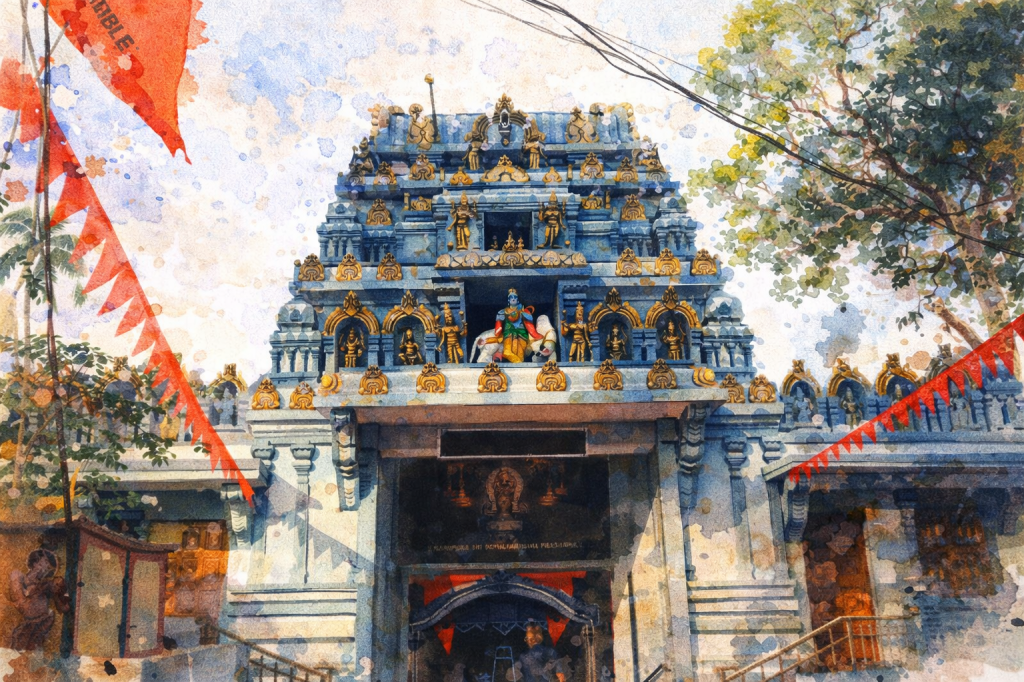
The heart of the temple is its extraordinary idol of Lord Krishna, revered as one of the oldest forms of Gopalakrishna. Tradition holds that this is the very form worshipped by Yashoda, Krishna’s foster mother, in Gokul. When Krishna left for Mathura during the Treta Yuga, Yashoda’s grief was said to be so intense that the Lord appeared before her as the mischievous child she adored holding butter balls, smiling with divine tenderness. That vision transformed into a black granite stone, the Krishnashila, through which Yashoda realized the eternal presence of the divine even in separation. This sacred idol is believed to have found its way to Kumbla during the Dwapara Yuga through the sage Kanva Maharshi. After consecrating the idol, Kanva Maharshi is said to have performed abhishekam by pouring water from his kamandalu. The water miraculously flowed north of the temple, forming a river known as Kumbini or Kumbha Hole “the water from the kamandalu.” Over time, this sacred stream lent its name to the town itself: Kumbla.
History blends seamlessly with myth at Kanipura. By the 10th century, during the rule of the Kadamba kings, the temple gained royal patronage, with King Jayasimha building or expanding the structure and ruling under the name Kanipura Sri Gopalakrishna. Kumbla became the capital of the region before passing into the hands of the Mypadi rulers. The temple’s architecture reflects this layered past with stone pillars, a spacious central courtyard, a granite-floored gopuram used for recitals, and a rare solid wooden pillar within the complex, unlike anything seen in neighboring temples. One of the most compelling aspects of the temple is its unbroken continuity. Because the idol is a Rishi Prathishte, scriptures forbid moving it from its original sanctum. Palm-leaf manuscripts preserved here, dating back over 1,800 years, detail pooja rituals and suggest that a shrine existed even before the 10th-century structure. A copper inscription on the dwajasthambam known as a Thamra Sashana records royal land grants to the temple as early as the 4th century, underscoring its antiquity and importance.
Kanipura was not only a spiritual center but also a seat of power. The coronations of Kumbla kings took place here, with the deity regarded as the supreme sovereign. Important decisions of the kingdom were made under the Lord’s blessings, a tradition echoed centuries later when Marthanda Varma assumed the title of Padmanabha Dasa. The temple’s influence also reached the cultural sphere, inspiring Parthi Subba, the celebrated architect of Yakshagana, who praised Sri Gopalakrishna of Kanipura in his compositions.
For pilgrims, the annual festival is a time of profound emotion and celebration. The Utsava Murthy, seated beneath the sacred Aswatha tree, is taken out in a grand procession that culminates in the Arattu, a ceremonial dip in the holy river. One of the most awe-inspiring rituals is performed by the priest, who carries the murti balanced on his head, walking in a measured rhythm without holding it a moment that leaves devotees spellbound. Expectant mothers offer prayers here, seeking blessings for healthy and wise children, while cows wander freely through the temple grounds, a gentle reminder of Krishna’s eternal bond with them.
Despite centuries of renovations, invasions, and upheavals, the essence of Kanipura remains untouched. Devotees often liken its spiritual aura to that of Guruvayur Temple, drawing pilgrims from far and wide. Yet, Kanipura has a character uniquely its own intimate, ancient, and deeply human in its portrayal of the divine. Ultimately, what lingers with every pilgrim is the child-like smile of Gopalakrishna within the stone sanctum, a smile that has endured yugas, soothed Yashoda’s sorrow, guided kings, and continues to offer solace to all who stand before it. To visit Kanipura is to realize that divinity here is not distant or imposing, but tender, playful, and timeless waiting quietly in Kumbla for those who seek it.
 STORIES by HEARITAGE
Leave a comment