Along the tranquil backwaters of Alappuzha, where water mirrors sky and palm fronds sway to ancient rhythms, rises the majestic St George Forane Church, Edathua. For pilgrims, Edathua is not merely a destination it is an experience of faith, healing, and quiet surrender. While historians may debate the finer points of its origin, there is no dispute about the church’s grandeur or the deep sense of solace devotees feel in the presence of St George. The very name Edathua carries echoes of a life shaped by water. In earlier times, trade and travel in Kuttanad flowed along canals and rivers, with merchants and soldiers moving in boats from one land stretch to another. This spot, welcoming and sheltered, became a resting point, a place of pause known as Edathavalam, meaning a wayside shelter. Over time, the name softened into Edathua, and the village grew around this spirit of refuge and hospitality.
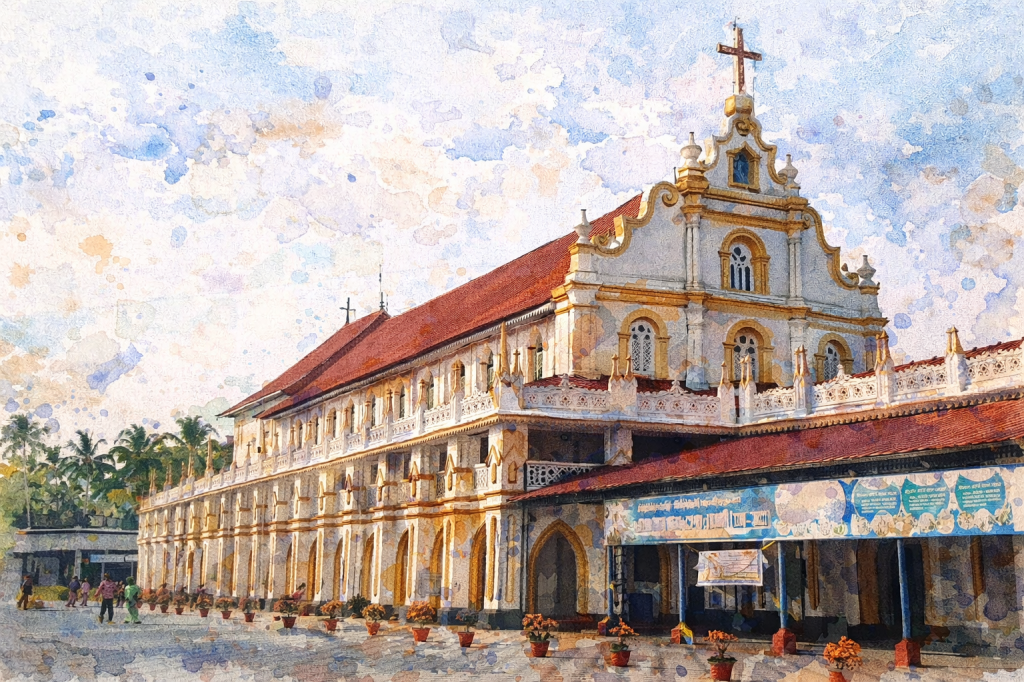
Christian faith, however, had reached these lands centuries before the present church was built. The people of Edathua were early believers who worshipped at nearby ancient churches such as Niranam Church, believed to have been established by St Thomas, and later at Champakulam Church, built in the 5th century. Under the Champakassery kings, the faithful of Kuttanad were permitted to worship freely, but as the Christian population grew, the longing for a church within the village became irresistible. The first church at Edathua was built in 1810 and was dedicated to Archangel Michael. It was rebuilt in 1824 as a cemetery church, and finally, in 1839, the present magnificent structure rose commanding in scale, yet graceful in its setting by the water. Though the building itself belongs to the 19th century, the faith it shelters is far older, rooted deeply in the spiritual history of Kerala.
The soul of Edathua, however, lies in its association with St George, whose revered icon transformed the church into one of the most important pilgrimage centers in South India. Two traditions narrate how the icon arrived here. One speaks of Edathua parishioners being irresistibly drawn to the radiant image of St George at Edappally and bringing it to their village in majestic snake boats. The more widely accepted story tells of the icon lying neglected at Edappally, until the people of Edathua recognized its sanctity and requested it. When the statue left Edappally, legend says the skies opened with torrential rain and fire broke out, convincing the parishioners there that a divine presence had departed. The icon was welcomed at Edathua with celebration, and the church was consecrated as St George Forane Church, a moment still remembered and reenacted in local tradition.
Architecturally, the church feels almost European in spirit. Designed by British engineers, it reflects medieval Gothic sensibilities, built to accommodate vast congregations. A narrow entrance leads pilgrims into a long, expansive nave that draws the eye toward the altar. Inside, the walls are adorned with age-old paintings and sacred art, while the altar itself stands as one of the most striking in South India, a three-tiered structure glowing in gold. Stucco angels and sacred imagery crown the sanctuary, and the revered statue of St George stands to the southern side of the altar, quietly commanding devotion. Outside, the steps descending toward the backwaters invite pilgrims arriving by boat, blending faith seamlessly with the landscape of Kuttanad.
Edathua’s fame as a healing shrine has spread far beyond Kerala. Devotees believe St George grants relief from mental afflictions and infectious diseases was a belief rooted in the saint’s own martyrdom, where unwavering faith enabled him to endure intense physical and mental suffering. During the annual festival, the banks of the backwaters come alive as thousands gather for the grand procession. Pilgrims carry the statue of St George, some walking on their knees in acts of penance, others bearing bricks on their heads as offerings. The diversity of offerings like candles, gold, pulses, vegetables, fish, and even replicas of human body parts also reflects deeply personal prayers for healing and wholeness.
Though the church has stood on the shores of Kuttanad for only about two centuries, its spiritual imprint on Kerala is timeless. Edathua is a place where waters carry prayers, where suffering finds hope, and where faith transcends boundaries of creed and community. Any pilgrim or traveler who journeys to Alappuzha would do well to pause at the doors of Edathua Church to stand before St George, listen to the silence of devotion, and embrace the enduring divinity that flows here as steadily as the backwaters themselves.
 STORIES by HEARITAGE
Leave a comment