Kerala has long been a welcoming shore for faiths that arrived from distant lands, carried by traders, monks, and missionaries who spoke of God in many tongues. Among these early spiritual journeys, Christianity is believed to have reached the Malabar coast as early as the 1st century. Centuries later, in the 6th century, one such journey quietly altered the destiny of a small village near Kothamangalam at Kadamattom leaving behind a legacy where devotion and legend continue to walk side by side. At the heart of this legacy stands the St George Orthodox Church, Kadamattom, a church whose story is inseparable from two extraordinary figures: the missionary Mar Abo and the legendary priest-mystic Kadamattathu Kathanar.
Fr Mar Abo is believed to have arrived in Kerala from Nineveh in present-day Iraq at a time when rigid caste divisions shaped everyday life. Moving from settlement to settlement, often unwelcome and weary, he finally reached Kadamattom hungry, exhausted, and seeking shelter. The only home that opened its door to him was that of a poor widow and her young son. Though they themselves had been without food for days, the widow offered what little comfort she could. It was here that the first miracle unfolded. Mar Abo asked the widow to boil water, placed a single grain of rice into the pot, and prayed. The water turned into a vessel full of cooked rice, enough to feed them all. Recognizing divine grace, the widow and her son embraced Christianity. The boy, later named Poulose, became Mar Abo’s devoted disciple. Through the widow, Mar Abo learned of the local ruler Ayakunnathu Karthavu, whose daughter suffered from severe mental illness. No healer could cure her. Mar Abo prayed, placed his hand upon her head, and she was healed. The miracle transformed the village. The ruler and his people accepted Christianity, and land was granted for a church dedicated to the Virgin Mary. The earliest structure was humble structure with a thatched roof and a simple cross but it became a sanctuary of hope.
Poulose grew under Mar Abo’s guidance and served the church faithfully. Legend tells that during one of his days in the fields, he was abducted by cave-dwelling tribes believed to practice cannibalism. Through prayer, his life was spared, and he was taken under the protection of their chieftain, a powerful mystic said to command supernatural knowledge. From him, Poulose learned occult wisdom and ancient mantras. When Poulose longed to return to Kadamattom, the chieftain allowed him to escape under cover of enchanted sleep. Upon reaching the church, its locked doors opened in response to his prayer to the Virgin Mary. When Mar Abo saw his spiritual son return, he ordained Poulose as a priest and entrusted him with the church. Before continuing his own mission southward, Mar Abo gifted Poulose a signet ring, saying it would signal his death if it fell from Poulose’s finger.
As Father Poulose assumed full responsibility, his reputation spread across Kerala. Combining deep Christian faith with mystical knowledge, he healed the afflicted, drove away evil spirits, and became known lovingly as Kadamattathu Kathanar. When the ring finally slipped from his finger, Poulose knew Mar Abo had passed away. He journeyed to pray at Mar Abo’s tomb at St Mary’s Orthodox Church, where legend says Mar Abo’s hand rose from the grave. Kathanar carried it back and placed it within the Kadamattom church, along with a Persian cross in remembrance of Mar Abo’s homeland. Upon his death, Kathanar was buried on the northern side of the church. The original St Mary’s Church later came to be known as St George Church, continuing its role as a refuge for the lost, the sick, and the searching.
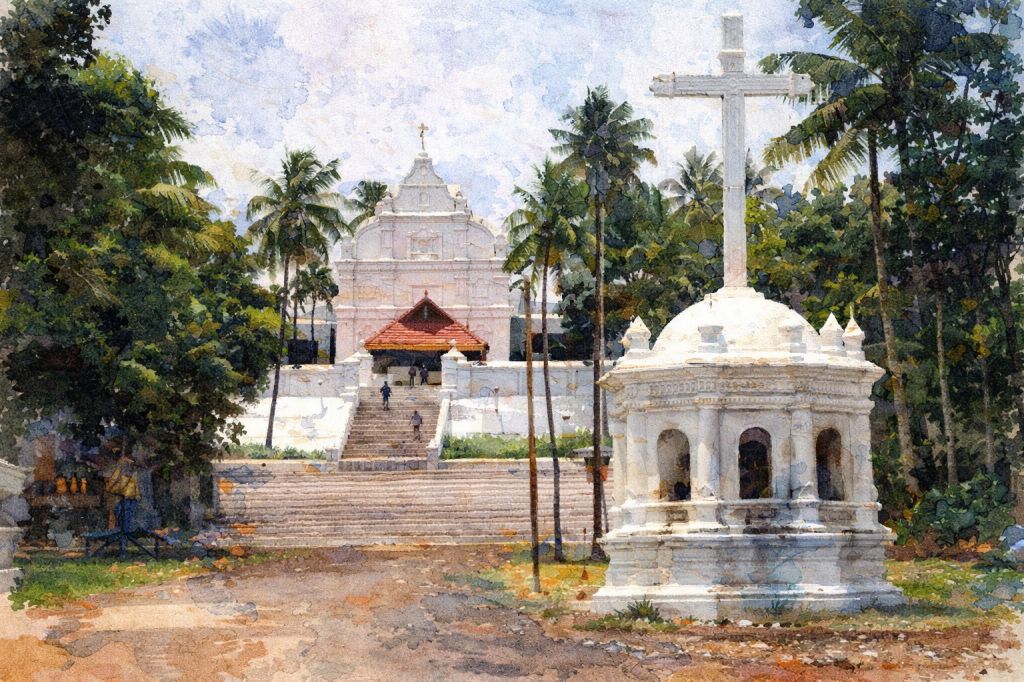
Architecturally simple, the present church reflects traditional Kerala church design, rebuilt around the 15th century. Its interior is modest yet deeply moving, with a tall altar crowned by a semi-circular, vividly colored canopy. Near the altar lies the tomb of Kadamattathu Kathanar, drawing pilgrims who seek blessings, healing, and courage. Nearby stands the Poyedam Church and the legendary Poyedam Kinar, a well believed in folklore to be a portal through which Kathanar traversed unseen realms. Whether one accepts these stories as faith or folklore, their presence adds an unmistakable aura to Kadamattom.
Kadamattom is more than a church, it is a landscape of memory where faith meets myth, and history merges with the supernatural. For pilgrims, it offers spiritual reassurance; for tourists, it opens a doorway into Kerala’s unique blend of religion, legend, and cultural imagination. One may question the miracles, but it is impossible to ignore the quiet divinity that still lingers in Kadamattom as a village forever shaped by two men whose lives changed Christianity in Kerala.
 STORIES by HEARITAGE
Leave a comment