Kerala is a land sanctified by ancient shrines, where faith and folklore flow together. Among these sacred spaces, the Ettumanoor Sree Mahadeva Temple rises with quiet majesty in the heart of Kottayam. Dedicated to Lord Shiva and revered as one of the foremost Shaivite temples of Kerala, this shrine is not merely a place of worship it is a living chronicle of devotion shaped by centuries of myth, ritual, and divine experience. The very name Ettumanoor is woven with sacred meaning. At this temple, the deity is worshipped in three sublime forms through the course of the day: in the morning as Ardhanareeswara, the harmonious union of Shiva and Shakti; in the afternoon as Kirathamoorthy, the divine hunter who bestowed the Pashupatastra upon Arjuna; and in the evening as Samhara Moorthy, the cosmic force of dissolution. This unique triadic worship elevates Ettumanoor to a position of great spiritual dignity among Shiva temples not only in Kerala, but across the subcontinent.
According to legend, Kharasura was not merely a demon but a learned sage, his devoted disciple Pingala requested gurudakshina which Khara initially refused wishing not to burden his pupil. However, Pingala persisted, urging his master to ask for something, anything that would complete his spiritual obligation. In a moment of anger and frustration, Khara demanded an unimaginable sum: 180 billion gold coins, fully aware that such a request was impossible for any mortal to fulfil. Almost immediately, Khara realized the gravity of his words. Yet, as prescribed by sacred scriptures, a gurudakshina once asked could not be withdrawn, for failure to fulfil it would render the disciple spiritually incomplete. Left with no earthly means to procure such wealth, Khara and Pingala together undertook severe penance, surrendering themselves to divine will and seeking the grace of Lord Shiva and Lord Vishnu. Lord Vishnu appeared before them first and, moved by their devotion, granted Khara the immense quantity of gold he had demanded. When Lord Shiva later manifested, Khara, without hesitation, offered the entire treasure at His feet. Pleased with this act of surrender, Shiva returned the gold to Khara. Unattached to wealth and wishing for nothing in return, Khara then presented the gold to Lord Vishnu, demonstrating complete renunciation of material desire. Deeply moved by this selfless devotion, Lord Shiva appeared once more and bestowed upon Khara three sacred lingas. He instructed that these lingas be carried south and consecrated at places equidistant from one another. To fulfil this divine command, Khara undertook a remarkable journey, holding one linga between his teeth and the other two in each hand. According to belief, the linga borne in his teeth was consecrated at Kaduthuruthy, the one carried in his right hand at Vaikom, and the one held in his left hand at Ettumanoor. Thus, through devotion, renunciation, and divine grace, these three sacred shrines came into being, eternally linked by the legend of Kharasura and his unwavering faith. It is believed that Khara worshipped here in the form of a deer, and that the Lord, moved by compassion, lifted him in His palms, an act that many believe gave the place its name, Ettumanoor, the land where the deer was raised.
Another cherished belief narrates how the sacred linga was discovered by a tribal woman while foraging in the forest. When her sickle struck the stone and it bled, fear and reverence spread, leading to the safeguarding of the linga until the temple took shape. Tradition also holds that the revered sage Vilwamangalam Swamiyar laid down the rituals of worship here, infusing the temple with lasting spiritual discipline. Whatever the version one believes, pilgrims agree on one truth that the palpable divinity of Ettumanoorappan, as the Lord is lovingly addressed.
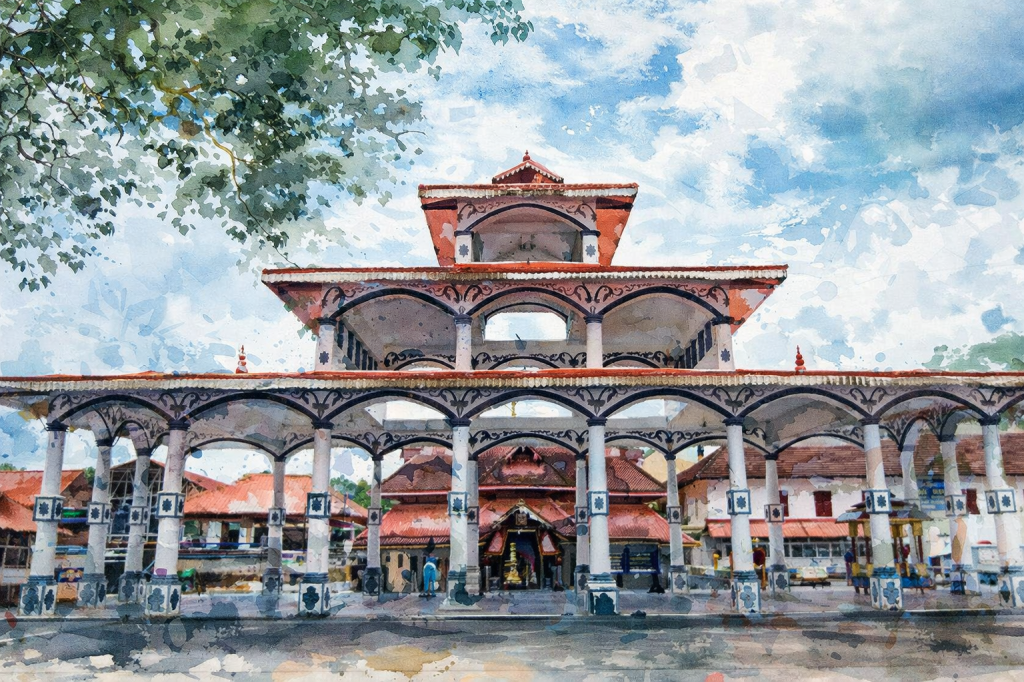
Architecturally, the temple reflects the classical Kerala style that evolved around the 16th century. The circular sreekovil, copper-clad roofs, massive gopuram, and fortified walls together create a space that feels both protective and profound. Inside, pilgrims are greeted by some of the finest mural paintings in India. The famed Pradosha Nritham of Shiva as Nataraja in cosmic dance is a masterpiece of Dravidian mural art, radiating movement, rhythm, and transcendence. Wooden carvings, stucco panels, and rare depictions such as the Rasalila and the coronation of Rama narrate epics silently to the devotee who pauses to look. The temple’s rituals and sacred objects deepen the pilgrim’s experience. The towering golden dwajastambham, crowned with Nandi and adorned with bells and sacred leaves, is among the tallest in South India. Nearby burns the kedavilakku, the ever-glowing lamp whose flame, according to legend, was rekindled by divine will after a humble bronze craftsman’s devotion was spurned. Two ancient Nandi statues one of wood and another of bronze stand as silent witnesses to centuries of prayer. The bronze Nandi, filled with paddy, is believed to bestow healing, especially for ailments of the stomach. Among Ettumanoor’s most treasured offerings is the famed Ezharaponnana or seven and a half golden elephants carved from jackfruit wood. This extraordinary set was gifted by the Travancore ruler Anizham Thirunal Marthanda Varma, and ceremonially presented during the reign of Karthika Thirunal Rama Varma. Safely preserved in the temple vaults, the elephants are revealed to devotees only during the annual Arattu festival, a moment pilgrims await with deep anticipation and reverence.
Ettumanoor has drawn saints and seekers across ages. Tradition recalls the worship of the Pandavas and Sage Vyasa here, while it is believed that Adi Shankaracharya stayed at the temple during his southern travels. The Tamil Shaivite poet Sundarar praised Ettumanoor among the sacred shrines in his Vaippu Sthalams. Even today, devotees express gratitude through Thulabharam, offering their weight in grains, coins, or other sacred items as an act of surrender. For pilgrims bound for Sabarimala, Ettumanoor is an essential halt, a place to seek blessings for a safe journey to the sacred hills and back. Steeped in myth, sanctified by ritual, and alive with devotion, the Ettumanoor Sree Mahadeva Temple stands as a luminous beacon of faith. To bow before Ettumanoorappan is to step into a timeless space where legend breathes, and where the devotee feels both humbled and uplifted in the presence of the Eternal.
 STORIES by HEARITAGE
Leave a comment