The city of Thrissur owes much of its present form, spirit, and cultural stature to one extraordinary ruler of the Cochin dynasty, Rama Varma Thampuran fondly remembered as Shakthan Thampuran. His vision for the city and unwavering commitment to governance earned him a lasting place in Kerala’s history. Standing quietly near the sacred precincts of Vadakkumnathan Temple, the Shakthan Thampuran Palace remains the most intimate monument to his life, ideals, and enduring legacy. The rulers of Kochi, known as the Perumpadappu Swaroopam, traditionally governed from their grand seat at Tripunithura. The Thrissur palace, then called Vadakkekara Kovilakam, served merely as a summer retreat. Built in traditional Kerala architectural style, it was a modest residence with tiled roofs, open courtyards, and functional living spaces surrounded by greenery. This would change dramatically when Rama Varma Thampuran ascended the throne in 1790.
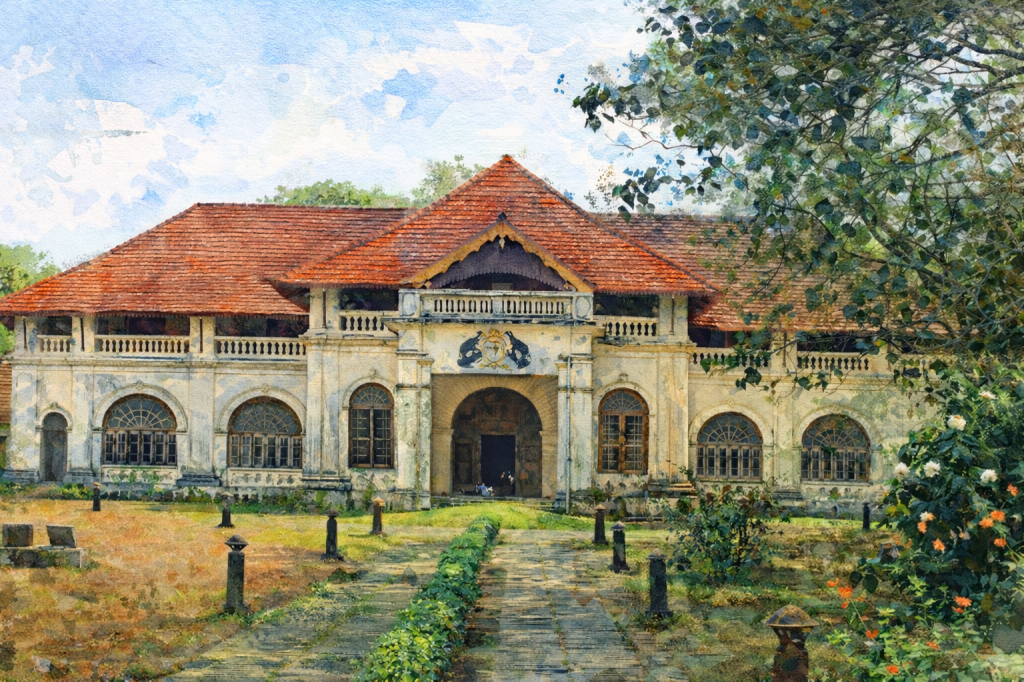
Deeply attached to Thrissur, Shakthan Thampuran chose to make the city his political and administrative centre. He ordered the palace to be reconstructed, retaining its two-tiered core while transforming it into a regal residence worthy of a capital. Completed in 1795, the palace emerged as a rare and graceful fusion of Kerala and Dutch architectural styles. The thick laterite walls, steep roofs, and tall doors were influenced by Dutch engineering, while the inner nalukettu, laterite peedam, and temple spaces reflected indigenous traditions. Italian marble floors cooled the interiors, wide corridors allowed light and breeze to flow freely, and the upper-level verandah offered serene views of the palace gardens. Behind the main structure lies a classic Kerala naalukettu, complete with a shrine dedicated to Pazhayannur Bhagavathi, the royal deity. The oottupura (dining hall) and kitchen were designed on a grand scale, capable of feeding hundreds its an architectural reminder of the ruler’s emphasis on hospitality and welfare. Every element of the palace was conceived to ensure comfort even during harsh monsoons, revealing the foresight of a king who valued both form and function. The palace also bears the weight of his final moments. Shakthan Thampuran died here and was laid to rest within the palace compound. His ornamental tomb stands alongside memorials of a Zamorin king and another Cochin Raja are silent witnesses to an era of shifting power and enlightened rule.
Shakthan Thampuran was not only a builder but a formidable statesman. He believed in centralized authority and social reform, firmly curbing the excessive power of feudal chieftains and temple elites. His uncompromising stance against crime and disorder earned him the title Shakthan, meaning “the Powerful.” One of his most transformative acts was reshaping Thrissur’s urban landscape by clearing dense teak forests around Vadakkumnathan Temple to create the expansive Thekkinkadu Maidan. Encircling it, he laid out the Swaraj Round which is still the city’s defining axis of movement. This visionary space became the stage for his greatest cultural legacy: Thrissur Pooram. Conceived to surpass the famed Arattupuzha Pooram, Shakthan Thampuran brought together temples from across the region to honour Vadakkumnathan, creating what would grow into Kerala’s most celebrated festival. His reign is rightly remembered as the golden era of the Cochin kingdom, influencing administrative practices far beyond its borders. Respected by the Dutch, the Zamorin, Travancore, Mysore, and the British, Shakthan Thampuran stood as a ruler of diplomacy and resolve.
Today, the palace functions as a museum under the Kerala State Archaeology Department. Its galleries display royal artefacts, rare coins, bronze sculptures, ancient manuscripts, and stone-age relics dating back to the 9th century. Within the compound lies one of the oldest serpent groves (sarpakaavu) in the region, dedicated to Nagaraja and Nagayakshi, as well as a heritage garden preserving indigenous trees that have stood for centuries. A flagstaff believed to date from the Mysore period recalls the time Tipu Sultan is said to have stayed here, adding yet another layer to the palace’s historical depth. A visit to Shakthan Thampuran Palace is more than a walk through an old building, it is a journey into the mind of a ruler who shaped Thrissur’s identity. Within its walls echo stories of power, reform, culture, and vision. To stand here is to understand why Thrissur became the cultural capital of Kerala, and why the name Shakthan Thampuran continues to command reverence long after his time.
 STORIES by HEARITAGE
Leave a comment