In most temples across India, Lord Krishna is worshipped in his serene shaantha shyamala form of gentle, playful, and eternally calm. Yet in the northern town of Taliparamba, pilgrims encounter a strikingly different vision of the Lord. Here stands the ancient Trichambaram Krishna Temple, where Krishna is revered in his fiercest Roudra Bhavam, moments after the slaying of Kamsa. Equal in sanctity to Guruvayur and often called North Guruvayur, Trichambaram offers devotees an experience that is both intense and deeply intimate. The origins of the temple are veiled in antiquity, with most traditions placing its presence well before the 10th century. Unlike most Krishna temples, Trichambaram’s rituals, legends, and even atmosphere reflect a powerful emotional state of the deity one that captures the raw humanity and divinity of Krishna after fulfilling his cosmic destiny.
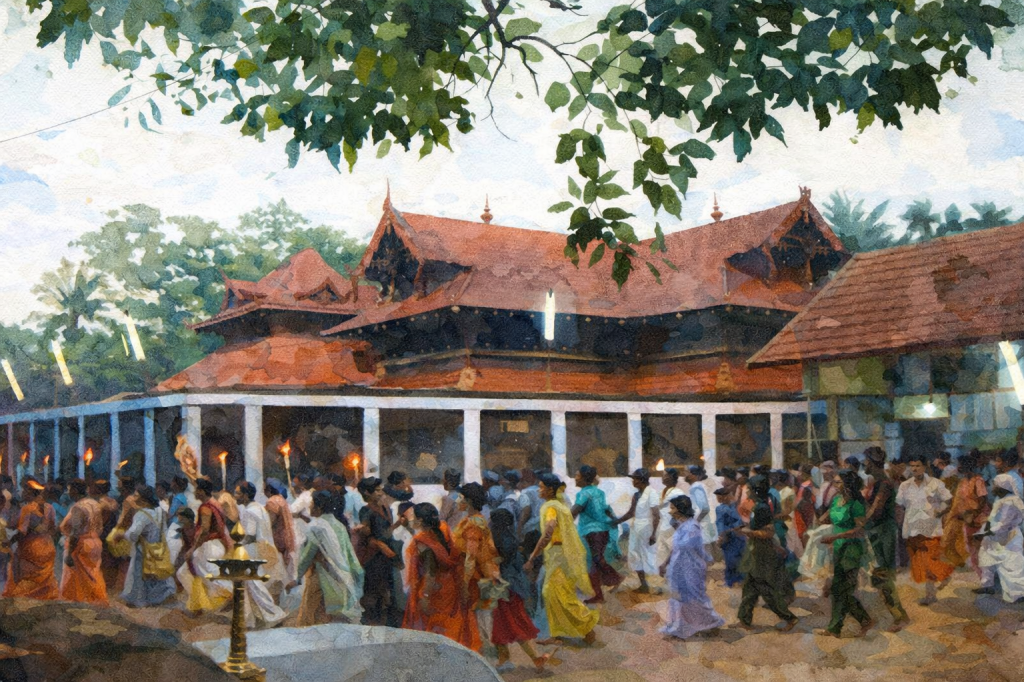
As one enters the temple complex, the first striking presence is the shrine of Goddess Jaladurga, set beside a serene pond. Tradition attributes the consecration of the temple to Parasurama, who established it at the request of Maharishi Shambhara. Jaladurga’s presence is also deeply linked to Krishna’s birth narrative. According to Hindu belief, the eighth child of Devaki was Yogamaya who escaped death at the hands of Kamsa, revealing herself as divine energy and foretelling his destruction. At Trichambaram, Jaladurga is worshipped in the form of a young child, reinforcing the belief that Yogamaya eternally accompanies Krishna, allowing devotees to experience the divinity of both siblings together. The very name Trichambaram is rooted in devotion. It is believed that Maharishi Shambhara chose this forested land to perform severe penance to please Lord Vishnu. When Vishnu manifested here, he presented Shambhara with the idol of Jaladurga. Even after his prayers were answered, the sage continued his stay, earning the place the name Shabharasthana, which evolved into Trishambharam and eventually Trichambaram “the sacred land of Shambhara.”
What truly sets Trichambaram apart is the posture of its main deity. Lord Krishna is worshipped here in the immediate aftermath of Kamsavadam, the slaying of his uncle Kamsa at the tender age of twelve. According to legend, after the fierce battle, the young Krishna still a child felt hunger and turned to his mother Devaki for food. This profoundly human moment is remembered every morning at the temple. The Lord is first offered nivedyam before any rituals commence, acknowledging his fierce yet vulnerable state. Traditionally, many devotees avoided early morning darshan, believing the Lord’s anger was still palpable during those hours. Trichambaram is also the sacred stage for one of Kerala’s most extraordinary ritual performances called Thidambu Nritham. This dance ritual traces its origin to a deeply moving legend. After consecrating the Jaladurga shrine, Parasurama questioned Maharishi Shambhara about his continued presence. The sage revealed that Lord Krishna had promised Devaki a vision of his divine dances and the playful leelas of Vrindavan performed specially for her. True to his word, Krishna, along with Balarama, enacted this celestial dance at Shambharavanam, accompanied by gopikas, friends, devas, and apsaras. When exhaustion overtook the divine brothers, Vasudeva and Nanda lifted them onto their shoulders, continuing the dance. Overwhelmed, both Shambhara and Parasurama fell at Krishna’s feet. Today, priests recreate this moment by carrying the idols of Krishna and Balarama on their heads, allowing devotees to relive that sacred vision.
Architecturally, the temple is a masterpiece of traditional Kerala vasthu. The sreekovil is built of red laterite stone, intricately carved with scenes from Krishnaleela. Its double-storeyed pyramidal roof rises majestically within protective walls. Though the exact construction date remains uncertain, the temple finds mention in the 11th-century Sanskrit text Musikavamsa. Exquisite mural paintings from the 15th century adorn the complex, while three sacred ponds serve different ritual purposes. One pond used for ancestral rites is uniquely devoid of fish, its clear stillness adding to the temple’s mystique. Within the temple compound stands another wonder, a fruitless Ilanji (Spanish cherry) tree. Legend says an ascetic once sat beneath it, suffering from severe skin rashes. Each falling fruit caused him pain, prompting cries to the Lord. Moved by compassion, Krishna emerged from the temple, healed the ascetic, and commanded the tree to bear no fruit henceforth. Though fruitless, the tree remains evergreen, and devotees sit beneath it seeking solace, healing, and divine comfort.
Equally distinctive is the complete absence of elephants from Trichambaram’s rituals and festivals. This belief traces back to Krishna’s encounter with Kamsa’s royal elephant Kuvalayapida, which Krishna and Balarama slew at Mathura. From that moment, it is believed Krishna developed an aversion to elephants, and even today, mahouts avoid bringing them near the temple. Trichambaram forms part of a sacred trinity of pilgrimage sites along with the Rajarajeshwara Temple and the Kanhirangad Vaidyanatha Temple. For devotees, visiting Trichambaram is akin to stepping into Vrindavan itself where Krishna is not a distant god, but a living presence, fierce yet compassionate, divine yet profoundly human.
 STORIES by HEARITAGE
Leave a comment