The misty fertile soil of Wayanad carry within them the echoes of resistance, courage, and sacrifice. Among the many stories the land whispers, none is as powerful as that of Kerala Varma Pazhassi Raja, the legendary warrior remembered as The Lion of Kerala. From the late 18th century to this day, ballads sung by forest communities continue to glorify a king who chose the jungles over submission and stood fearlessly against British colonial power. On the serene banks of the Kabini River, in the town of Mananthavady, rises the dignified Pazhassi Raja Memorial. More than a monument, it is a sacred space of remembrance & one that allows travellers, historians, and patriots alike to reconnect with a chapter of Indian resistance written not in palaces, but in forests.
Unlike many kings, Pazhassi Raja left behind very few physical traces of his reign. British forces systematically destroyed structures associated with him, attempting to erase his memory from history. Yet his story survived that is still protected and preserved by the Thiyya, Kurumba, and Kurichiya communities of Wayanad, who continued to honour him as their rightful king. What makes Pazhassi’s rebellion extraordinary is that he fought almost entirely on his own, without alliances with neighbouring rulers or princely states. So formidable was his resistance that British records described him as the toughest adversary they encountered in India. His mastery of guerrilla warfare using dense forests, local intelligence, and swift ambushes proved devastatingly effective. It is even believed that Arthur Wellesley, later famed for defeating Napoleon Bonaparte, studied and adapted Pazhassi’s guerrilla tactics during his campaigns in Spain.
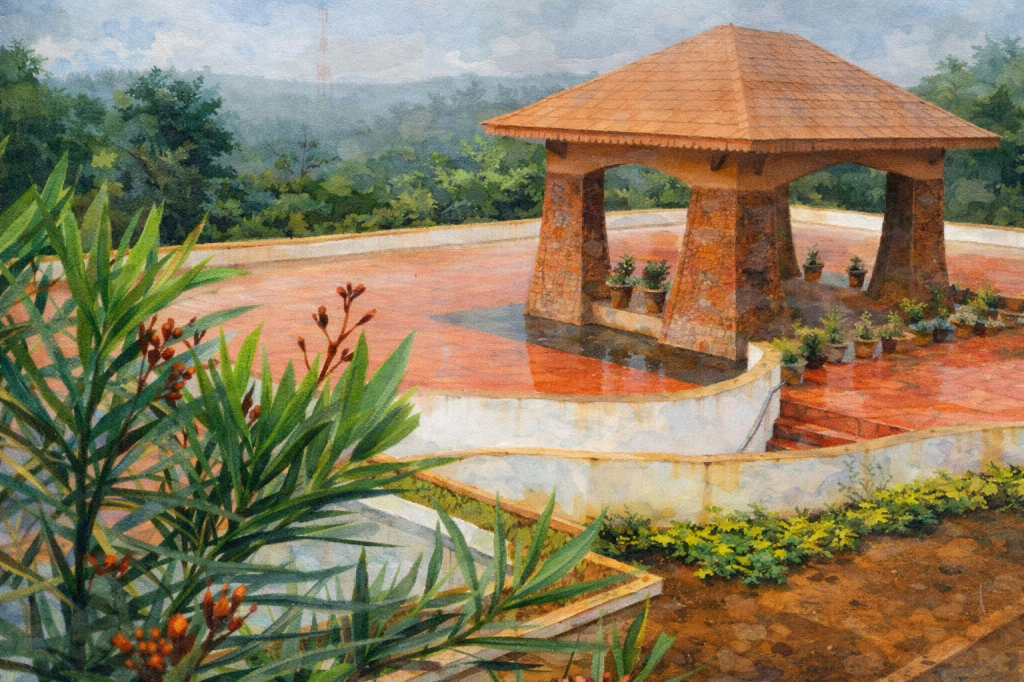
Ultimately, the British managed to end the rebellion only by killing Pazhassi. Yet even in death, the Lion commanded respect. Despite their notorious cruelty towards enemies, the British accorded him a state funeral, a rare honour. His body was brought to Mananthavady, and the last rites were performed according to the traditions of the Kottayam royal family. The tomb at the memorial marks the exact site where those rites were conducted. The memorial itself is an evocative blend of symbolism and simplicity. The tomb is built as a circular pit using red laterite stone, echoing both the earth he defended and the forests that sheltered him. Surrounding it is a spacious mandapam, whose outer walls are sculpted with vivid scenes from Pazhassi Raja’s life with his battles, alliances with tribal warriors, and defiance of colonial rule. Carefully landscaped gardens and flowering plants add a sense of calm, inviting visitors to pause and reflect rather than merely observe.
Pazhassi Raja’s military genius extended beyond his struggle with the British. He played a crucial role in preventing the Mysore Empire from annexing the Kottayam kingdom, successfully resisting both Hyder Ali and later Tipu Sultan. Ironically, Pazhassi initially allied with the British to counter Mysore invasions. The turning point came when the British refused to recognise him as the rightful ruler of Kottayam and exiled him to the forests. What followed was a 12-year-long war of attrition that drained British resources and morale. Pazhassi’s greatest strength lay not in numbers or weaponry, but in his bond with the land and its people. His strategy of cutting supply lines, launching sudden ambushes, and disappearing into the forests inflicted heavy losses on the British. Repeated attempts to capture him including plans hatched at Tellicherry Fort failed miserably. However, after the fall of Tipu Sultan, British power grew overwhelming. In 1805, betrayal sealed Pazhassi’s fate. A traitor, Pazhayaveedan Chandu, murdered his trusted aides, leaving the king vulnerable. Pazhassi was killed soon after, his palace destroyed, and his queen captured only to end her life in despair.
Opened to the public in 1996, the memorial complex also houses a well-curated museum that deepens one’s understanding of Pazhassi and his times. The museum’s four galleries take visitors through a chronological and thematic journey of his life. The Pazhassi Gallery displays personal items associated with the king like his famed sword, weapons, writing tools, and everyday objects bringing a human dimension to the legend. Equally compelling is the Tribal Gallery, which honours the forest communities who stood by Pazhassi long after his royal privileges were stripped away. Weapons of the Kurichiya bowmen and women, household utensils, and cultural artefacts reveal how deeply intertwined the rebellion was with the lives of the indigenous people. The Heritage Gallery sheds light on the lesser-known social and cultural history of the region, while the Numismatics Gallery showcases coins, manuscripts, stamps, and documents from Pazhassi’s era, offering scholars valuable insight into the period.
The story of Pazhassi Raja is one of unwavering resistance rooted in justice and loyalty to his people. Visiting the Pazhassi Raja Memorial is not just a journey through history, it is an emotional encounter with a king who chose sacrifice over surrender. Set against the quiet flow of the Kabini and the timeless forests of Wayanad, the memorial stands as a powerful reminder that true heroism does not fade with time. It is, without doubt, a must-visit destination for anyone seeking to understand the soul of Kerala’s past.
 STORIES by HEARITAGE
Leave a comment