Kerala’s temples are not merely places of worship; they are living spaces where myth, landscape, and faith merge seamlessly. Among these sacred shrines, the Peralassery Temple stands apart for its unique beliefs and powerful legends. Revered deeply by devotees, this ancient temple in Kannur is dedicated to Lord Subramanian and is one of the rare temples in Kerala where serpents are worshipped with the same reverence as the deity himself.
The origins of Peralassery are shrouded in legend rather than written history. According to belief, the temple dates back to the Treta Yuga and was originally an Ayyapankavu. One of the most profound myths associated with its origin speaks of Lord Subramanian’s unparalleled wisdom. When he questioned Lord Brahma about the true meaning of Omkaram and received no answer, Subramanian imprisoned the creator in anger, bringing cosmic activity to a halt. Alarmed by this imbalance, Lord Shiva intervened, and Brahma was released. Yet, Subramanian’s action was a cosmic transgression, and he was asked to atone in a place where none could find him. Seeking solitude and penance, Lord Subramanian chose the land where Peralassery stands today, but only after obtaining the consent of Lord Sastha. To remain unseen, he assumed the form of a serpent and dwelled within the temple grounds. This act laid the foundation for the temple’s extraordinary association with serpent worship, a tradition that continues to this day.
The Ramayana adds another sacred layer to Peralassery’s story. During their search for Devi Sita, Rama, Lakshmana, and Hanuman passed through this region. Lord Rama sensed the presence of Lord Subramanian and decided to perform pooja, but a consecration required an idol. Hanuman was sent to fetch one, yet the land lush and green offered no stone. As time passed, Rama grew impatient and consecrated the spot using his royal bangle (Peruvala). When Hanuman returned with an idol and attempted to remove the bangle, it would not move. As he tried again, a serpent emerged from beneath it, warning him. Hanuman realized that the serpent was none other than Lord Subramanian himself. Accepting the divine will, the stone idol was placed above the bangle. From this sacred event, the place came to be known as Peruvalassery, later evolving into Peralassery.
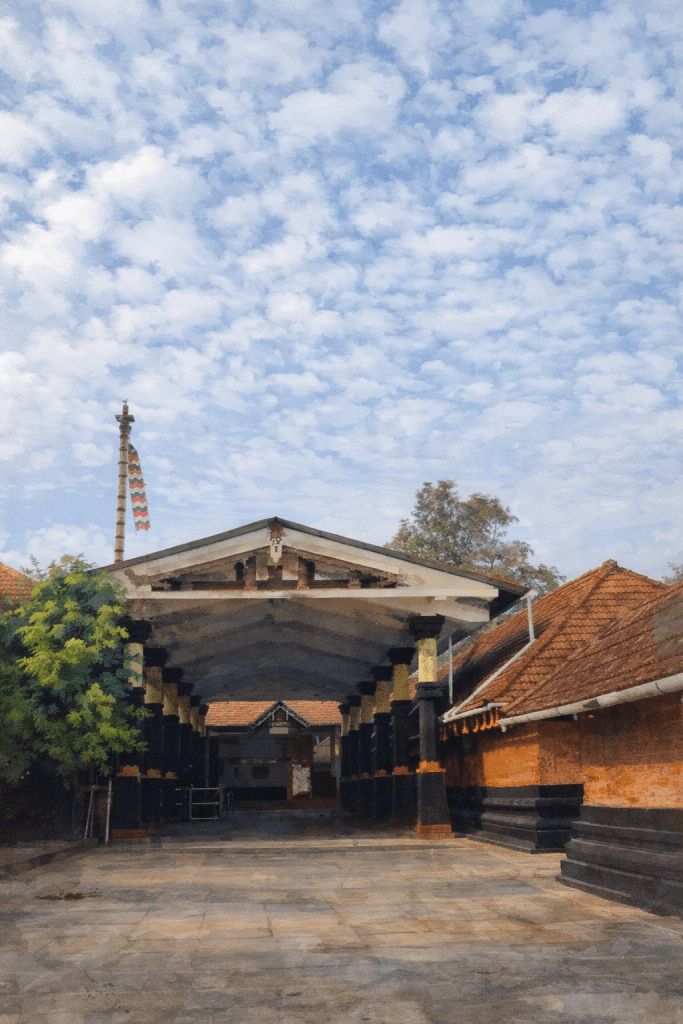
The temple complex itself is as spiritually evocative as its legends. The ancient banyan tree at the entrance is believed to date back to the time of Lord Rama, standing as a silent witness to centuries of devotion. One of the most striking features of the temple is its massive pond considered to be the largest temple ponds in Kerala. Designed like a North Indian stepwell or baori, with steps descending from all sides, the structure creates a mesmerizing optical illusion. Tradition holds that all the steps converge at the deep central point, and it is believed that waters from the River Cauvery reach this pond annually during Thula Sankramam. Devotees also believe that Lord Subramanian bathed here before assuming his serpent form.
While Lord Subramanian is the presiding deity, serpent worship holds exceptional importance at Peralassery. The sarpakavu beside the temple is a sacred grove where devotees offer eggs, rice, milk, and water as sarpabali. The temple grounds house an extraordinary collection of stone serpent idols, venerated by people across religions, reflecting the inclusive spiritual culture of the region. Festivals add vibrant life to the temple. The annual celebrations in the Malayalam month of Dhanu are marked by Thidambu Nritham and classical ritual arts such as Chakyar Koothu, Ottamthullal, and Kathakali. The temple is also an essential stop in the Nalambalam pilgrimage undertaken during Ramayana Masam, with a mandatory visit to the nearby Makreri Temple completing the sacred circuit.
The ritual of sarpabali, rare in North Malabar, remains one of Peralassery’s most compelling spiritual practices. For pilgrims, a visit to this temple is not merely about darshan, it is an encounter with ancient beliefs where gods, serpents, and humans share a sacred bond. Standing amidst its timeless architecture and legends, Peralassery Temple offers a profound reminder of Kerala’s deeply rooted spiritual heritage.
 STORIES by HEARITAGE
Leave a comment