The northern stretches of Kerala, known historically as Malabar, have witnessed the rise and fall of many kingdoms, each leaving behind a legacy shaped not merely by power, but by faith, loyalty, and coexistence. Among these realms stood Valluvanadu, a principality whose capital lay near present-day Perinthalmanna. The rulers of this land, known as the Valluvanadukonathiri, were deeply devoted to a hilltop shrine at Angadipuram – Thirumanthamkunnu, a sacred space where mythology, ritual, and history blend seamlessly. Perched atop a forested hillock, the temple commands reverence not only for its antiquity but for the extraordinary legends that define its identity. Though the presiding deity is Lord Shiva, the temple is venerated across Kerala as a Bhagavathy Kshethram, owing to a divine episode involving Goddess Parvathy herself.
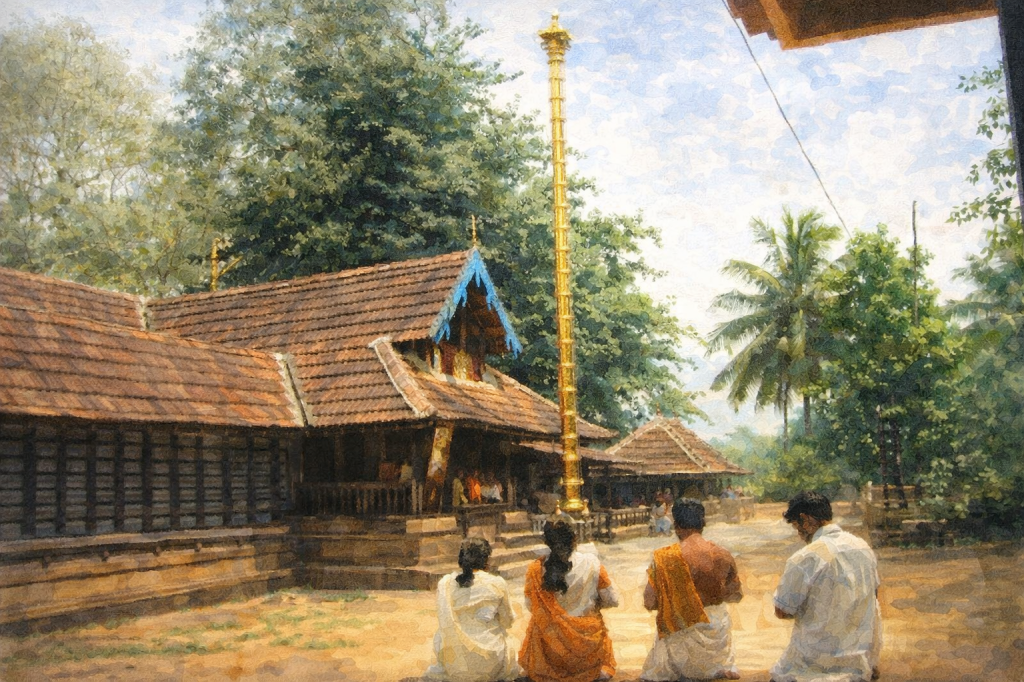
According to ancient belief, the origins of Thirumanthamkunnu trace back to King Mandhatha of the Suryavamsa lineage. Renouncing his kingdom in pursuit of spiritual truth, Mandhatha undertook severe penance at Mount Kailasa. Pleased by his devotion, Lord Shiva granted him one of the nine sacred lingams of Kailasa. Carrying the divine form southward, Mandhatha eventually arrived at a secluded hill enveloped by dense forests, birdsong, and wild creatures, a place he felt destined for worship. When he placed the lingam upon the ground, it became immovable. Mandhatha established his hermitage here and worshipped Shiva in harmony with fellow ascetics. Unaware of these events, Goddess Parvathy later discovered the absence of the lingam dearest to her heart.
On learning the truth, her grief turned into resolve. She sent Bhadrakali and the Bhuta Ganas to retrieve it. As the divine attendants ascended the hill, they were blinded by the radiant light of the lingam. Unable to advance, they hurled weapons upward. The ascetics, lacking arms, responded by throwing aathangu nuts from forest trees nuts that miraculously transformed into arrows mid-air. This fierce exchange, remembered as Aathangeru, forced Bhadrakali into her terrifying Vishwaroopa. Realising the divine nature of the conflict, Mandhatha embraced the lingam in surrender. In her fury and grief, Bhadrakali pulled the lingam free, splitting it with thunderous force. The cosmic disturbance summoned the divine trinity of Brahma, Vishnu, and Shiva along with Parvathy herself. Faced with the sorrow of both Mandhatha and Parvathy, the Goddess chose compassion over possession. She merged herself into the lingam, declaring that while Mandhatha would keep the form, her presence would eternally sanctify it. Thus, though the lingam remains Shiva, the spirit worshipped is Parvathy, making Thirumanthamkunnu one of the rare temples where divinity transcends form and gender.
It is believed that during the cosmic upheaval, Goddess Parvathy appeared with Balaganapathy, the child form of Lord Ganapathy, who could not be left alone. His presence at Thirumanthamkunnu gave rise to one of the temple’s most enduring traditions, Mangalya Pooja. For centuries, men and women facing obstacles in marriage have sought blessings here. Balaganapathy, worshipped as the remover of impediments, is believed to grant marital harmony swiftly. The ritual transcends caste and religion, drawing devotees from all walks of life. Those whose wishes are fulfilled return to offer gratitude, sustaining a cycle of faith that remains unbroken.
While the consecration is believed to date back to the dawn of Kali Yuga, the temple’s architectural form reflects classic Kerala design that is simple, powerful, and deeply symbolic. The sreekovil uniquely features doors on either side, allowing devotees a rare darshan experience. Nearby stands the Ganapathy shrine, close to the moolasthanam, reinforcing the belief in swift divine intervention. The long stone staircase leading to the hilltop temple is more than a path, it is a symbolic reenactment of Aathangeru. Each year, on the first day of the Malayalam month of Thulam, this myth is dramatically relived. Two groups of devotees enact the legendary battle, one representing Mandhatha and the ascetics, the other Bhadrakali and the Bhuta Ganas, hurling aathangu nuts in a ritual spectacle unlike any other in Kerala.
Centuries later, Thirumanthamkunnu became entwined with another chapter of Malabar’s turbulent history, the Mamankam festival. After the Valluvanadu kingdom lost control of Mamankam to the Zamorin, loyal Nair warriors known as Chavers vowed to assassinate the Zamorin during the festival, fully aware it was a mission of certain death. These warriors departed from the Chaverthara, the platform at the base of Thirumanthamkunnu hill, seeking the blessings of Bhagavathy before embarking on their final journey. Though none succeeded, their sacrifice immortalised the temple as a site of rebellion, honour, and unwavering loyalty.
Today, Thirumanthamkunnu celebrates an eleven-day Pooram festival, with Aarattu as a sacred culmination. Animal sacrifice is common in Bhadrakali temples & is notably absent here, underscoring the Goddess’s compassionate aspect. There is also a cherished belief that Chottanikkara Bhagavathy is the younger sister of Thirumanthamkunnu Devi, linking two powerful centres of Shakti worship. A pilgrimage to Thirumanthamkunnu is not merely an act of devotion. It is a journey into myth, history, sacrifice, and living tradition. As one ascends the ancient steps, every stone seems to echo stories of sages, goddesses, warriors, and devotees each bound by faith that transcends time.
 STORIES by HEARITAGE
Leave a comment