When the Dutch displaced the Portuguese as the dominant European power in Kochi, they brought with them not just cannons and commerce, but an enduring belief in infrastructure, urban planning, and architectural grandeur. Masters of port engineering and water management, the Dutch carried lessons from their homeland to every colony they touched. Kochi, with its intricate network of backwaters, rivers, lagoons, and the open sea, reminded them unmistakably of the Netherlands. This familiar landscape inspired them to build bridges, jetties, warehouses, and trading posts but one crucial element was missing: a grand residence worthy of their authority and prosperity. That absence led to the creation of what would become the first Dutch palace built outside Europe called Bolgatty Palace.
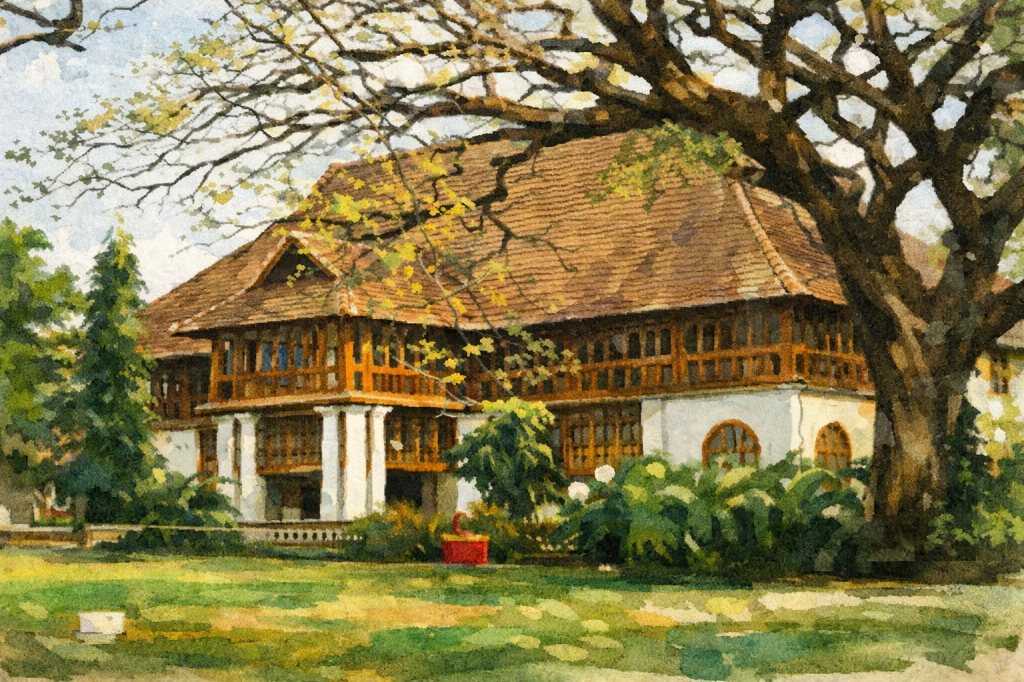
By the early 18th century, Kochi was a thriving port where Arab, Chinese, and European traders competed for influence. Though the Raja of Cochin remained formally in power, the Dutch steadily tightened their control over trade and governance. For the Dutch merchants and administrators, a stately governor’s mansion was essential, not only as a residence but as a declaration of supremacy to rival traders. Mattancherry was first considered, but the presence of the Cochin Raja’s palace there diminished its symbolic value. The Dutch eventually found what they were seeking in a small, circular island nestled in the vast waters of Vembanad Lake. Covered in coconut groves and frequented by migratory birds, the island was known to Arab traders as Gol-jetty, meaning “round island.” Under Dutch pronunciation, the name evolved into Bolgatty. The island belonged to the Cochin Raja, who regarded it as unused land. Recognising the Dutch intent and perhaps their inevitability he granted them the island. Construction began soon after, and in 1744, the Bolgatty Palace rose gracefully from the water.
The architects of Bolgatty Palace left nothing to chance. Inspired by stately mansions in the Netherlands, the palace was designed with its façade facing the marina, making the waterway the primary ceremonial entrance. Approaching the palace by boat, visitors were greeted by a grand foyer framed with Dutch-style pillars, wide windows, and symmetrical proportions that conveyed order, power, and refinement. Inside, the palace revealed its opulence through subtler means. Wood was used generously for beams, ceilings, and staircases, lending warmth to the interiors. Double-layered roofs kept the rooms cool, while large gabled ceilings enhanced both ventilation and visual grandeur. Tiled floors, expansive windows with glass panes, and carefully proportioned rooms created a sense of quiet authority rather than ostentatious display as an architectural language typical of Dutch colonial design. Bolgatty Palace served as both the office and residence of the Dutch Malabar Commander, who also held the title of Governor of Cochin. The surrounding gardens, landscaped meticulously by successive governors, were reserved for high-ranking officials and state guests, reinforcing the palace’s exclusivity.
The Dutch retained control of Bolgatty Palace until the late 19th century. With the arrival of the British and the expanding reach of the East India Company, Dutch influence in Kochi waned. Eventually, the palace and island were handed back to the Cochin Raja. For a time, the estate fell into neglect, its quiet halls echoing only with memories of imperial ambition. In 1909, seeking to monetise the land, the Cochin Raja leased Bolgatty to the British. The British rechristened it Governor’s House, adhering to their convention of reserving the term “palace” solely for royal residences in Britain. To their credit, the British maintained the estate well, adding expansive lawns and developing a golf course around the mansion, transforming the island into a leisure retreat for colonial officers.
Bolgatty continued to serve as the British Governor’s residence until Indian Independence. In 1976, recognising its heritage value, the Government of Kerala converted the palace into a heritage luxury hotel, entrusting its management to the Kerala Tourism Development Corporation (KTDC). Today, Bolgatty Palace holds several unique distinctions. It is the oldest surviving Dutch palace outside the Netherlands, and also Kerala’s first heritage hotel. While modern amenities such as a swimming pool, restaurants, bar, and luxury suites have been sensitively added, the soul of the palace remains intact. Guests can choose rooms overlooking the marina, gardens, or pool, each offering a tranquil view shaped by centuries of history. Visitors who do not stay overnight often come to stroll through the lawns, attend cultural events, or simply sit beneath the shade of ancient trees as boats glide across the backwaters just as they did in Dutch times. Perhaps the most enchanting experience remains the boat ride to and from the palace, cutting through the calm waters of Vembanad.
The journey, unchanged in spirit for over two centuries, allows visitors to approach Bolgatty the way governors and dignitaries once did slowly revealing itself through palms and sky. In an age when many historic structures have been lost to neglect or modern development, Bolgatty Palace stands as a testament to what thoughtful preservation can achieve. More than a hotel, it is a living chapter of Kochi’s layered history as Dutch ambition, British administration, royal diplomacy, and modern tourism coexisting under one tiled roof. A visit to Bolgatty is not merely a stay or a sightseeing stop; it is a journey through time, where architecture, water, and memory continue to flow together as they have for centuries.
 STORIES by HEARITAGE
Leave a comment