Kerala, according to ancient belief, is not merely a geographical region but a land born of penance and divine will. Mythology tells us that the warrior sage Parasurama, burdened by the sin of having annihilated unjust Kshatriya kings, sought redemption by gifting land to Brahmins. Guided by Varuna, the god of oceans, he hurled his axe from Gokarna to Kanyakumari, causing the sea to recede and the land of Kerala to rise up to the Western Ghats. This sacred stretch came to be known as Parasurama Nadu. Legend further holds that this long land has a precise midpoint where north and south meet in perfect balance. It is here, at this symbolic heart of Kerala, that the Keraladeeshapuram Temple stands. Ancient texts refer to this shrine as Kerala Ardheeshwaram Kshethram, the temple of the middle land, lending it a cosmic and geographic sanctity unlike any other.
The temple is nestled in the serene village of Mulakkal near Tanur, approached by narrow winding roads shaded by groves and quiet hamlets. A visit here feels like a journey backward through centuries, into a Kerala untouched by haste. This was once the royal temple of the Vettathunadu kingdom, whose rulers governed these lands from the 13th century onward. The Vettathunadu rulers were feudal lords under the suzerainty of the Zamorins of Calicut. Their relationship with the Zamorins remained formal for centuries, though political rivalries often simmered beneath the surface. The arrival of the Portuguese in the late 15th century altered the balance of power in Malabar. Seeking leverage against the Zamorins, the rulers of Tanur allied themselves with the Portuguese, gaining temporary prominence through military support and trade alliances. This fragile power equation shifted again with the fall of Valluvanadu and the Zamorins’ control over the Mamankam festival, events that diminished the political relevance of Tanur. Later, Dutch intervention briefly stabilised regional conflicts, until the British arrived and reorganised Malabar into smaller vassal territories. During British rule, the Keraladeeshapuram Temple came under colonial control, but its upkeep was never a priority. Eventually, temple rights were handed back to the Zamorin family, under whose guardianship the shrine continues to function today.
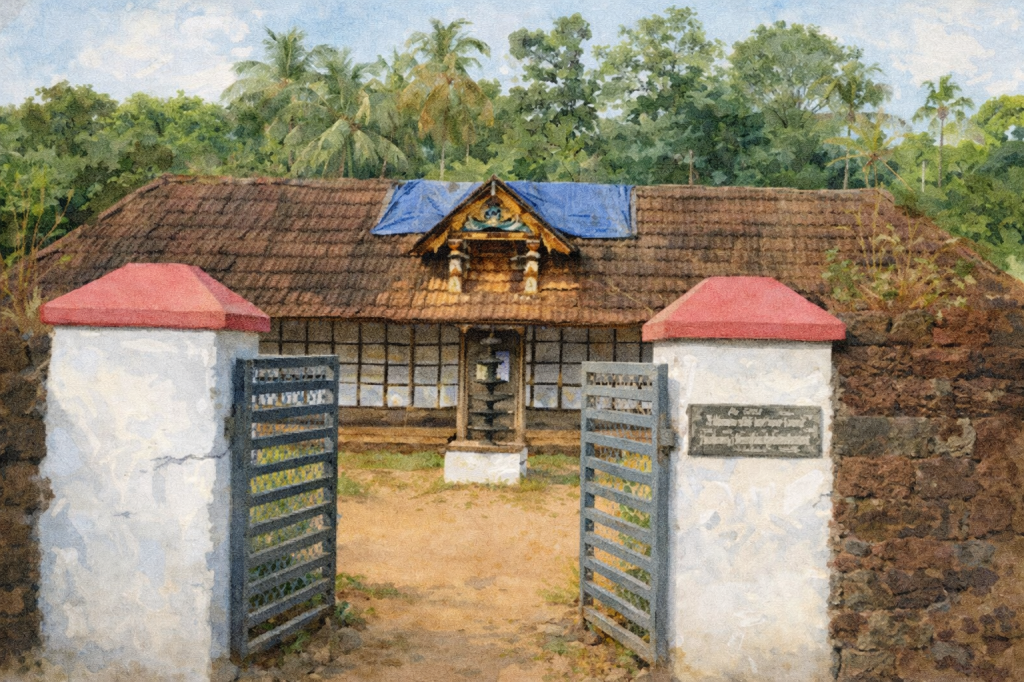
At first glance, Keraladeeshapuram Temple appears modest, almost unassuming. Gone are the signs of past opulence that once marked it as a temple of great wealth. What remains is a simple yet dignified structure that is quadrangular in plan, with two entrances leading to the sanctum. Within resides a rare and deeply endearing idol of Lord Krishna, carved from Krishna Shila stone. The deity is depicted not as a regal monarch or cosmic teacher, but as the mischievous child of Vrindavan, holding a ball of butter in his hand. This Bala Krishna form, playful and intimate, is considered unique and instantly draws the devotee into a personal relationship with the Lord. The terracotta-tiled roof and weathered wooden elements reflect an older architectural ethos when temples were built not to impress, but to comfort; not to display power, but to offer peace. The carvings may have faded with time, yet the spiritual warmth of the space remains intact. In front of the temple stands a kalvilakku, a stone lamp believed by tradition to have been placed here by Parasurama himself. This single object anchors the temple firmly in mythic time, reminding pilgrims that even the humblest shrine may stand upon extraordinary origins.
Though time has dimmed its grandeur, Keraladeeshapuram remains one of the five most significant temples in the Malappuram region. Its annual festival continues to draw devotees, reaffirming the bond between the temple and the local community. Under the quiet stewardship of the Zamorin family and the devotion of villagers, daily worship carries on with dignity and simplicity. For pilgrims, a visit here is not about spectacle. It is about standing at the symbolic centre of Kerala, on land believed to have risen from the sea by divine will. It is about meeting Krishna not as a distant god, but as a child with buttered hands and a playful smile. And it is about remembering that sanctity often survives not in grandeur, but in humility.
 STORIES by HEARITAGE
Leave a comment