Kerala’s cultural soul is best discovered not just in its landscapes, but in the stories its people have carried across centuries. In the northern stretch of the state historically known as Malabar folklore is not merely remembered, it is lived. Among the many expressions of this living tradition, none is as striking or as powerful as Theyyam, a ritual art form where gods descend into human form through rhythm, colour, and trance. For travellers who wish to understand this deeper cultural fabric, a visit to the Kerala Folklore Akademi offers an unforgettable journey into belief, memory, and myth. The Akademi functions within the historic Chirakkal Palace, once the royal residence of the Chirakkal kings. The setting itself prepares visitors for what lies ahead. In front of the palace stretches the Chirakkal Chira, believed to be the largest artificial pond in Kerala, its calm waters reflecting coconut palms and the timeless serenity of the region. Established in 1995 and administered by the Kerala Department of Culture, the Akademi is an autonomous institution devoted to preserving and promoting the traditional art forms of the state.
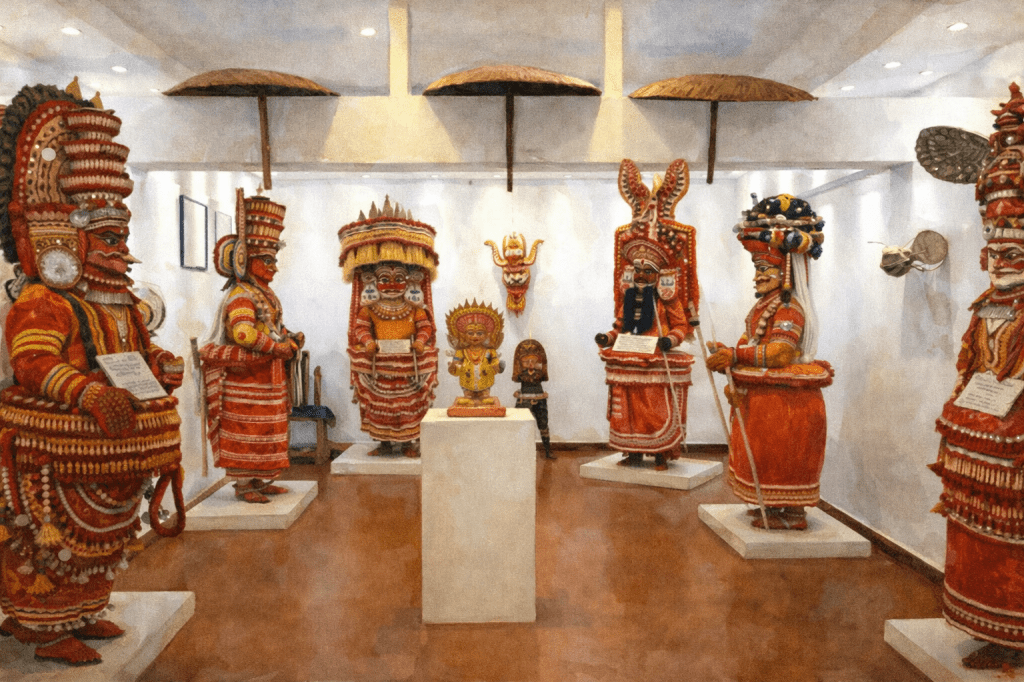
Stepping inside the museum feels like entering a sacred performance frozen in time. Room after room reveals life-sized representations of Theyyam figures, meticulously recreated with their elaborate headgear, face paint, ornaments, and ritual attire. Each display is accompanied by explanations of the deity, the legend behind it, and often the lineage of artists who have kept the tradition alive. For visitors unfamiliar with Theyyam, this contextual storytelling is invaluable as it transforms vibrant costumes into living narratives of faith, justice, and social memory. The central hall is particularly captivating. Here, multiple Theyyam forms stand together, allowing visitors to compare their visual language and symbolic elements. Displays explain preliminary rituals such as Vellattam, elaborate performances like Thiruvappana, and related ritual traditions such as Mudiyettu. Detailed panels also illustrate the intricate facial painting techniques, where natural pigments and sacred geometry turn the performer into a divine presence.
An upper gallery expands the experience further, showcasing ritual masks, bronze artefacts, terracotta figures, and forms like Padayani, linking Malabar’s traditions with those of southern Kerala. Together, these exhibits reveal how folklore evolves across geography while remaining rooted in shared beliefs. One of the most compelling narratives visitors encounter is that of Muchilottu Bhagavathy, whose life-sized representation greets guests near the entrance. Her story preserved entirely through oral tradition is one of intellect, injustice, and transformation. A young woman of exceptional wisdom, she challenged a male-dominated scholarly assembly with her insight, only to be condemned for her candour. Wronged and excommunicated, she chose self-immolation to affirm her purity. Legend holds that her spirit attained divine form, later worshipped as Bhagavathy. Today, the Theyyam of Muchilottu Bhagavathy is among the most revered in North Malabar, symbolising not only divine justice but also the timeless recognition of women’s intellect and dignity.
Beyond the galleries, the Akademi invites visitors to linger. The open spaces by the pond are ideal for quiet reflection, especially in the evenings when water lilies bloom and the palace silhouette softens in the fading light. The descendants of the Chirakkal royal family still reside nearby, lending the place a continuity that bridges past and present. For tourists seeking more than photographs, for those who wish to understand Kerala through its stories, rituals, and living traditions & the Kerala Folklore Akademi is indispensable. It is not merely a museum, but a cultural sanctuary where gods speak, history breathes, and folklore continues its timeless dance.
 STORIES by HEARITAGE
Leave a comment