In the heart of Palakkad, where the Western Ghats gently open into the plains of Kerala, stands a fort unlike any other in South India. Broad, austere, and surrounded by an ever-filled moat, Palakkad Fort, popularly known as Tipu’s Fort, is less a monument of ornamentation and more a statement of military genius. Though its popular name remembers Tipu Sultan, the true architect of the fort’s destiny in Kerala was his father Hyder Ali, the formidable ruler of Mysore. For the traveller walking through its massive granite gateways today, Palakkad Fort is not merely stone and water; it is the echo of Hyder Ali’s ambition, strategy, and relentless pursuit of power in Malabar.
Long before Mysore’s banners flew over Palakkad, the site housed a simple defensive structure built in the early 17th century by the Zamorin of Calicut. This was not yet a grand fort, but a fortified wall meant to station troops and assert Zamorin authority over the Palakkad Gap which was the most crucial natural passage between the Tamil plains and the Malabar coast. The region was administered by the Palakkad Achan, a feudal lord under the Zamorin. By the mid-18th century, tensions between the Achan and the Zamorin escalated, pushing Palakkad into political uncertainty. When diplomacy failed and allies proved unreliable, the Achan turned toward a rising power in the east of Hyder Ali, the shrewd general of Mysore. For Hyder Ali, Palakkad was more than a request for military assistance, it was an invitation into Malabar. At the time, Hyder Ali was already consolidating power within Mysore, and the Palakkad Gap offered him a strategic doorway to the rich spice-producing coast of Kerala. Accepting the Achan’s plea, Hyder Ali marched into Palakkad, repelled the Zamorin’s forces, and soon realized the immense strategic value of the location. By 1761, having overthrown the Mysore king and crowned himself ruler, Hyder Ali no longer needed intermediaries. Palakkad was absorbed directly into Mysore’s expanding empire.
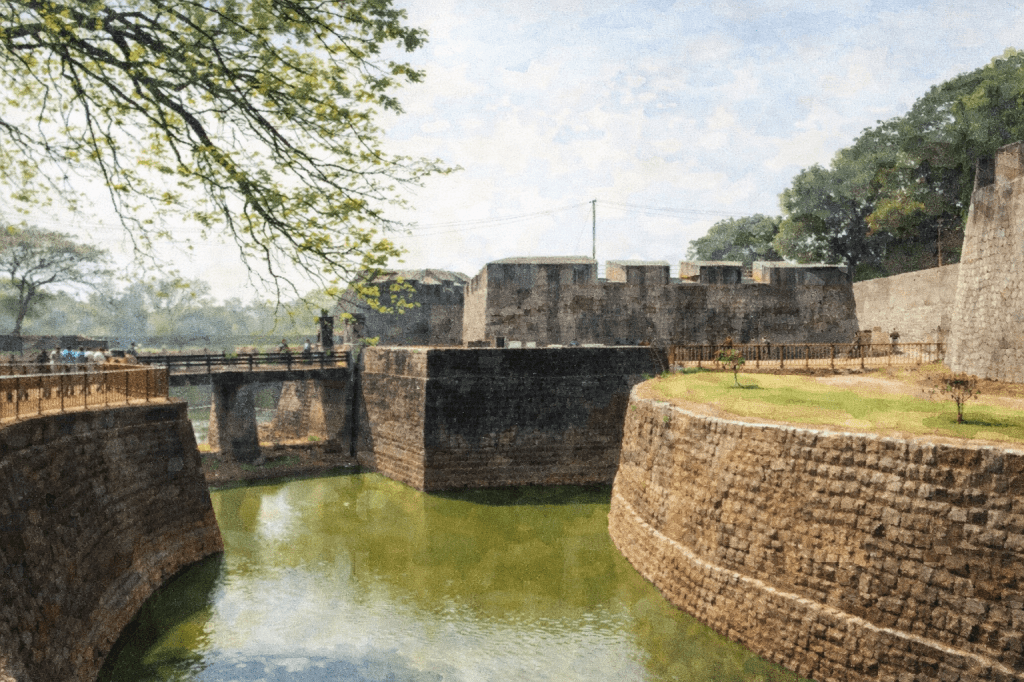
Recognizing Palakkad as the key to controlling Malabar, Hyder Ali ordered the construction of a fort that would be virtually indestructible. In 1766, French military engineers were commissioned to redesign and rebuild the structure into what we see today. The result was a masterpiece of military architecture: massive granite walls laid in a slanting rhombus design, seven bastions offering uninterrupted defensive coverage, one of the widest and deepest moats in India, fed by perennial water sources, a movable bridge at the entrance, making enemy advances nearly impossible. The moat was Hyder Ali’s greatest defensive weapon. It never dried, even in peak summer, and rendered siege tactics ineffective. Stories speak of boiling oil poured from the bastions upon intruders who dared to reach the walls, a chilling reminder of 18th-century warfare. After completing the fort, Hyder Ali named it after his heir, Tipu Sultan by sealing both political legacy and personal pride into stone. Tipu later stayed here and used the fort as an administrative and military base, but its soul remained unmistakably Hyder Ali’s. Designed to be self-sufficient, the fort could house over 10,000 soldiers, with vast granaries, armouries, and living quarters. This design reflected Hyder Ali’s deep concern for the welfare and readiness of his army, a trait that defined his leadership.
One of the most intriguing features of Palakkad Fort is the Anjaneya (Hanuman) Temple within its walls. Despite Hyder Ali and Tipu Sultan being devout Muslims, the temple was not only preserved but actively maintained. Local belief held that the original fort site bore an image of Hanuman, believed to ensure victory in battle. Hyder Ali, a practical leader who respected local sentiments, allowed worship to continue uninterrupted. Even today, visitors pause here before exploring the fort as a silent testament to Hyder Ali’s pragmatic governance. More than Tipu Sultan, Palakkad Fort reflects the life and vision of Hyder Ali, as a soldier who rose through merit, a ruler shaped by warfare, and a strategist who understood geography better than most of his contemporaries. His alliances with the French, diplomacy with the Nizam, battles against the Marathas, and relentless resistance to the British all find silent reflection within these granite walls. Naming Tipu as his successor was no accident; Hyder Ali saw in his son the same fire that once propelled him from obscurity to empire.
Palakkad Fort remained the strongest Mysore bastion in Kerala. The British captured it briefly, but Hyder Ali reclaimed it with force. Even after his death, Tipu Sultan fiercely defended the fort, frustrating British efforts for years. Only after an eleven-day siege in 1783 did the British finally secure Palakkad Fort. Yet its strategic importance endured. It passed through Zamorin hands briefly before becoming a British garrison, later serving as a mint, prison, and administrative center. Coins minted here like Hydari and Sultan Panam still speak of the fort’s economic role during Mysore rule.
Today, Palakkad Fort no longer echoes with marching soldiers or cannon fire. Lawns have replaced barracks, and government offices occupy old quarters. Yet, as you walk along the moat or stand atop the bastions, it is impossible not to feel the weight of history. This fort is not merely Tipu’s namesake, it is Hyder Ali’s gateway to Malabar, a monument to ambition, strategy, and resistance. For any traveller seeking to understand Kerala’s military past and the man who dared to challenge empires, Palakkad Fort remains an essential pilgrimage into history.
 STORIES by HEARITAGE
Leave a comment