Museums are gateways to collective memory & spaces where history is not merely stored, but narrated, interpreted, and brought to life. Among the many museums in Kerala, the Museum of Kerala History at Ernakulam stands apart for its unique approach to storytelling. Rather than displaying ancient artefacts behind glass, this museum recreates Kerala’s long and complex past through life-size tableaux, synchronised sound, lighting, and narration, offering visitors an immersive historical journey. Established in 1987 by the visionary historian and philanthropist R. Madhavan Nayar, the museum remains one of the most engaging educational spaces in the state. The museum is privately owned and curated under the Madhavan Nayar Foundation. Its central feature is a two-level circular gallery, where visitors move sequentially through time. Each exhibit is accompanied by a carefully scripted audio narration and dramatic lighting that activates as the visitor approaches. This method ensures clarity, continuity, and accessibility making complex historical themes understandable even to first-time visitors and children.
The journey begins with a depiction of prehistoric humans, illustrating Kerala’s earliest inhabitants nomadic communities dependent on hunting, gathering, and forest life. This sets the foundation for understanding how geography shaped early civilisation.
One of the most striking early exhibits is Nannan of Ezhimala, a legendary ruler remembered for his stern justice and authority. His depiction is rare and invaluable, as Nannan survives largely through Sangam literature and oral tradition.
Next follows Senguttuvan (Senguvattan), one of the earliest recorded Chera kings, symbolising the consolidation of political power and cultural identity nearly two millennia ago. The exhibit highlights Kerala’s early links to Tamilakam and classical literature.
The tableau of Ay Andiran, ruler of the Ay dynasty, sheds light on southern Kerala’s maritime trade connections with China and Southeast Asia, reinforcing Kerala’s early global outlook.
A pivotal moment in Kerala’s social evolution is captured in the exhibit on Aryan migration, which explains the introduction of Vedic traditions, social structures, and ritual practices into the region around 1000 BCE.
Religion finds prominent space in the narrative. The arrival of St. Thomas the Apostle in 52 AD at Kodungallur is depicted as a defining moment in the birth of Christianity in India. This is followed by the life and philosophy of Adi Shankaracharya, Kerala’s greatest spiritual thinker, whose doctrine of Advaita reshaped Hindu philosophy.
The transition from early kingdoms to medieval rulers is marked by exhibits of Kulasekhara Alwar, a Chera ruler and Vaishnavite saint, and Cheraman Perumal, the legendary king known for his patronage of multiple faiths and administrative reforms.
Trade and diplomacy are represented through the meeting of Mar Sapir Iso with Ayyan Adikal, illustrating the codification of trade privileges for Syrian Christians. Similarly, the exhibit of Joseph Rabban receiving copper plate grants from Bhaskara Ravi Varman highlights Kerala’s historic tolerance and hospitality toward Jewish settlers.
Cultural life is enriched through the depiction of Devadasis, presented accurately as temple artistes and custodians of sacred dance, countering later misconceptions.
The rise of imperial ambition is shown through Ravi Varma Kulasekhara, who proclaimed himself Emperor of South India, followed by the arrival of Vasco da Gama, marking the beginning of European colonial presence.
Malabar’s political turbulence is vividly portrayed in the exhibit on Mamankam, the grand festival turned battlefield of honour, alongside representations of Kalaripayattu, Kerala’s ancient martial tradition.
The ground floor concludes with resistance narratives of Kunhali Marakkars, the naval commanders of the Zamorin, and the Coonan Cross Oath, a defining protest by Syrian Christians against Portuguese ecclesiastical domination.
The second level celebrates Kerala’s cultural and intellectual flowering. The gallery opens with Kathakali, displaying multiple costume styles and facial designs, emphasising the evolution of this iconic art form.
Scholarly traditions are remembered through Revathi Pattathanam, the literary conclave patronised by the Zamorins. Scientific achievement finds place in the depiction of Sankaranarayanan, an early astronomer who studied celestial movements centuries ahead of his time.
Language and literature come alive through Thunchath Ezhuthachan, revered as the father of Malayalam, whose simplified script democratised education.
European influence is revisited through the meeting of Van Rheede and Itty Achuthan, representing early botanical documentation and cross-cultural collaboration. Kerala’s vibrant folklore is embodied in Kunjan Nambiar, the creator of Ottanthullal.
Among rulers, Shakthan Thampuran stands tall as an able administrator, while resistance heroes like Kerala Varma Pazhassi Raja and Velu Thampi Dalawa symbolise Kerala’s defiance against colonial power.
The artistic and musical renaissance is represented by Swathi Thirunal, Raja Ravi Varma, and Herman Gundert, whose contributions to music, painting, and linguistics shaped modern Kerala.
Urban transformation and industrial growth are depicted through Sir Robert Bristow, the engineer behind modern Kochi port. The narrative culminates in the rise of the Communist movement, showcasing Kerala’s unique political journey that led to the world’s first democratically elected communist government.
Beyond the main audio-visual exhibit, the museum houses several supplementary galleries: like the Doll Gallery featuring ethnographic and cultural dolls from across India, Art and Painting Gallery showcasing works by modern and traditional artists, Miniature Gallery with Mughal and Rajput painting traditions. Each space complements the central narrative, deepening the visitor’s understanding of Indian and Kerala heritage.
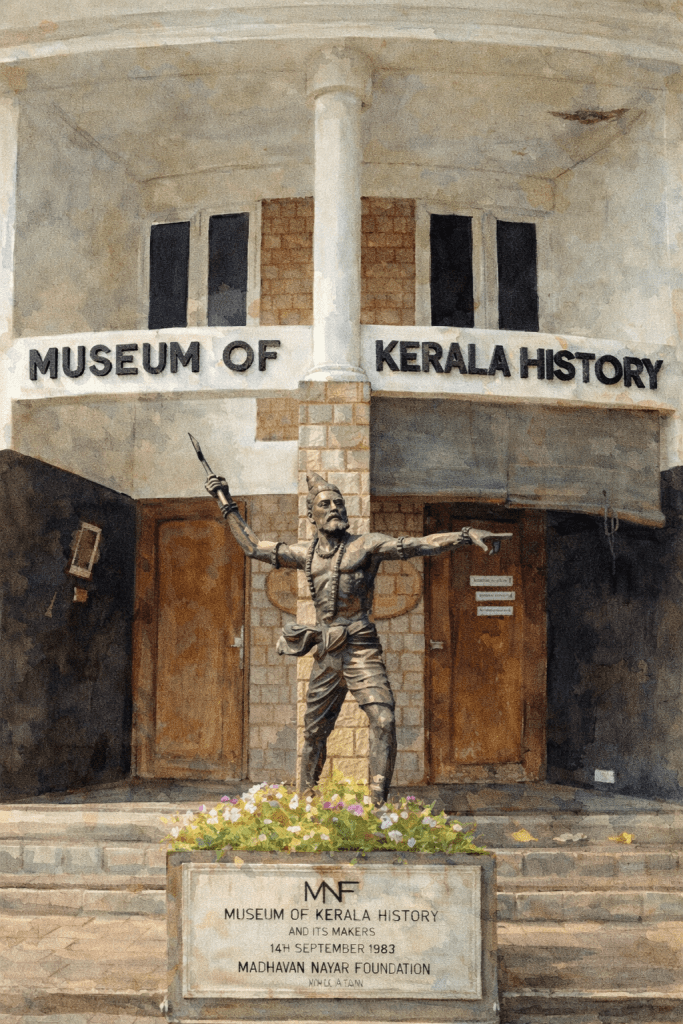
As visitors exit the museum, they are greeted by the statue of Parasurama, the mythological creator of Kerala symbolically marking the completion of a historical cycle. The Museum of Kerala History is not merely a collection of displays but a chronological experience, one that compresses centuries into a few unforgettable hours. It stands as a tribute to R. Madhavan Nayar’s vision, and as an essential destination for anyone wishing to understand Kerala beyond landscapes and monuments. For students, families, researchers, and travellers alike, this museum offers knowledge, inspiration, and a renewed respect for the layered history of God’s Own Country.
 STORIES by HEARITAGE
Leave a comment