The name Raja Ravi Varma continues to resonate deeply among art lovers, historians, and pilgrims of culture alike. More than a painter, he was a visionary who bridged tradition and modernity, devotion and realism, the sacred and the everyday. A visit to Kilimanoor Palace, his birthplace and lifelong sanctuary, is not merely a heritage walk, it is an intimate journey into the mind and soul of one of India’s greatest artists. Today this palace is a private residence where families still reside & is open to only selected parts of the areas.
The palace predates Ravi Varma’s birth, yet today it stands inseparably linked to his life and work. The existing palace complex, over 300 years old, took its present form in 1753. Originally known as Chootayil, it was the ancestral estate of the Kilimanoor Pillai family. History records Kilimanoor as a place of courage and loyalty, most notably in 1740, when its feudal lords and army resisted a powerful Dutch force, an extraordinary event at a time when European powers dominated regional kingdoms. Recognising this bravery, Maharaja Marthanda Varma exempted Kilimanoor from taxes and granted it autonomous status, making it the only such estate under Travancore rule. The king’s personal affection for the place was deep, for his father, Raghava Varma, was born here.
It was into this culturally rich and politically significant setting that Raja Ravi Varma was born in 1848. From an early age, his talent was unmistakable with charcoal sketches adorned palace walls, revealing a child already drawn to form, expression, and beauty. Recognising his promise, Maharaja Ayilyam Thirunal became his patron and arranged for Ravi Varma to receive formal training, including exposure to Western painting techniques in Madurai. This foundation shaped his distinctive style, where Indian themes met European realism. Ravi Varma preferred canvas over rigid surfaces, believing its flexibility allowed him to create flowing lines and lifelike expressions. Equally skilled in watercolours and oils, he mastered anatomy, perspective, and light elements that brought unprecedented realism to Indian art. Yet his greatest contribution lay in democratizing art. Through lithographic printing, he made affordable reproductions of his paintings, allowing ordinary households to own images of gods, goddesses, and epic heroes. This single act transformed religious imagination across India and made him a household name far beyond Kerala. Criticism never deterred him. Some contemporaries accused him of sensuality bordering on vulgarity, others of diluting traditional art forms. Ravi Varma responded not with words, but with masterpieces, remaining steadfast in his belief that art must evolve while remaining accessible.
Notable works such as Damayanti Talking to the Swan, Shakuntala Writing a Letter, Lady Lost in Thought, Arjuna and Subhadra, Jatayu, Tilottama, Krishna with Yashoda, Narasimha Avatar, and Mohini Playing with a Ball continue to define Indian visual culture. Remarkably, Ravi Varma was keenly aware of the value of his art. He allowed his works to be auctioned and used the proceeds for the welfare of his people and the development of the palace itself.
A tireless traveller, Ravi Varma journeyed across the country in search of inspiration. Mythology fascinated him most, and characters from the Puranas and epics came alive through his brush. His depiction of Hindu women as graceful, dignified, and sensuous redefined divine beauty. Goddesses looked like women one could recognise, and women appeared divine in their poise. Western influences blended seamlessly with Indian narratives, creating a visual language that was both modern and rooted. International recognition followed swiftly. At just 25, his painting won first prize at the Vienna World Exhibition, catapulting him onto the global art stage. Artists from around the world visited his studio at Kilimanoor to understand his technique. By the late 19th century, Ravi Varma had become one of the most celebrated artists of his time. It is believed he created over 300 paintings, spanning portraits, landscapes, mythological scenes, and divine forms. Many originals today reside in the Sri Chithira Thirunal Art Gallery in Thiruvananthapuram, while others are housed in Kilimanoor Palace, Kowdiar Palace, and private collections.
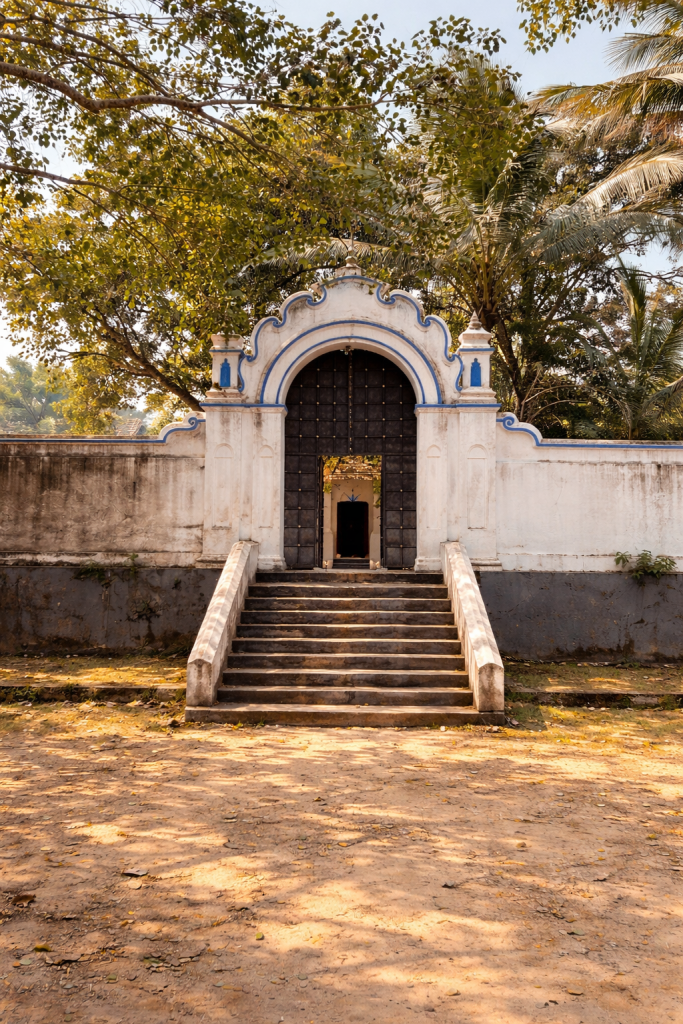
Much of Kilimanoor Palace’s present grandeur owes itself to his efforts. The complex, spread over six acres, follows traditional nalukettu architecture and consists of multiple structures connected by stone pathways. Visitors enter through a modest padippura and arrive at the very hall that once served as Ravi Varma’s studio where he painted daily. Nearby stands the Pazhaya Malika, his old residence, and further on, the Natakashala, where Kathakali and Kaliyattom performances once animated palace nights. The palace grounds include dining halls, kitchens, sacred groves, ponds, and temples. The Kochu Madapalli is remembered as the place where Velu Thampi Dalawa had his final meal before rebelling against the British. The Puthiya Malika, a two-storeyed residence personally designed by Ravi Varma, stands as a poignant reminder—he passed away before he could live in it.
Today, as a protected monument, Kilimanoor Palace offers far more than a glimpse into royal life. It allows visitors to walk through the creative universe of Raja Ravi Varma, a man who painted gods with human tenderness, women with divine grace, and India with a vision that transcended time. To visit Kilimanoor is not just to see art, but to witness the making of modern Indian aesthetics itself.
 STORIES by HEARITAGE
Leave a comment