Hidden amid the emerald forests of Wayanad, in the quiet town of Mananthavady, stands the ancient Thrissilery Temple, a sacred shrine believed to be over five millennia old. Time here feels suspended, as though the forest itself guards the sanctity of a place where divinity, ritual, and ancestral faith converge. For pilgrims, Thrissilery is not merely a temple, it is the first step in a sacred journey of transcendence that culminates at Thirunelli, one of the most revered pilgrimage centres in Kerala. The name Thrissilery is derived from the words Thiru–Shila–Eri, meaning the sacred stone beside the pond. It refers to the Swayambhoo Shiva Lingam, believed to have manifested naturally, resting near a perennial water body. Thrissilery is counted among the 108 sacred Shiva temples of Kerala, yet its importance goes beyond enumeration, it is inseparably bound to the ancestral rites performed at Thirunelli.
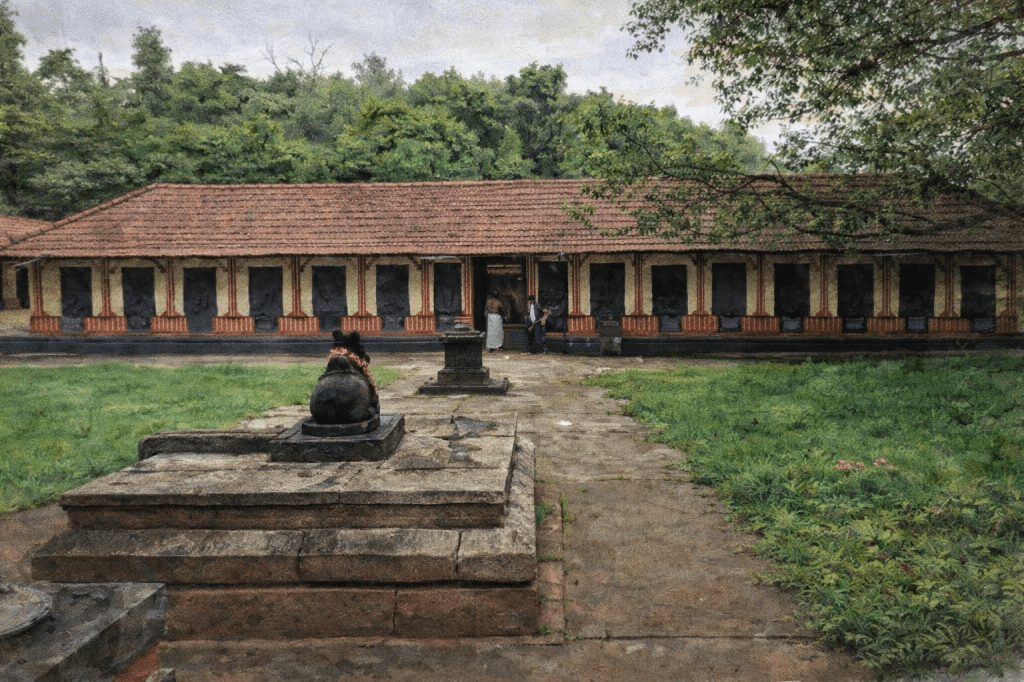
According to legend, Thirunelli once housed both Lord Vishnu and Lord Shiva. Over time, disputes arose between the Vaishnavites and Shaivites, leading to Shiva’s devotees leaving the sacred land. It is believed that Lord Shiva himself followed them, manifesting as the Swayambhoo Lingam at Thrissilery. Thus, while Thirunelli became the abode of Lord Vishnu, Thrissilery emerged as the spiritual counterpart as an essential prelude to all rites of passage. This belief forms the foundation of one of the most unique pilgrimage traditions in Kerala. Pilgrims performing ancestral rites (pithru karma) at Thirunelli must first seek permission from Lord Shiva at Thrissilery. Only then may they proceed to Papanasini at Thirunelli, where the rites are performed at what is believed to be the feet of Lord Shiva. After the rituals, devotees pray to Lord Vishnu at Thirunelli, completing the sacred cycle. Importantly, pilgrims are not permitted to return to Thrissilery after the rites, as it is considered inauspicious symbolising the finality of the soul’s journey.
Adding to this mystique is the fact that Thrissilery is the only place where a lamp is lit for these rituals, as Papanasini itself has no lamps. Thus, even today, many unaware pilgrims unknowingly bypass an essential spiritual step, while those who follow tradition understand the deeper symbolism behind it. Water plays a central role in Thrissilery’s mysticism. The temple pond is believed to be connected to Papanasini itself, and like its counterpart, it has never dried up. The well within the temple maintains a constant water level, unchanged through seasons. Local belief holds that a hidden treasure lies deep within, guarded by Lord Ganapathy, seated eternally on the well’s steps. Unlike most temples, Thrissilery has no flagstaff (dwajasthambam) and conducts no annual temple festival. Elephants are not part of its rituals. The absence of spectacle only enhances its spiritual gravity. The most significant offering here is the 1000-pot Abhishekam, performed daily with unwavering devotion. Shivaratri, however, is observed with profound reverence, drawing pilgrims from across Kerala to witness the night-long prayers beneath the forest canopy.
The journey between Thrissilery and Thirunelli once wound through dense forests, paths walked by sages and seekers alike. While history offers no clear record of the temple’s construction, it is widely believed to date back to the era of Parasurama, the mythical creator of Kerala. The temple complex is surrounded by sacred groves, housing several unique sub-shrines. Among them is the Jaladurga Temple, standing within a pond that has never dried up. Believed to possess healing properties, this shrine is said to be one of the 108 Durga temples consecrated by Parasurama. Equally remarkable is the Vanasastha Shrine, where Lord Sastha is depicted seated in deep meditation, in lotus posture, under an open sky. The sanctum has no roof, allowing nature itself to become part of the worship. Philosophers and devotees alike have drawn parallels between this form and that of Lord Buddha, making it one of the most intriguing icons in Kerala’s spiritual landscape. Within the main sanctum, Goddess Parvathy is represented only by a peedam (seat), based on the belief that she departed to attend Daksha’s Yagna at Kottiyoor without Shiva’s consent and never returned. The silence of this absence adds a profound emotional depth to the temple’s aura.
Thrissilery is not a place one visits casually. It is a temple of duty to one’s ancestors, to tradition, and to cosmic order. Its rituals remind pilgrims that devotion is not merely prayer, but adherence to sacred responsibility. To stand within the precincts of Thrissilery is to acknowledge the unseen—souls that have passed on, paths that must be followed, and beliefs that transcend time. A pilgrimage here is not just an act of worship; it is a humble submission to an ancient spiritual order that continues to guide generations, silently and steadfastly, from the depths of the forest.
 STORIES by HEARITAGE
Leave a comment