In the very heart of Thalassery, amid busy streets and centuries-old mercantile memories, stands a mosque that tells a story far deeper than stone, timber, or prayer. Odathil Palli is not merely a place of worship, it is a monument to the remarkable history of the Keyi family, whose integrity, enterprise, and cultural influence helped shape Thalassery into the cosmopolitan port town it once was. Odathil Palli has stood here for over two centuries, quietly witnessing the ebb and flow of colonial powers, trade caravans, and changing times. Its name comes from the word odam, meaning garden. Long before the mosque was built, this land was a lush sugarcane garden during the Dutch period. The Dutch, impressed by the honesty and upright character of Moosakakka of the Keyi family, gifted this land to him as an act later formally recognised by the British after they took control of the region.
To understand why the Keyis were favoured by European powers and Indian rulers alike, one must look back to their origins. The Keyis arrived on the Malabar Coast in the 17th century from Gujarat, already established as wealthy ship owners and traders. The word Keyi itself, derived from Urdu, means “owner,” reflecting their maritime and mercantile roots. Interestingly, the title “Keyi” was conferred only in the 19th century; earlier family heads were respectfully addressed as Kaakka. The true foundation of the family’s prominence was laid by Aluppikaakka, a benevolent and shrewd businessman whose ethical practices earned widespread trust. The Keyis traded extensively in spices, timber, and metals, becoming indispensable to the commercial life of Thalassery. Even today, many market spaces and historic buildings in the town remain under the ownership of the Keyi family are a silent reminder of their once-vast influence.
The family’s fortunes rose further with Moosakakka, nephew of Aluppikaakka, who expanded trade networks beyond Malabar into Kochi and Travancore. This expansion was driven as much by necessity as ambition. When Tipu Sultan invaded Malabar, the Keyis resisted his forces, standing firm by their principles of free trade and independence. However, when the Chirakkal Raja and the Arakkal family entered into treaties with Mysore, the Keyis were forced to retreat southward. They found refuge under the Travancore kings, who welcomed them warmly, well aware of their reputation for truthfulness and fair dealing. In Travancore, the Keyis prospered even further, diversifying their trade and increasing their wealth. With the fall of Tipu Sultan and the end of Mysore rule, the British East India Company invited the Keyis back to Thalassery to revive trade. They returned, building large pandikasalas near the port and re-establishing Thalassery as a vibrant commercial hub. It was during this period that the British, following the Dutch precedent, offered the former sugarcane garden of Karimbin-odam to Moosakakka. True to Keyi principles, he refused to accept the land freely and instead paid a token amount, believing wealth must only be acquired through rightful means. On this land, in 1806, he built Odathil Palli.
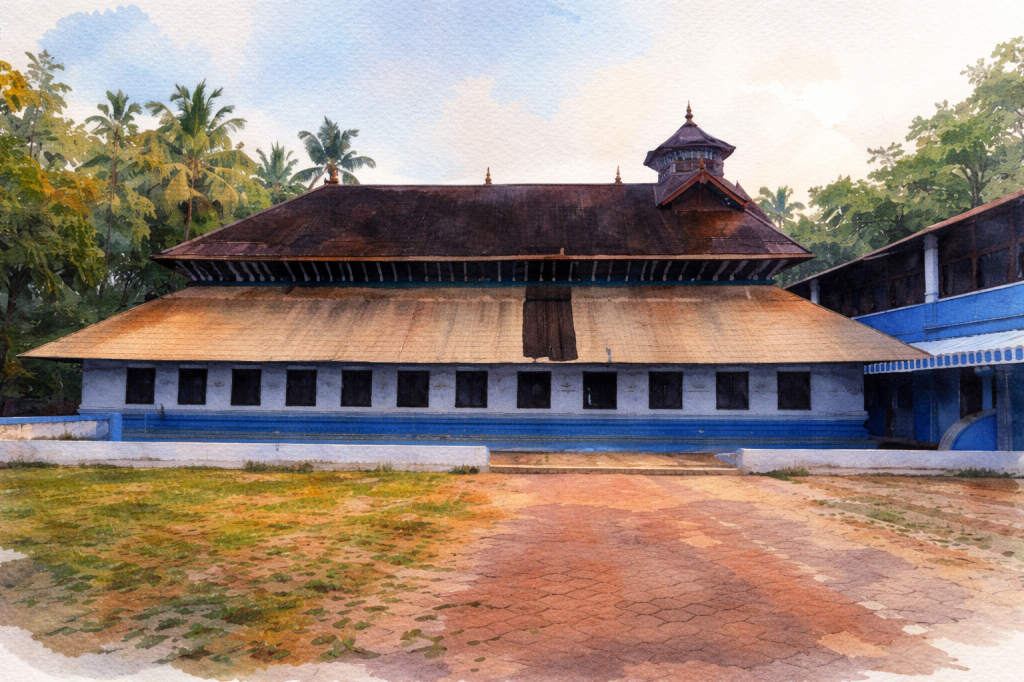
Architecturally, the mosque is a fascinating blend of cultures. Its external form follows the traditional Kerala temple style, a reflection of regional craftsmanship and shared aesthetics. Inside, however, the mosque adheres strictly to Islamic traditions, with a vast prayer hall supported by an intricate arrangement of wooden pillars. Natural light streams in through doors on the lower level, illuminating timber ceilings carved with delicate designs. The use of wood throughout the mosque is striking with doors, pillars, staircases, frames, and roof beams were crafted from timber sourced from Kozhikode. The outer roof is even more remarkable, clad not in terracotta tiles but in copper plates, a testament to the opulence and confidence of the Keyis. Crowning the structure is the minar, adorned with a golden conductor. This feature once sparked opposition among local Hindu communities, as such conductors were traditionally seen only on temples. The matter was resolved when the Zamorin intervened, granting approval to preserve communal harmony as a powerful example of coexistence in historic Thalassery.
Within the mosque lies the tomb of Moosakakka himself, and burial rights here are reserved exclusively for members of the Keyi family, reinforcing the deep bond between the mosque and its founders. Today, Odathil Palli remains a serene space for prayer, contemplation, and memory. For visitors, it offers far more than architectural beauty, it provides insight into a family whose ethical trade, cultural adaptability, and principled living left an indelible mark on Thalassery. To stand within its copper-roofed halls is to step into a chapter of Kerala’s history where faith, commerce, and integrity walked hand in hand.
 STORIES by HEARITAGE
Leave a comment