In South India, and especially in Kerala, the chant “Amme Narayana, Devi Narayana, Lakshmi Narayana, Bhadre Narayana” rises naturally from the hearts of devotees whenever Goddess Bhagavathy is worshipped. This sacred invocation finds its most powerful expression at the Chottanikkara Bhagavathy Temple, one of the most revered shrines dedicated to the Divine Mother. Believed to be among the 108 Durga temples consecrated by Parasurama himself, Chottanikkara is not merely a temple it is a living centre of faith, healing, and ancient belief. So profound is the sanctity of this temple that even the celebrated Mookambika Temple, regarded as one of the foremost Bhagavathy shrines in India, traditionally waits for the opening of the Chottanikkara temple before commencing its daily morning rituals. For centuries, this temple in Ernakulam district has drawn not only devout pilgrims but also those seeking relief from mental distress, inner turmoil, and unexplained afflictions. Its myths, rituals, and spiritual practices are deeply woven into the cultural and devotional fabric of Kerala.
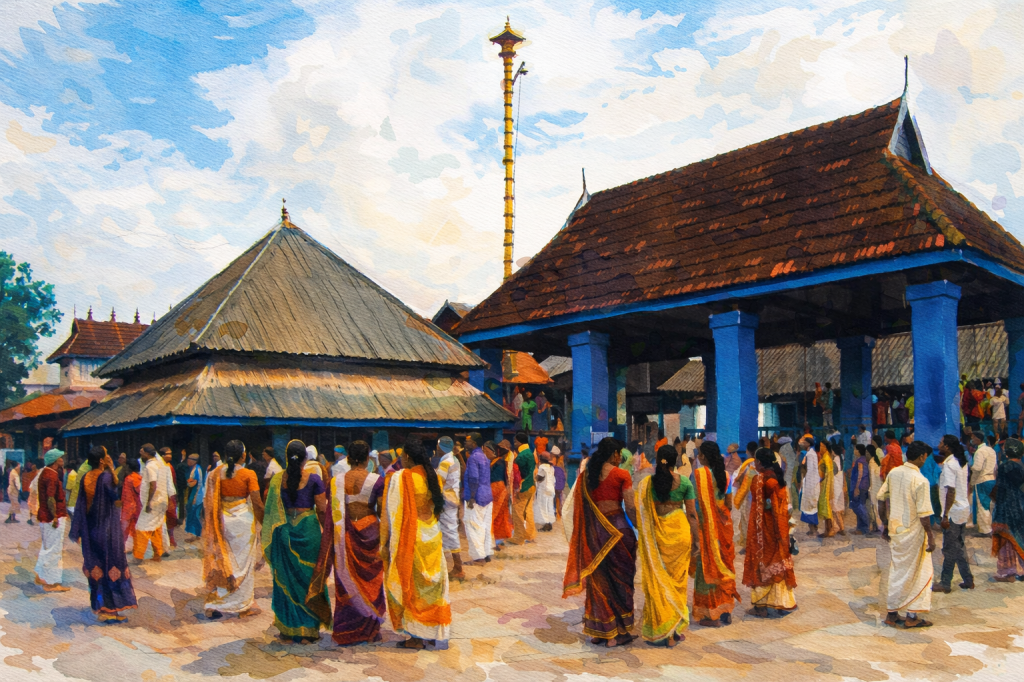
The Chottanikkara temple complex is spread across a vast area and is divided into two spiritually distinct yet interconnected spaces. The Melkavu is the main shrine, where the principal deity resides, while the Keezhukavu is dedicated to Goddess Bhadrakali in her fiercest and most protective form. At the Melkavu, the Goddess is worshipped in three divine manifestations according to the time of day, Saraswati in the morning, Mahalakshmi at noon, and Durga in the evening. This unique concept symbolises the Goddess as the giver of knowledge, prosperity, and protection within a single sacred space. The idol here is a Rudraksha Shila, a formless stone without defined features, adorned with a golden covering that gives the Goddess her visible form. Equally unique is the presence of Lord Vishnu (Narayana) on the same pedestal within the sanctum as an arrangement rarely found elsewhere. This divine union explains why the Goddess here is always praised alongside Narayana, reinforcing the belief that Shakti and Vishnu are inseparable. The origin of these sacred idols is rooted in powerful folklore passed down through generations.
According to ancient belief, centuries ago this region was inhabited by a tribesman named Kannappan, a fierce devotee of Goddess Kali. In keeping with the customs of his people, worship involved animal sacrifice, and Kannappan was entrusted with performing these rituals. His devotion, however, was marked by cruelty and fearlessness, leaving him seemingly devoid of compassion. One fateful day, Kannappan brought home a buffalo for sacrifice, unaware that it had a calf. His young daughter grew fond of the calf, playing with it lovingly. When the time came for the next sacrifice, Kannappan placed the calf on the altar. As he raised his weapon, his daughter clung to his legs, pleading with him to spare her beloved pet. Moved by her tears, Kannappan broke tradition and spared the calf, vowing never again to perform sacrifices. While the village welcomed this change of heart, tragedy soon followed as Kannappan’s daughter died under mysterious circumstances. The villagers believed that Goddess Kali, angered by the abandonment of sacrifice, had caused the child’s death. Overcome with grief and guilt, Kannappan fell into despair. One night, he saw a strange light glowing in his cowshed. From a distance, he noticed a small child seated inside, watched over by another unseen presence. Terrified, he waited until morning, only to find two stones embedded in the ground. That night, the Goddess appeared in his dream, assuring him that she was pleased with his devotion and had manifested herself in the stones. From that day until his death, Kannappan worshipped them faithfully. The villagers believed he regained his sanity through this devotion. The area was later abandoned, reclaimed by dense forest. Years later, a woman cutting grass struck one of the stones with her sickle and saw blood ooze from it. Alarmed, she called the village chief, who discovered two sacred stones beneath a Pavizhamalli tree, believed to be the very tree still standing in the temple complex today. Though wrapped in myth, tradition holds that Parasurama later consecrated these stones inside the sanctum as Lakshmi and Vishnu, formalising worship for all devotees.
The temple’s strong association with Goddess Saraswati is linked to Adi Shankaracharya. According to legend, the great sage meditated in the Himalayas to invoke Saraswati, seeking her blessings for universal knowledge. The Goddess agreed to follow him southward on the condition that he would not look back. When the sound of her anklets ceased near the Kudajadri hills, Shankaracharya turned in fear, and the Goddess halted, transforming into stone thus manifesting as Mookambika. Unable to complete his divine mission, Shankaracharya pleaded for her presence further south. It is believed that Goddess Saraswati finally consented to reside at Chottanikkara as Rajarajeswari. This belief explains why rituals at Mookambika traditionally commence only after the opening of Chottanikkara temple.
The fame of Chottanikkara spread far and wide due to the Keezhukavu, where Goddess Kali is worshipped in her most powerful form. It is believed that the Goddess here has the ability to heal mental illnesses, possessions, and deep psychological afflictions. A fearsome Yakshi once terrorised the region and was cursed that she would meet her end upon entering Chottanikkara. A namboothiri decided to end the menace of the yakshi & asked his friend to entice the Yakshi to the temple which he did & realising her mistake she grabbed the leg of the man who prayed to Goddess for help. Through divine intervention, Goddess Kali destroyed her near the temple pond, washing away the blood in what is now known as Rakthakulam. The sacred Palamaram (tree) nearby is believed to absorb negative energies, and devotees still pray beneath it for liberation from suffering. The idol at Keezhukavu is said to have been consecrated by Vilwamangalam Swamiyar, who discovered the Goddess while bathing in the pond. One of the most distinctive rituals here is Guruthi, once involving animal sacrifice but now symbolically performed using red-coloured water. Those seeking healing undergo extended rituals and remain within temple premises. Upon recovery, a strand of hair and an iron nail are affixed to the Palamaram, signifying closure. Neem leaves are distributed to ward off future afflictions, beliefs that continue with deep faith even today.
Among the most cherished festivals here is Makam Thozhal, instituted by Vilwamangalam Swamiyar. On the auspicious Makam star in the month of Mithuna, the Goddess is believed to reveal herself in her most resplendent form. The deity is ceremonially bathed, paraded on caparisoned elephants alongside Lord Sastha, and finally revealed after the Ucha Pooja at the exact moment Swamiyar once beheld her divine vision. Dressed in radiant silk and jewels, with four arms bearing Varam, Abhayam, Shankha, and Chakra, the Goddess grants both protection and blessings. Witnessing this moment is believed to fulfil devotees’ deepest wishes.
The temple’s architecture is as layered as its mythology. Built across multiple levels, tradition attributes its design to Viswakarma, the divine architect. The craftsmanship of the Vishwakarma Sthapathis is evident in the exquisite woodwork, carvings, and structural harmony throughout the complex. The Edattu Namboothiri family became the first priests of the temple. Legend says the initial offering to the Goddess was puffed rice presented in a coconut shell, an act still commemorated in temple rituals today. The hereditary rights of this priestly family continue, making Chottanikkara a rare example of uninterrupted ritual tradition.
Chottanikkara Bhagavathy Temple stands today as a profound symbol of Kerala’s devotional ethos where the Goddess is approached as healer, protector, mother, and guide. Beyond myths and rituals, the temple has served as a place of emotional healing, social harmony, and spiritual awakening. For pilgrims, a visit to Chottanikkara is not merely a ritual act, it is a surrender to the compassionate power of the Divine Mother herself.
 STORIES by HEARITAGE
Leave a comment